
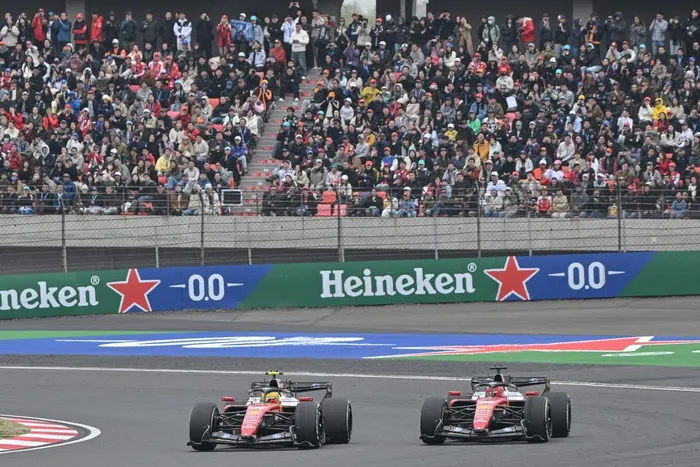
With the FIA investigating the Silver Arrows' front wing, Ferrari sense blood in the water at Suzuka. Photo: AFP
Image: AFP
Max Verstappen’s struggles at Red Bull this season indicate a fifth straight victory at Suzuka will be highly unlikely, leaving the race wide open for anyone willing and able to claim it.
But with the way things are going, it seems increasingly likely that either Mercedes or Ferrari will rise to the occasion and swoop in on the victory. Mercedes have dominated the opening rounds of 2026, winning both Australia and China, and demonstrating a clear technical edge under the new regulations.
Yet, their early supremacy is now under scrutiny.
The German team are facing questions from the FIA over their front wing, which reportedly closes too slowly under aerodynamic load. Active aerodynamics rules, introduced this year, require movable elements, like front wings, to transition between modes within 400-milliseconds.
The Silver Arrows’ system appears to take longer, potentially creating a “two-phase” response that gives the car lower drag on straights without technically breaching static tests.
This latest controversy follows on the heels of the engine compression ratio loophole earlier in the season, which already left some fans questioning Mercedes’ ethics and integrity.
Together, these issues threaten to overshadow their early-season dominance, and could even affect their on-track performance at Suzuka if the FIA decides to intervene or clarifies the regulations in a way that forces adjustments.
Ferrari, meanwhile, are in a rare position: out in front and with momentum on their side. The team’s early-season pace has been less spectacular than Mercedes, but the combination of a consistently delivered car and fewer regulatory distractions means they could finally capitalise.
The Scuderia’s engineers have designed a front wing system that is fully compliant with active aero regulations, eliminating the risk of penalties or forced changes. At Suzuka, where pace and downforce are paramount, a fully legal and reliable car could make all the difference.
The Japanese GP itself offers a unique chance for a shake-up. Suzuka’s flowing, technical layout, including the Esses and 130R, rewards aerodynamic balance and driver skill more than raw engine power.
With Red Bull struggling for outright pace and Verstappen unable to rely on his traditional dominance, this weekend is arguably the perfect storm for Mercedes or Ferrari to claim the spotlight.
For Ferrari, this could mark a turning point. A victory at Suzuka would be the first the team has enjoyed in what must feel like a lifetime for their fans, and it would be a clear signal that the Scuderia can not only compete but also challenge the sport’s new pecking order.
A clean weekend, free of technical drama, could translate into a psychological edge heading into the mid-season stretch, a rare position of strength for the Italians in recent years.
Mercedes, while still the fastest team on paper, will have to navigate both fan scrutiny and FIA oversight, ensuring their car is fully compliant without losing performance.
Even minor adjustments to fix the front wing could compromise their balance at Suzuka. With Verstappen unlikely to repeat his past dominance, and Mercedes facing off-track pressure, the Suzuka GP is genuinely open and Ferrari may finally have the chance to seize an opportunity that has eluded them for far too long.
Moreover, the Japanese GP will represent the final F1 action for over a month, with both the Bahrain and Saudi Arabian GPs cancelled due to the continued war in the Middle-East. The next stop on the calendar is on May 5 in Miami.
Jehran Naidoo is sports reporter for Independent Media and social media coordinator of the our YouTube channel The Clutch.