
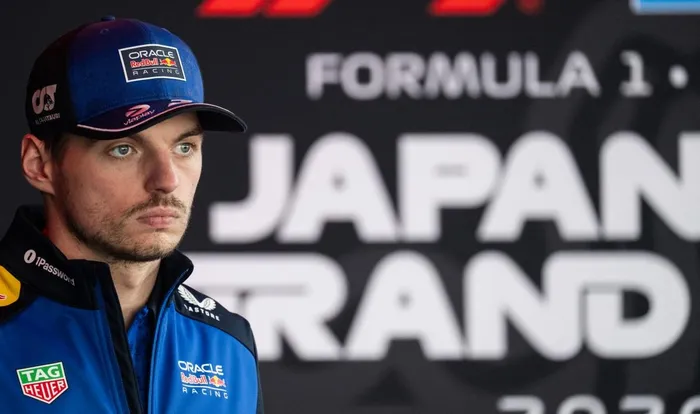
Red Bull Racings Max Verstappen has been outspoken about the new Formula One regulations.
Image: AFP
The FIA has introduced a late but telling adjustment ahead of qualifying for the Japanese Grand Prix. It's a move that not only impacts this weekend, but underlines just how different Formula One’s modern age is from the ground-effect era.
The FIA confirmed that the maximum permitted energy recharge limit for qualifying has been reduced from 9.0 MJ to 8.0 MJ, following unanimous agreement between teams and power unit manufacturers.
While minor on paper, the change strikes at the core of how performance is currently extracted under the 2026 regulations. Unlike the ground-effect era (2022–2025), where aerodynamic efficiency and mechanical grip dictated qualifying pace, the 2026 cars rely far more heavily on electrical energy deployment.
In previous seasons, energy recovery systems played a supporting role; drivers still depended primarily on downforce, tyre preparation, and clean execution to deliver lap time. Now, energy has become a primary performance differentiator.
What this means in practice is that teams had begun optimising energy harvesting and deployment to such a degree that qualifying laps risked becoming overly dependent on electrical boost rather than driver input.
The reduction to 8.0 MJ effectively limits how much “extra” performance can be deployed over a lap, forcing teams to be more selective in where and how they use that energy. Simply put, it is going to be more boring than before.
In contrast to the ground-effect era where drivers could push flat-out with relatively consistent performance, 2026 has introduced a layer of strategic lift-and-coast, harvesting zones, and deployment timing, even in qualifying.
This tweak is designed to dial that back slightly, restoring a more natural rhythm to a flying lap.
The FIA described the adjustment as a "refinement" based on feedback from drivers and teams, many of whom raised concerns about maintaining qualifying as a pure performance challenge. It also reflects how quickly the governing body is adapting the rules in real time as the new regulatory framework is stress-tested.
Front-running outfits such as Mercedes-AMG Petronas Formula One Team and Scuderia Ferrari, both strong in hybrid efficiency, could feel the effects most, as their advantage in energy deployment may be slightly reduced.
However, the broader expectation is a tighter field and a greater emphasis on driver precision in Japan. Well, that's just according to the FIA.
Ultimately, this change signals yet another step in what direction F1 is heading, which is a more controlled environment — geared away from the pureness of the sport and more towards business.