
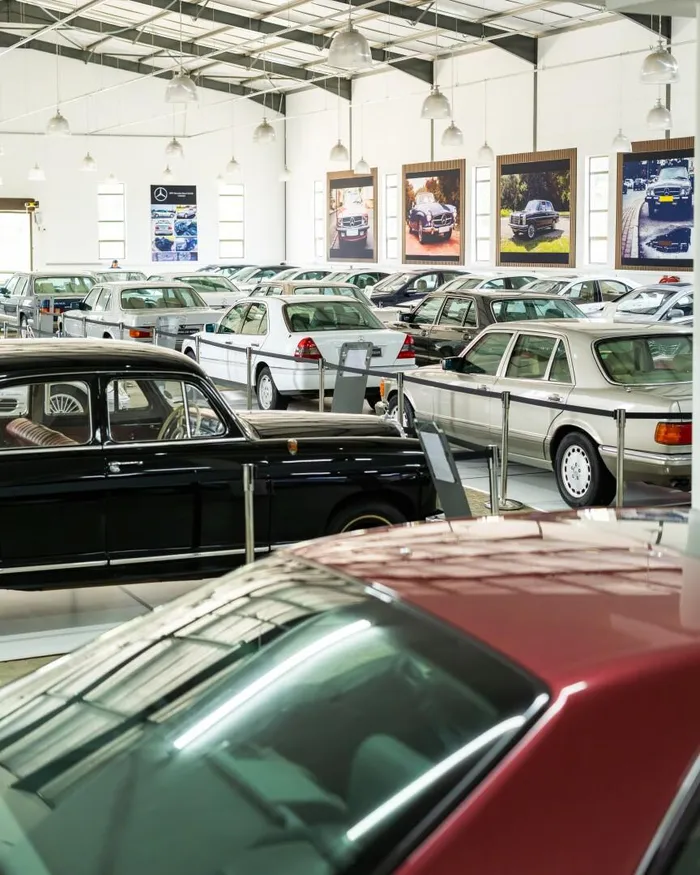
Part of the more than 250 cars displayed at the Makotopong Car Museum.
Image: Supplied
Mercedes-Benz turns 140 this year, and in that time, there have been a number of world firsts that have helped shape the industry, some of the most beautifully designed cars and a plant in South Africa.
The brand’s story begins in 1886 when Carl Benz patented the Motorwagen while Gottlieb Daimler was developing his own motorised carriage.
Those parallel inventions laid the groundwork for the automobile as we understand it today and eventually converged in 1926 when their companies merged, resulting in the famous three-pointed star.
Moments that mattered
Mercedes-Benz's history is a storied one with certain milestones that changed the industry. Bertha Benz’s long-distance drive in 1888 proved the car could function beyond the workshop.
In 1959, Béla Barényi’s safety cell and crumple zones redefined passive safety and remain foundational today. ABS in the late 1970s and electronic stability control in the 1990s followed the same pattern: introduced on Mercedes-Benz models, then adopted industry-wide.
Those developments explain why Mercedes-Benz still carries weight, and while they have history on their side, the future is very much what they are focused on.
Makotopong: nostalgia and context
Locally at the Makotopong Car Museum near Mokopane, media were treated to more than 250 Mercedes-Benz vehicles, illustrating how broad the brand’s footprint has been in South Africa, spanning passenger cars, buses, trucks and vans.
It shows how deeply embedded Mercedes-Benz has been in local transport and industry.
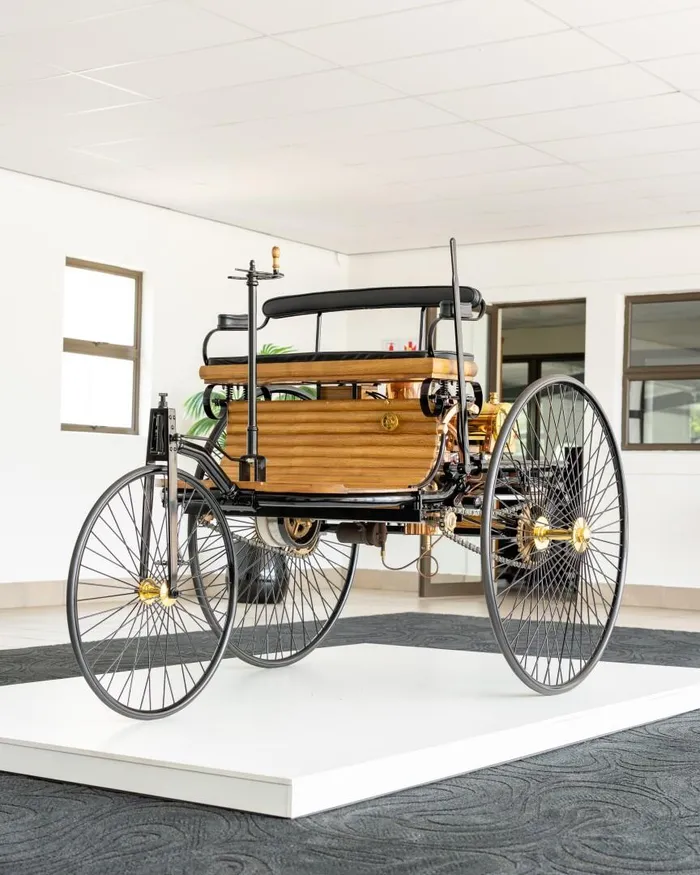
A replica of the first patented Motorwagen.
Image: Supplied
The South African connection
Mercedes-Benz’s relationship with South Africa stretches back to the late 19th century, but its modern industrial presence is anchored by the East London plant.
Established in 1958, the facility has evolved into a key part of the brand’s global manufacturing network and has served as the sole global production hub for the C-Class sedan.
Product wave
Over the next two years, more than 40 new or significantly updated models will be introduced globally, with several confirmed for South Africa.
At the top of the range sits the updated S-Class, traditionally the clearest expression of where Mercedes-Benz believes luxury, safety and technology should be.
Alongside it are niche offerings, including a new Mercedes-Maybach SL and an ultra-limited S680 V12 Edition. These cars are less about volume and more about signalling the upper limits of what the brand is still willing to engineer, even as the industry turns more towards electrification.
The CLA
More importantly for South Africa is the new-generation CLA. Positioned as an entry point to the brand, it introduces Mercedes-Benz’s latest digital architecture, including a new operating system and AI-driven interface.
For local buyers, it shapes affordability, running costs and long-term relevance in a market that is increasingly sensitive to value.
SUVs are still the go-to
SUVs remain central to Mercedes-Benz’s South African mix, with the expanded GLC line-up reflecting that.
The GLC 200 4MATIC adds a mild-hybrid petrol option that prioritises efficiency while retaining all-wheel-drive capability. It is not a radical change but an incremental update that will resonate with buyers.
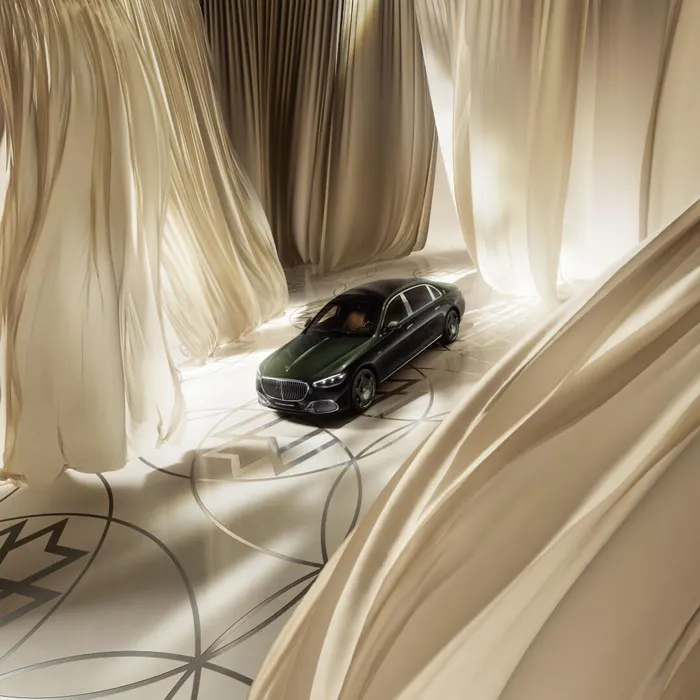
The Mercedes-Maybach ultra-limited S680 V12 Edition.
Image: Supplied
Vans dominate
Beyond passenger cars, Mercedes-Benz vans remain a cornerstone of the brand’s local presence. The story began in 1896 with early motorised transporters and continues today through the Sprinter and V-Class ranges.
In South Africa, the Sprinter’s significance goes well beyond logistics. Locally converted Inkanyezi and Inkanyezi XL models are purpose-built for the minibus taxi sector, prioritising durability, safety and passenger space.
The Inkanyezi XL, in particular, with its extended wheelbase and improved legroom, shows a global manufacturer adapting a product specifically for South African operating conditions rather than forcing a one-size-fits-all solution.
Electric vans
Electrification is beginning to gain traction in the van segment. The eSprinter has already been introduced locally, with pilot fleets demonstrating that electric commercial vehicles can function in South African conditions when supported by the right infrastructure and use cases.
The arrival of the EQV adds a fully electric option for premium people-moving, aimed at operators and private buyers who want zero local emissions without sacrificing comfort or space.
Mercedes-Benz is preparing its next-generation electric van architecture, known as VLE. Designed from the ground up for electric use, it signals a move away from adapting combustion platforms and towards purpose-built solutions that can scale across different applications.
140 years matters
In South Africa, the brand’s relevance will be measured by what arrives in showrooms, fleets, and taxi ranks over the next few years.
A broad incoming product range and a pragmatic approach to electrification suggest they are ensuring it still makes sense on South African roads.