
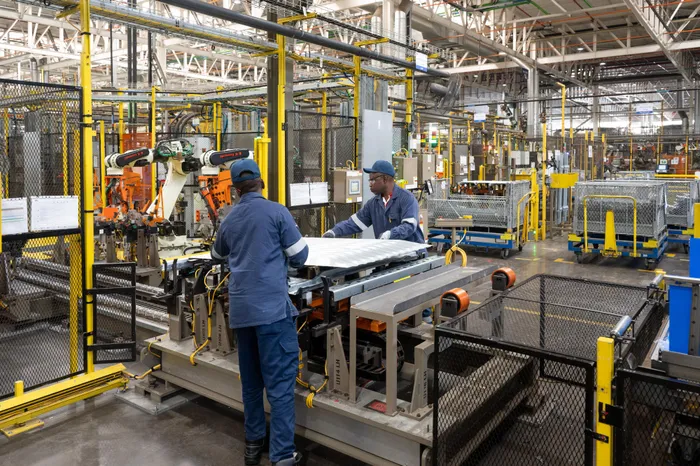
A recent report highlights the challenges and necessary interventions to secure the automotive sector's future.
Image: Supplied
South Africa’s automotive industry is falling behind key targets set out in the South Africa Automotive Masterplan (SAAM), according to the latest automotive sector report by BDO South Africa.
The South Africa Automotive Sector 2024/25 report assesses progress against the masterplan and outlines areas requiring intervention to maintain the sector’s competitiveness.
The report says that while the sector remains one of the country’s most significant industrial contributors, its long-term competitiveness is under pressure.
The automotive sector contributes 5.2% to South Africa’s GDP and accounts for 22.6% of total manufacturing value addition, supporting more than 110,000 direct manufacturing jobs.
With retail included, the industry employs over 300,000 people across approximately 23,000 establishments.
SAAM set a production target of 784,509 vehicles by 2025. Output reached 599,755 units in 2024, with 554,613 units recorded in the first eleven months of 2025.
The report says that this shortfall contributed to a 22.8% decline in automotive exports in 2024.
Local content levels are currently between 38% and 42%, falling short of the 48.2% target set for 2025.
The sector employs approximately 115,000 workers, which is significantly below the 224,000 jobs that SAAM aims to support by 2035.
Over the past two years, 12 component manufacturers have closed, resulting in more than 4,000 job losses.
According to the report, infrastructure remains the most critical constraint across all SAAM pillars.
Port congestion is extending export lead times by up to 40%, while declining rail capacity and energy instability are increasing operating costs as manufacturers turn to backup power solutions.
“These vulnerabilities are particularly acute given that nearly half of South Africa’s OEM production is concentrated in the Eastern Cape,” the report said.
The shift to new energy vehicles (NEVs) is reshaping global markets, placing additional pressure on South Africa’s export strategy.
The report highlights that the country remains heavily reliant on European markets, where internal combustion engine vehicle sales are expected to be phased out between 2030 and 2035.
Full electric vehicles face a 25% import duty, while concerns around residual values and the carbon intensity of the national grid persist.
“The challenge for South Africa lies in ensuring that its automotive industry not only retains its current scale and importance, but evolves fast enough to remain relevant in this changing environment,” said Siyabonga Mthembu, automotive sector lead at BDO South Africa.
The report outlines four priority interventions to close the gap between policy and performance, including recalibrating SAAM targets, adopting a technology-neutral NEV framework, improving infrastructure, and strengthening supplier development.
“SAAM’s credibility now depends on accelerating the policies already in place. Restoring momentum will require execution-driven renewal rooted in measurable outputs, not aspirational goals,” Mthembu said.