
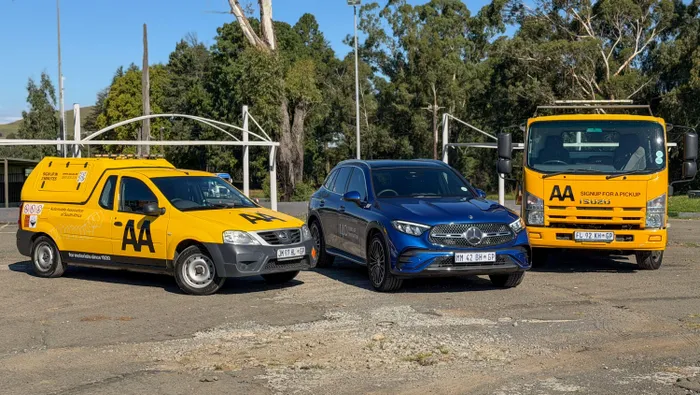
AA vehicles on patrol along the N3 reflect the ongoing effort to improve safety on busy corridors.
Image: Mpho Mahlangu
A road trip from Pretoria to Clarens, via the demanding terrain of Van Reenen’s Pass, offers more than a scenic contrast. It presents a clear and often sobering reflection of the challenges facing South African motorists.
The 1,000-odd kilometre return journey, undertaken in partnership with the Automobile Association of South Africa (AA) and Mercedes-Benz, formed part of a broader initiative to examine the relationship between driver behaviour, high-risk routes and the role of modern vehicle safety systems.
The N3 corridor remains one of the country’s most critical transport arteries, carrying a high volume of both commercial freight and private traffic. Its importance to the economy is undeniable, but so too is its reputation as a high-risk environment, particularly during peak travel periods.
Long-haul trucks, variable weather conditions and demanding topography combine to create a driving environment where lapses in concentration can have severe consequences. Few sections of the N3 illustrate this more clearly than Van Reenen’s Pass.
Characterised by steep gradients, sweeping bends and rapidly changing conditions, the pass has long been identified as a high-risk zone. However, as discussions with the AA revealed, the risks associated with such routes are rarely due to infrastructure alone. Human factors such as fatigue, impatience and poor decision-making remain the leading contributors to road incidents. This is where the role of vehicle technology becomes increasingly relevant.
Many modern vehicles are equipped with advanced driver assistance systems. While they serve an important purpose, it is equally important to remember that they are designed not merely as convenience features, but as active safety interventions. Adaptive cruise control, lane-keeping assist and autonomous emergency braking systems work in unison to reduce driver workload and mitigate potential hazards. In practice, these systems function as an additional layer of awareness — monitoring, correcting and, where necessary, intervening. Yet their presence does not diminish the driver’s responsibility.
Technology can support, but it cannot replace attentiveness. The effectiveness of these systems ultimately depends on a driver who remains engaged, informed and responsive to the conditions around them.
As the route transitions from the intensity of Van Reenen’s Pass into the more tranquil landscape approaching Clarens via the picturesque Golden Gate Highlands National Park, the contrast is striking. The road relaxes, the pace steadies and the demands on the driver shift. But the underlying principle remains unchanged: awareness is not situational — it is constant.
What emerges from this journey is a broader understanding of road safety as a shared responsibility. Organisations such as the AA continue to play a vital role in research and public education, while vehicle manufacturers push the boundaries of what modern safety systems can achieve. However, the most critical component remains the individual behind the wheel.
Conversations with AA patrol teams — often the first responders on South Africa’s roads — highlight the human side of road safety. One such account involved a tow truck driver who stopped to assist a stranded vehicle, only to discover that a pregnant woman inside had gone into labour. Acting quickly, the driver helped contact emergency services, and an ambulance was dispatched in time to assist. It is one of many examples that underscore the vital role the AA plays, often behind the scenes, in supporting road users.
South Africa’s roads do not simply demand technical driving ability — they require discipline, awareness and an understanding of the environment in which one is operating. Routes like the N3, and particularly Van Reenen’s Pass, serve as a reminder that driving is not a passive activity, but an active responsibility.
In the broader conversation around mobility and safety, that distinction has never been more important.
IOL Motoring