
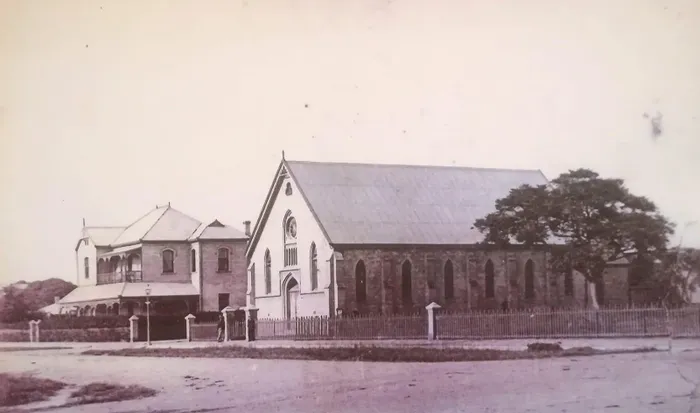
The Wesleyan Methodist Church and Parsonage at 81 and 89 Russell Street, circa 1904.
Image: Local History Museum
The small Wesleyan Methodist Church at 89 Russell Street is the sole survivor of a much larger church property which stretched from St George's Street to Smith Street. The church itself dates from about 1890. Next door was the parsonage which was designed by Percy Barr, probably in 1891 or 1892 when he was part of Street Wilson’s practice. In some ways, the parsonage was a more impressive building than the church itself, certainly when compared to the much grander main church in West Street, erected in 1877.
These smaller churches, however, served the growing Methodist community well. In 1904, they had the largest number of members in Natal. At this time, the parsonage was the home of the Rev. John Gould, whose name is indelibly associated with the modern history of Wesleyanism in Natal.
Ordained in 1878, he had held many prominent positions in England before coming to Durban. The father of seven children, he was also a keen sportsman, enjoying riding, fishing and shooting. He was behind the erection of the tennis court alongside the church. One wonders if he or his parishioners played tennis after the Sunday service.
The court was popular with the Durban Ladies College, whose principal Miss Moore Smith encouraged her young charges to enjoy a game - suitably dressed of course.
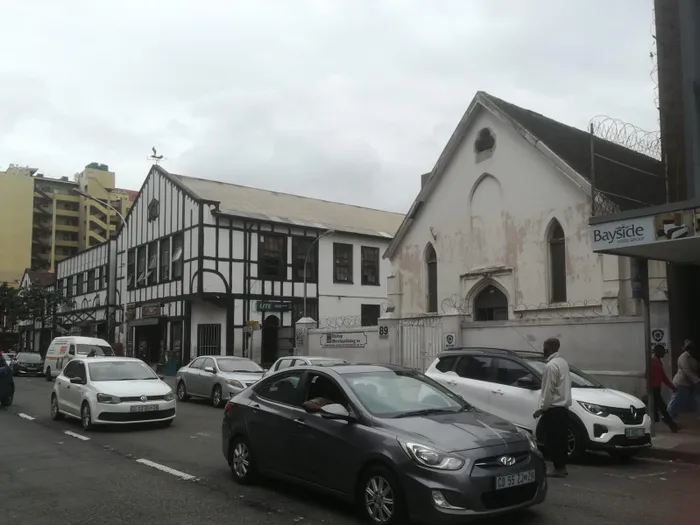
The old church and its surrounds in Joseph Nduli Street today.
Image: Mark Levin
After the College moved out, the newly formed Durban Technical Institute (later the Natal Technikon) took over the premises which was across the road on the other corner of Russell and Smith Streets. A Day Continuation School was established in 1910 for teenage boys wanting a technical education. This school (later Glenwood High School) also operated on these premises until 1912. No doubt they also used the church’s tennis court.
After the Technikon and its school vacated the premises, it became the Girls’ Friendly Society Lodge until 1955. They too used the court, but with the boys gone, mixed doubles would have been difficult.
If Rev Gould wished for ecclesiastical company, the St Paul's Anglican vicarage was just down the road at 1 Russell Street on the Esplanade end. During Gould's time, the vicar was the Rev. O'Connor Fenton. Later vicars of St Paul's who lived at 1 Russell Street (later renumbered to 9) included Canon Inman and, in the 1950s, the Rev Wade who was the father of Virginia Wade, the 1977 Wimbledon champion. If the tennis court still survived, it would have been demolished in 1953 when the Smith Street portion was developed with the erection of Bible House. Later this site was the Value Lodge; today it is the Bayside Hotel.
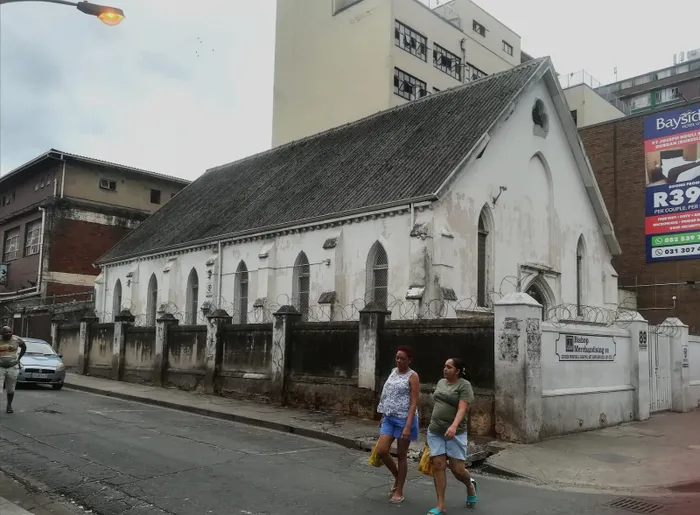
To get a better view of the chhurch today, this picture was taken looking down The College Lane side of the church.
Image: Mark Levin
The Methodist Church disposed of the Russell Street properties in the 1920s. The Durban City Mission took over the church, operating there from the 1920s to the 1960s as a non-denominational church. Thereafter, the Durban People’s Church congregation worshipped there until 1980 when it made the decision to sell the church, which was put up for auction. An occasional congregant, Mr Bishop, successfully bid for it. His business, Bishop Merchandising, was seeking new premises. In 1982, it moved from Fenton Road to the church where it remains 43 years later.
Krish Govender, who has worked for the business during its whole period in Russell Street, noted the sharp decline in the area. In the 1980s and the early 1990s it was still a wonderful part of town, but today has been overtaken by crime and grime. Fortunately, the church with its hint of Gothic revivalism has survived.
The parsonage did not. It was demolished in 1926, making way for a private hotel on part of the site and business premises on the remainder. Reliance Press and its successor, Cameron and Payne, operated there for decades from 1926. Different owners changed the name of the hotel from the Glenbrook to the Saxon, the Russell and the Atlantic. In the 1970s and 1980s, a Chinese restaurant and the Tudor Rose Steak House were popular. The mock Tudor decorations survive, but little else.