
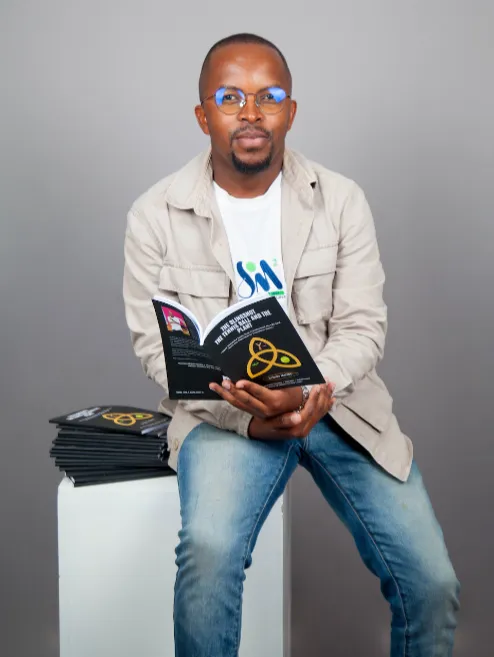
Sydney Madibo
Image: SUPPLIED
Sydney Madibo spent most of his life trying to lift others up — whether in a classroom, a boardroom or a community hall.
And for the Vaal-born educator, author and entrepreneur, it had come full circle, he said, bringing him back to the communities that had shaped him.
The 32-year-old was teaching learners with special needs at Isizwe-Setjhaba Special School in Steelpark, Vereeniging.
Madibo first came to the school while participating in a Christmas donation programme for a non-profit company he worked with.
“When I learnt the school was advertising posts for additional staff, I felt that I could contribute meaningfully to the school itself and to the lives of the learners,” he said.
“I am a passionate educator at heart and have taught in Sebokeng and the Free State for a few years.
"My line of work, and even my work within my business, was centred around imparting knowledge and sharing skills.
"Teaching is inextricably linked to the person I am.”
Growing up in Vanderbijlpark shaped the leader he would become, he said.
“I was always exposed to, mentored by, led by and guided by leaders in their own rights,” he said.
“I was influenced by guys who were leaders in my school, guys who were student activists and student representatives when I was at university, guys who ran their own businesses and movements in the community, and even the lifelong friends I made during debate competitions.
"I was also influenced by my teachers and people I went to school with.”
He said his father had an entrepreneurial ability, and his mother was a proud and outspoken activist throughout her teaching years.
"The many people I had crossed paths with were responsible for the person I had become.”
During weekdays, Madibo said he focused fully on teaching, while his holidays were dedicated to running his business, the Sydney Madibo Institute of Leadership Excellence.
The institute developed leadership programmes for companies, focusing on sustainable employee growth, skills workshops, and programmes that encouraged meaningful development.
“I was inspired to start the institute with the hope that it would one day cultivate leaders who could use their skills and expertise to improve our society,” he said.
“There was a sharp decline of leaders in our society, and this institute had the potential to do that.”
His clients included MiWay Insurance, Seriti Institute, Father A Nation and Unilever, with programmes such as major Movember campaigns.
“So far it had been instrumental in championing these campaigns, and it could continue to do this important work into the future,” he said.
Madibo was also the winner of One Day Leader season 5 on SABC1.
“Winning One Day Leader was the evidence I needed to show me how valid a dream could be when one was willing to put in the work and apply themselves deeply and meaningfully in developing themselves,” he said.
“One developing themselves was beneficial for society, because it was society that benefited from that development.”
His new book, The Slingshot, The Tennisball and The Plant, came from long nights spent battling insomnia.
“The title of the book summarises my life story,” he said.
“I had to face a lot of challenges to be launched to where I am now — that was the slingshot.
"I had to dust myself off and rise above situations that were meant to take away my future from me — that was the tennis ball’s bouncebackability.
"And the plant was the patience process required for one to go through as they grew. They needed to nurture themselves and care for themselves while they went through their growth process.”
Madibo hoped the book would inspire readers to create a legacy of individuals who dared to rise above adversity.
“From my book, I was hoping readers could learn that a life story had the power to shape you into someone you could be proud of, or someone you could regret being,” he explained.
“All the accounts in the book were aimed at one simple thing: creating a legacy of individuals who dared to rise above adversity and earn their rightful place in this world as positive role models, community-centred leaders, providers and protectors of their families, among many other qualities.”
A significant part of Madibo’s work involved teaching learners about gender-based violence and positive masculinity through Father A Nation.
“Working on gender-based violence with learners taught me that they were aware of these issues, they were affected, and they did have a voice,” he said.
“Learners in schools were actively troubled by the socio-economic challenges they were facing in their schools and homes, and they needed to be taught and reminded that they were the leaders of tomorrow’s society.”
He also spoke to men and boys about the pressures they faced.
“Men and young boys indicated that they were not seen, that they were not heard, and that they suffered in silence and isolation,” he said.
“As a result of this isolation and silent pain, they lashed out and in this lashing out ill-treated and abused the very people they were supposed to be caring for, loving and protecting.
"Men needed to be taught that not a single one of us had any autonomy or entitlement over any woman, child or person in the LGBTIQ+ community.
"Unless we were actively willing to deal with our own traumas and disappointments, it would always be the most vulnerable who were at the receiving end of our reactions.”
Madibo believed society needed ethical leaders with values and principles of servanthood.
“In schools, learners needed more ethical leaders.
"Society needed leaders who were sensitive to the needs of the people and their immediate environments.
"Society also needed younger leaders who were aligned with the people they were leading and accustomed to speaking to their challenges in a contextually fitting manner.
"Society needed more leaders that they could look up to and follow on the basis of proven impact and change.”
Looking ahead, he hoped to continue changing as many lives as possible.
“In the next few years, I was hoping to change as many lives as possible through the work I did in the different fields I found myself in,” he said.
“All my work was for the community, and I think that automatically found expression through the work I did.”
IOL News