
Residents were told to conserve water as Knysna faces a big water crisis
Image: FILE
With Knysna’s rivers running bone-dry and dams at dangerously low levels, the municipal manager has recommended tightening the taps further by raising water restrictions all the way to stage four.
And for families and small business owners in the Garden Route town, the looming stricter restrictions bring real worry, as every drop of water counts for cooking, cleaning, and keeping holiday makers comfortable during the busy festive season that helps the town’s economy stay afloat.
The municipality, which currently has level three restrictions in place, will make the final decision at a special meeting on Friday, mayor Thando Matika told IOL.
Matika said a suggestion by municipal officials to escalate the restrictions had been made, but that such a decision will only be taken at the next meeting after considering the latest data on water supply and demand.
Knysna municipal manager Dr Lulamile Mapholoba has also asked residents to drastically reduce water consumption.
“Residents are reminded that level three water restrictions are still in place,” he said.
“The water restriction level may have to be escalated if rainfall patterns and associated river flow do not improve significantly.
"I urge residents to drastically reduce consumption so that we can avoid the need to increase restrictions and punitive tariffs.”
Mapholoba said it was nothing new.
“Remember that there is a difference between water restriction levels and drought situation levels,” said Mapholoba.
“Water restrictions are regulatory measures that tell us how to manage our water consumption during times of scarcity.
"Drought situation levels are tiered tariff- and water supply management measures that are implemented to control levels of water consumption relevant and appropriate to varying degrees of water scarcity.”
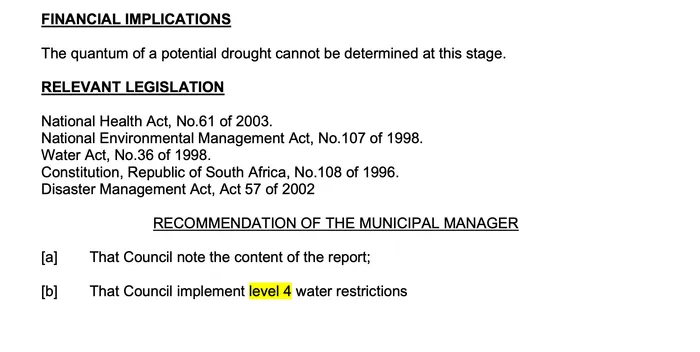
The Knysna municipality recommended that the council implement level four water restrictions.
Image: SCREENSHOT
At a recent special council meeting, the shocking state of the region’s water supplies was laid bare. The recommendation was that the council implement level four water restrictions.
According to an agenda report presented to council this month, all major towns under Knysna municipality rely heavily on surface‑water schemes fed by perennial rivers such as the Knysna, Gouna, Karatara, Groot, Homtini and Goukamma rivers.
Minor sources such as the Knysna Reverse Osmosis Plant, a spring at Bigai, and various low‑yield boreholes now supply only about “30% of the production of the demand".
The municipality’s off‑channel storage dam, which under ideal conditions can hold 860 megalitres — roughly 70 days’ supply — is being drawn down as river flows shrink and rainfall remains far below average.
Rainfall for 2025 has been alarmingly low.
The report notes that in August, only 5mm was recorded at the Water Treatment Works — “the lowest on our records for the month".
Forecasts suggest rainfall over the coming months, including the summer period, will remain about 26% below the long-term average for the region.
The situation in Knysna draws a strong parallel to the water crisis that Cape Town suffered between 2015 and 2018, when the city faced severe droughts and dam levels fell to critical lows.
At its lowest point, Cape Town’s combined dam levels dropped below 25%, prompting the city to implement Level four-B restrictions, which limited daily water use to 50 litres per person, banned garden watering, and introduced emergency measures including water rationing and desalination.
Knysna’s current water shortages and reliance on dam reserves mirror many of the same vulnerabilities that brought Cape Town to the brink of “Day Zero".
Current storage levels in Knysna leave the town with little margin for error.
The Akkerkloof Dam is at “approximately 27% of its capacity which equates to 17 days of storage”, while Glebe Dam adds only another eight days’ supply.
The Knysna River itself is “extremely low”, forcing the municipality to operate just one pump — and only “at certain intervals".
At the Charlesford Raw Water Pump Station, only two of three pumps are functional; the third pump remains delayed, pending work from a service provider.
Without full pumping capacity and with river flow dangerously low, the dams are now the town’s final buffer.
The council meeting provided further context on the urgency of the situation.
According to the sitting: “Council notes with concern the extremely low levels in the municipality’s water storage dams and the reduced river flows feeding the bulk water supply.
"Council further notes that minor water sources such as the Knysna Reverse Osmosis Plant, the Bigai spring and low-yield boreholes provide only approximately 30% of the production of the demand.
"With peak water demand approaching during the summer months, council recognises the need for urgent interventions to ensure sufficient water supply to all communities.”
Level three restrictions currently mean that municipal potable water is for human consumption only, the watering of gardens is prohibited, the washing of vehicles and/or boats is not allowed, and the domestic consumption must be limited to 20kl per household per month.
It also means that water restricting/management devices will be installed for transgressors and business consumption is to be reduced by 30% on the previous year’s monthly average consumption, except car washes.
Health and correctional facilities must also install their own tanks that will be filled by municipal tankers, areas where households receive a free basic water allocation will be limited to 6kl per household per month, or 200 litres per household per day.
Lobby group Knysna United said the restrictions were needed.
Chair Rev Ralph Stander said he was confused as "the Lord was giving us water almost every night".
"Almost every night it is raining in Knysna ... the Lord is giving us water, but the water is just flowing in the lagoon," he said.
"The restrictions are needed, and we need intervention from the provincial government ... we don't have any experienced people at the municipality to deal with this."
Stander also said though it hampered tourism, Knysna was ready for tourists.
"Holiday makers need water," he said.
“The sad part is that most people who can afford it don’t drink municipal water but buy water instead.
"And most hotels, guesthouses and self-catering apartments have water tanks and are able to keep supplying their clients.
"All in all, Knysna is open for business and tourists must come. We need tourism, and I’m sure Knysna will go out of its way to accommodate visitors.”
IOL News