
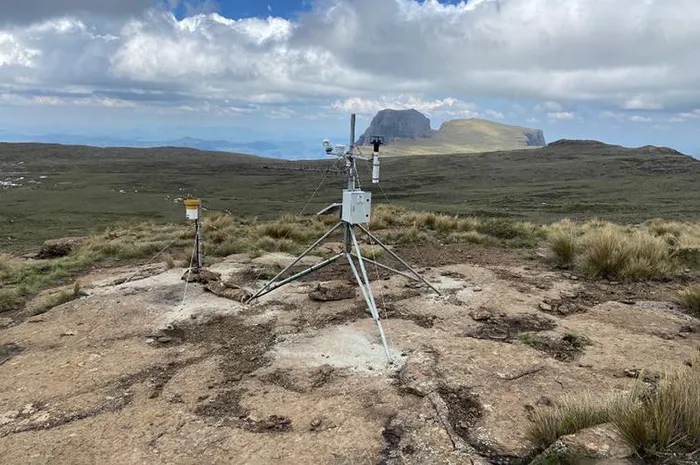
The highest weather station in Southern Africa has been installed in the Mont-aux-Sources area of the Maluti-Drakensberg by the South African Environmental Observation Network (NRF-SAEON), in collaboration with the University of the Free State’s Afromontane Research Unit (ARU).
Image: Supplied
The Mont-aux-Sources area of the Maluti-Drakensberg has just become the site of the highest weather station in Southern Africa, an initiative aimed at enhancing climate research and conservation efforts in a region known for its exceptional biodiversity.
Installed by the South African Environmental Observation Network (NRF-SAEON) in collaboration with the University of the Free State’s Afromontane Research Unit (ARU), this automatic weather station is perched at an altitude of 3,100 metres above sea level atop the iconic Amphitheatre. Its strategic location is poised to deliver critical real-time climate data that is essential for understanding the unique alpine and high-altitude ecosystems that exist in this mountainous landscape.
The weather station, part of a growing network of advanced research infrastructures deployed across the Northern Drakensberg, embodies the joint efforts of NRF-SAEON’s Expanded Freshwater and Terrestrial Environmental Observation Network (EFTEON) and the Grasslands Node. It is specifically designed to monitor a range of environmental metrics, including temperature, humidity, wind speed, incoming solar radiation, rainfall, and barometric pressure.
“These continuous measurements are essential for tracking climate change, extreme weather events, and catchment health in real time," said Dr Kathleen Smart, biogeochemist and manager of EFTEON Northern Drakensberg. "The information will be openly available to researchers, land managers, hikers, tourism operators, and anyone interested in the dynamics of this truly remarkable landscape.” Live measurements can be accessed on the NRF-SAEON live weather platform, where downloadable datasets are also available.
According to Prof Ralph Clark, Director of the ARU, this station represents the culmination of years of collaboration between NRF-SAEON and the ARU. “It opens a window into the environmental processes that shape mountain ecosystems, which are vital for water security and biodiversity,” he remarked.
Positioned along an altitudinal gradient that stretches from the Qwaqwa Campus of UFS to Witsieshoek Mountain Lodge and into the alpine zone of the Maloti-Drakensberg escarpment, this new station is one of five that form part of a comprehensive monitoring system. These stations complement ongoing research initiatives within the Mount-Aux-Sources Long-Term Socio-Ecological Research Platform (MaS-LTSER), which stands as Africa’s only cross-border, mountain-focused LTSER platform. In this open-air laboratory, factors such as streamflow and wetland water content are continuously monitored.
“This region is critical for several reasons,” said Prof Johan van Tol, who leads the MaS-LTSER initiative. “It supports the livelihoods of many people in the Free State, KwaZulu-Natal, and Lesotho, many of whom depend heavily on the availability and quality of ecosystem services derived from these mountainous landscapes. On a national scale, this includes areas of agricultural significance.”
Abri de Buys, EFTEON Chief Instrument Technician, and Jeremy Moonsamy, EFTEON’s Northern Drakensberg Instrument Technician, were integral to the installation of the weather station. Moonsamy noted, “This is a strategic water source area. It is the origin of several major rivers in South Africa, including the Orange, Tugela, and Vaal systems. It is therefore vital to monitor and understand the conditions and processes driving change in this region, including issues such as climate change, land use and land management impacts, and atmospheric pollution.”
De Buys underscored the significance of the project, stating, “Most of the weather networks in South Africa tend to be located in lower lying areas where most human activity takes place. There's a shortage of information from our high mountainous areas, the area that NRF-SAEON is slowly moving into.”
IOS