
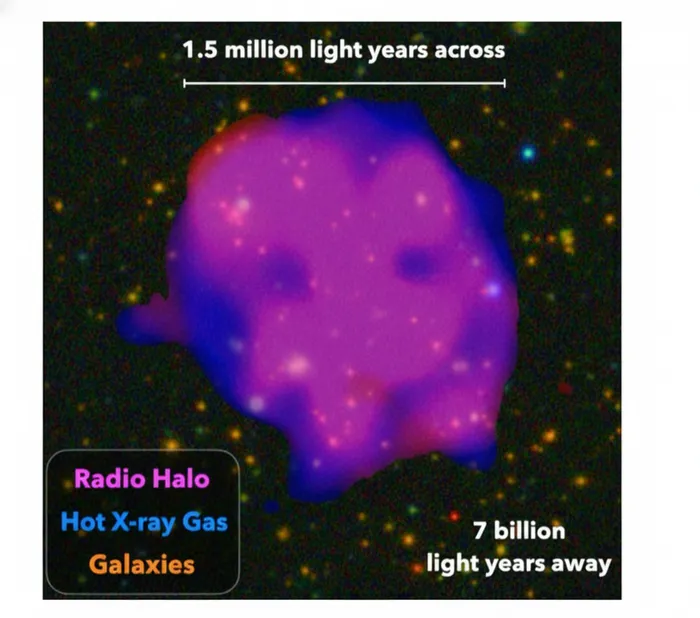
The MeerKAT radio telescope has discovered radio halo (pink) and hot X-ray gas (blue) between the galaxies (orange) that make up the massive galaxy cluster SPT-CLJ2337-5942, the most distant radio glow ever found.
Image: Gemini
A team of South African scientists has made an unprecedented discovery from the South African Radio Observatory’s (SARAO) MeerKAT radio telescope, uncovering a rare and extremely faint radio glow originating from a colossal cluster of galaxies approximately 7 billion light-years away. This phenomenon, known as an ultra-steep-spectrum radio halo, stands as the most distant example ever detected, revealing the universe's complex and dynamic nature.
The investigation, led by Isaac Magolego, a PhD student at the University of the Witwatersrand (Wits), under the guidance of Professors Roger Deane and Kshitij Thorat from Wits and the University of Pretoria, has received acceptance for publication in the esteemed Monthly Notices of the Royal Astronomical Society: Letters.
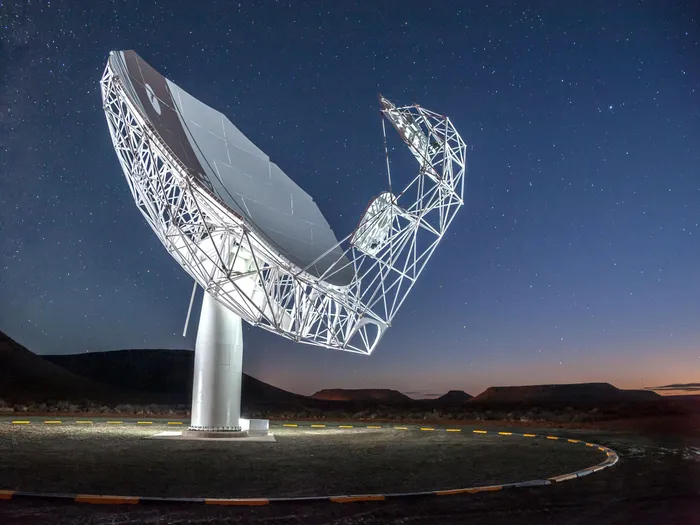
One of the 64 MeerKAT Telescopes observing our skies.
Image: UWC
Galaxy clusters are the universe’s heftiest formations, bound by the force of gravity and housing thousands of galaxies alongside massive volumes of hot gas. The newly identified radio glow lies at the centre of the cluster SPT-CLJ2337−5942, which possesses a staggering mass — about a quadrillion times that of the Sun, or a million billion times heavier.
Radio halos emanate when highly energetic particles traverse magnetic fields within these galaxy clusters. Such events often take place during colossal cluster collisions, creating intense turbulence that invigorates older particles, enabling them to emit radio light — much like how storms generate waves in turbulent seas.
Initially, Magolego perceived this discovery as typical for radio halos. However, a deeper analysis unveiled its unique characteristics: “At first, I thought this was a normal radio halo. But the detailed analysis revealed something far more unusual: the most distant ultra-steep-spectrum radio halo ever detected. It’s incredibly exciting, and I’m so grateful to SARAO for supporting my journey from undergraduate studies all the way to this discovery with MeerKAT in the final year of my PhD,” he said.
The radio glow's shape aligns remarkably well with X-ray images capturing the hot gas in the cluster, establishing a firm connection between turbulence, magnetic fields, and energetic particles. The rarity of these halos shines through their concealment by the intense afterglow of the Big Bang in the universe's early epochs. Thus, the ability to uncover examples at such a significant distance is of critical importance to astrophysicists.
This groundbreaking finding stems from the collaborative MeerKAT–South Pole Telescope (SPT) survey, an international project that combines MeerKAT’s advanced radio sensitivity with high-frequency observations from the South Pole Telescope, a ten-metre diameter radio telescope stationed at the Amundsen-Scott South Pole Station in Antarctica.
Professor Deane, co-lead of the MeerKAT-SPT survey alongside Professor Joaquin Vieira from the University of Illinois Urbana-Champaign, commented on the significance of this achievement: “This result highlights MeerKAT’s remarkable ability to reveal new important astrophysical laboratories in the distant universe — a key driver of our survey design strategy.”
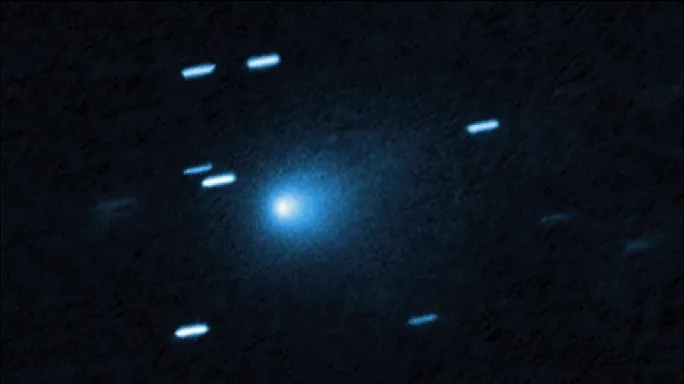
This image from NASA shows the fast-moving interstellar object 3I/ATLAS that has got many to wonder about alien encounters that have been reported over the years. An international research team of scientists from South Africa and Sweden has made significant strides in understanding this celestial visitor, using South Africa's MeerKAT radio telescope.
Image: Supplied / NASA
Pontsho Maruping, Managing Director of SARAO, articulated the broader implications of this discovery: “This highlights MeerKAT’s extraordinary sensitivity and the power of collaboration between SARAO, our universities, and global partners. It also reflects the impact of SARAO’s 20-year investment in human capital development, with Isaac’s achievement demonstrating the strength of our talent pipeline. As we enter the SKA era, MeerKAT continues to affirm South Africa’s leadership in cutting-edge radio astronomy.”
As MeerKAT continues to make strides in radio astronomy, future observations using this powerful telescope, alongside the Square Kilometre Array Observatory (SKAO), are poised to decode the commonality of such unusual radio halos and reveal further mysteries about the early universe. The journey does not conclude here — Magolego will further his research as a SARAO postdoctoral fellow at the University of Pretoria, stimulating a new generation's curiosity in the celestial realm.
IOS