
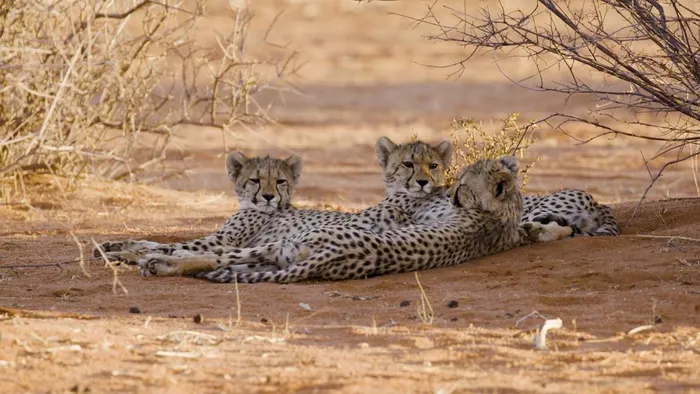
Cheetah cubs are popular in the Middle East where they are kept as exotic pets.
Image: Supplied.
IT’S a race against time to save the world’s fastest land mammal as cheetah numbers continue to plummet. Only about 7 500 remain in the wild, with roughly 1 400 of them in South Africa.
Ahead of International Cheetah Day this week, Wild Africa, a wildlife communicator, said efforts to save the species must be stepped up if cheetahs are to survive the next century.
Co-founder Peter Knights told the Independent on Saturday that even without humans in the mix, cheetahs face a hard life.
“They struggle very often because they have lions and hyenas that will come and take their young. They'll very often make a successful kill and they get pushed off by other animals. So being a cheetah in itself is a pretty tough life. But then on top of that, we also have all the human pressures, which are ever increasing, losing their habitat, being exploited for the illegal pet trade, and other pressures on them where they're seen as potentially in conflict with agriculture.”
Most cheetahs now live outside protected areas, which exposes them to habitat loss, conflict with livestock farmers, shrinking prey numbers and illegal trade.
Knights says that even inside protected areas, fenced reserves can isolate populations, creating high levels of inbreeding.
“And so there's been quite a few genetic issues for them, because they're just exposed to their own family members and aren't able to breed and interact. So there's quite a lot of work going on to translocate cheetahs from one place to another in order to maintain a viable genetic variability in the species. A lot of people don't know, but actually the cheetah originally was a North American animal, believe it or not, and it actually made its way down through Asia into Africa. And now it's really only surviving in Africa.”
Cheetahs are listed as vulnerable on the IUCN Red List, and two subspecies are ranked as critically endangered. Wild Africa notes that they are also listed as endangered under the US Endangered Species Act and are protected globally.
According to Knights, habitat loss confines cheetahs to smaller, disconnected areas. Today they occupy just 9% of their historic range, with 77% of individuals living outside protected areas.
“This increases conflicts with livestock farmers, prey depletion, poaching, and illegal wildlife trade. Cheetahs also have low reproductive success, with wild females producing an average of only 1.7 cubs to adulthood, making population growth difficult.”
For people who fear the big cat, Knights says there is little reason for worry, even in rural areas where cheetahs are occasionally seen.
“Leopards occasionally will attack human beings. Lions will occasionally attack human beings. Cheetahs, not really. They’re not dangerous to human beings, and it is really the small animals like sheep and goats that they will occasionally take, especially when what often happens is their prey species have been wiped out or declined, and their options are more limited.”
“There’s no need for people to be scared of their own personal safety from cheetahs. We don't fit the bill. We're too big and we just don't fit the bill for their diet.”
Knights says that while influencers posting photographs with cheetahs have dropped off dramatically, illegal trade continues in the Horn of Africa and East Africa, where cubs are shipped to the Middle East as pets. The Cheetah Conservation Foundation in Somaliland is caring for about 100 cheetahs seized in the past two or three years.
A short-term win, he says, would be to end the trade in cheetah cubs bound for wealthy buyers.
“Very often, they're not weaned so they may die of dehydration while on the way. Often people have no skills to keep them alive. And then when people do have them, they are often not fed the proper diet. So they will be fed chicken, and they will have all kinds of bone problems and other issues. They will often die very young, because they're not exercising. These are animals, which roam over vast distances and obviously, sprint around; keeping it in your lounge is not going to be very healthy for them. So a lot of them die very prematurely and then in some cases, people go out and buy another one.”
He believes wildlife tourism can play a powerful role in saving the species.
“People going on safari actually help to support the conservation of these animals. It puts money into the economies, it helps support the park infrastructure. So, I tell people from around the world, please come and visit Africa, come and see these animals, because by coming and spending tourism dollars, you are supporting the conservation of those animals.”
Wild Africa says cheetahs have naturally low reproductive success and typically don’t raise more than three cubs.
“You do see three or four cubs sometimes, but it’s usually very small. I think the problem is that when the mother goes to hunt, they have to leave the babies. And they're very vulnerable, and hyena and lion men will kill those babies if they find them. On the hunting side, often a cheetah will run and catch something and it’s exhausted, it’s desperately trying to eat its meal, and larger animals, hyenas, lions, leopards will come and push them off the kill. And so they can hunt successfully, but then not get the rewards,” said Knights.
He says Africa may hold the key to restoring cheetahs to parts of Asia where they’ve vanished. African cheetahs are already being introduced to India.
“I do think there’s room for us to help use Africa’s cheetahs to help repopulate some of those parts of Asia. Cheetahs are an amazingly beautiful animal and it would be tragic if we can’t help them survive into the next century.”