

As South Africans battle mental health issues, an innovative project is paving a new path towards emotional wellbeing — looking up, reflecting, and connecting under the expanse of the night sky.
Image: Atiabii/Pexels
As mental health challenges continue to escalate in South Africa, a groundbreaking research project is leveraging an unexpected ally: the night sky. Researchers from Stellenbosch University’s CoCREATE Health Hub, alongside the International Astronomical Union Office of Astronomy for Development, are unveiling novel ways in which stargazing experiences can enhance emotional wellbeing, reduce stress, and foster social connections.
With nearly 40% of South Africans experiencing symptoms of depression or anxiety, the urgency for innovative and accessible approaches to mental health has never been more pronounced. The pioneering initiative, dubbed Astronomy for Mental Health, marks a first for South Africa, scientifically exploring the potential of awe, immersion in nature, and “cosmic perspective-taking” to support mental resilience.

Researchers say that stargazing serves as an effective mental health strategy in areas where access to mental health care is limited. It is free, culturally inclusive and requires minimal equipment.
Image: File
Under the leadership of Prof Lynn Hendricks, Dr Therese Fish, and Nikki Thomas of Stellenbosch University, alongside Dominic Vertue, Dr Charles Takalana, and Kevin Govender from the IAU OAD, the project examines how structured stargazing sessions — ranging from community gatherings to elaborate overnight retreats — can bolster mental health. This research is grounded in Kaplan’s Attention Restoration Theory, which posits that natural environments, particularly those that engage the senses in a gentle manner, can facilitate mental recovery from fatigue.
According to the researchers, the night sky’s vastness and tranquillity exemplify what they term “soft fascination”, an effortless attention that assists in restoring clarity and perspective. An expanding body of evidence suggests that experiences filled with awe trigger brain regions associated with emotional regulation, decrease cortisol levels, and foster a sense of calm. The research team is particularly fascinated by the “Overview Effect”, a term used by astronauts to describe the profound awareness shift that occurs when viewing Earth from space. By encouraging ordinary individuals to gaze at the cosmos, the researchers aspire to elicit similar feelings of tranquillity, gratitude, and belonging.
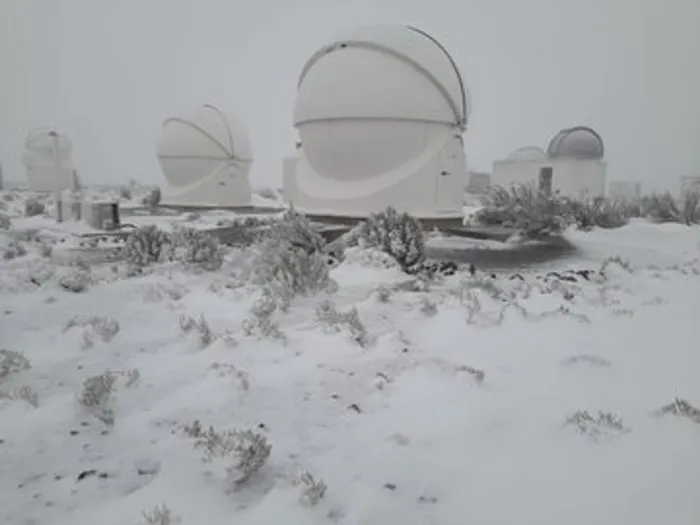
The Sutherland Observatory covered in snow. Sutherland, known for its dark night skies and home to the Southern African Large Telescope, offers an amazing stargazing experience
Image: Thea Koen
A recent event in Sutherland — a location renowned for its dark night skies and home to the Southern African Large Telescope — welcomed fourteen families from diverse backgrounds for a guided astronomy weekend. Participants explored the Karoo landscape, marvelled at the rings of Saturn, observed lunar craters, and engaged in reflective conversations around a fireside.
Preliminary results from this stargazing experience were promising. Participants noted immediate relief from depressive symptoms and a boost in their overall mood. Through a combination of self-report questionnaires, reflective journaling, and focus group discussions, researchers observed a consistent trend: within 24 hours of engaging with the night sky, participants reported reduced anxiety and enhanced emotional states.
“If the effect was solely about escape or rest, we would anticipate a similar response from any weekend getaway,” Hendricks explains. “What we’re discovering is that the cosmic element — the vastness, the awe — induces a shift that’s uniquely profound. It not only calms individuals, but transforms their understanding of self and their role in the universe.”
Among the compelling findings, participants described a newfound “mental spaciousness”, experiencing clarity of mind that allowed for more effective processing of emotions. Many reported a lasting sense of life perspective and purpose. One participant reflected on their experience, stating, “I still picture the Milky Way when things feel heavy. It reminds me that my problems aren’t infinite.”
Dr Fish, Vice-Dean of Clinical Services and Social Impact at Stellenbosch University’s Faculty of Medicine and Health Sciences, emphasises the importance of this initiative: “Through this collaboration, we are pioneering new avenues for healing that exist outside traditional clinical settings. Families are not only reconnecting with one another, but also rediscovering their bond with nature and a collective sense of humanity.”
Govender, Director of the OAD, highlights the crucial role of astronomy: “This discipline has always urged us to ponder profound questions. Now, we’re learning that it can also offer us the space to contemplate these questions calmly, together, beneath the same sky.”
Importantly, the researchers underscore that stargazing serves as an effective mental health strategy in areas where access to mental health care is limited. It is a free, culturally inclusive practice requiring minimal equipment.
The project is set to continue until 2029, with intentions to broaden its scope to include youth programmes, urban stargazing initiatives, and an array of psychological and physiological assessments. Researchers plan to explore experiences across diverse environments — from city backyards to the deep skies of Sutherland — to enhance their understanding of how and why astronomy influences mental health.
The team anticipates publishing a paper detailing their preliminary findings by the end of 2025, with approvals from the Social, Behavioural and Education Research (SBER) Ethics Committee of Stellenbosch University in place.
IOS