Judge orders Department of Health to act against xenophobic protests blocking clinics
Threat to democracy
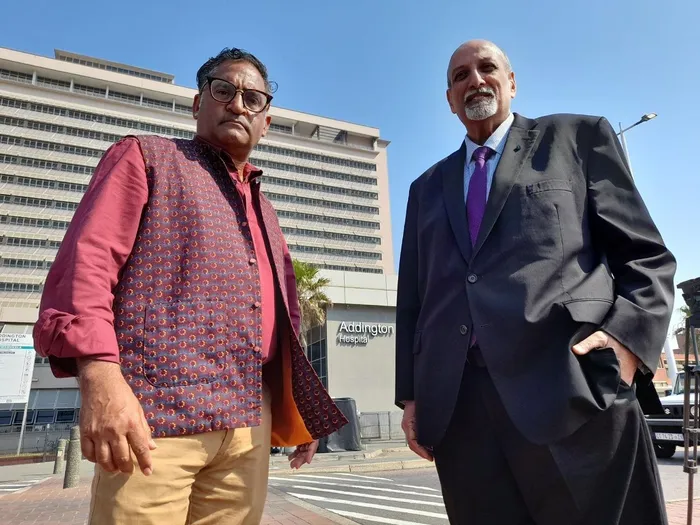
Dr Raymond Perrier the director of the Dennis Hurley Centre and public health expert, Professor Salim Abdool Karim, outside Addington Hospital where they confronted vigilantes preventing foreigners from accessing medical care.
Image: Supplied
THE Department of Health has been compelled to act against ‘xenophobic’ vigilantes after the Gauteng High Court ruled that blocking access to public health facilities is illegal.
Judge Wilson on Thursday found that the blockades violated both legal and constitutional rights to healthcare.
He warned that xenophobia is not just a social problem but a direct threat to democracy and human rights. “Xenophobia is one of the greatest threats to democracy and human rights we presently face. Leaving aside that it feeds on the most toxic of human instincts: the hatred of the other… the problem with xenophobia is its misdirection. If we can blame foreigners, we need not look to ourselves for the solutions to the poverty and inequality that scar our society,” he said.
The judgment came after three civil society organisations approached the court on behalf of foreign nationals, and some South Africans, who were harassed or turned away from public clinics because they couldn’t produce a South African identity document.
While most of the illegal protests occurred in KwaZulu-Natal and Gauteng, the applicants; Treatment Action Campaign, Médecins Sans Frontières, and Kopanang Africa Against Xenophobia, focused on unlawful actions at Johannesburg’s Yeoville and Rosettenville clinics. Respondents included the National and Gauteng Departments of Health, the national and provincial police commissioners, and the South African Human Rights Commission.
Judge Wilson questioned why clinic security staff appeared to have ceded control of access to the vigilantes. “If the vigilantes have overwhelmed the security guards (there is little to suggest this on the papers), then security needs to be enhanced. If the security guards are actively assisting the vigilantes because they are sympathetic to the vigilantes’ aims, steps must be taken to discipline or replace them,” he said.
The judge also criticised the police for claiming their role was limited to investigating complaints, rather than taking proactive action.
“The answer, it seems to me, is plain enough: wrest control of the clinics from the hands of the vigilantes, or show that it is beyond the capacity of the police — assisted, where necessary, by the other state respondents — to do so. Once that is done, the police will have discharged their responsibilities,” he wrote.
Foster Mohale, from the National Department of Health, told the Independent on Saturday that authorities would work with other state entities to ensure no one obstructs access to public clinics. “No unauthorised person may obstruct or hinder physical access to this clinic or the provision of healthcare services within the clinic. Any person violating this instruction will be removed from the premises and its surroundings and reported to the police,” he said.
Constitutional law expert Dr Suhayfa Bhamjee said that, at first glance, the case might seem limited to two clinics. “In reality, it is a stark reminder that the constitutional promise of healthcare for all is under siege, and that government inertia can be as dangerous as vigilante violence.” She said the court ruled that it was unlawful, discriminatory, and “a direct attack on the right to health enshrined in section 27 of the Constitution.”
Dr Bhamjee said Judge Wilson’s order forces the City of Johannesburg, Gauteng health authorities, national health officials, and SAPS to act “immediately and decisively.”
She added that the judgment has broader implications: “While the interim order applies only to two clinics, the reasoning applies everywhere. The Constitution does not stop at provincial borders. Nor does the National Health Act, which obliges both the Minister of Health and provincial departments to remove barriers to access. Provinces cannot shrug off these duties or hide behind service-level agreements. The court made that crystal clear.”
She warned that similar orders would likely follow if blockades occur elsewhere. “Provinces that fail to act could face urgent litigation, structural interdicts, and hefty cost orders. The judgment sets a persuasive precedent that will shape policy and policing nationwide.” She said provincial health departments must audit clinics, train security, and co-ordinate with SAPS to prevent discrimination. “Waiting for a crisis or a court order is not an option,” she said.
Dr Bhamjee added that the ruling exposes the weakness of the state’s response to xenophobic violence. As Judge Wilson observed, “It is a great pity that litigation was required” to enforce what should have been a basic duty.
Dr Raymond Perrier, director of the Dennis Hurley Centre in Durban, welcomed the court ruling. He said that after months of illegal protests and hundreds of South Africans and foreign nationals falling sick, and some dying, the two injunctions now legally require the police and Department of Health to act.
“As Judge Wilson points out, it is a source of shame that government officials need to be forced by the courts to do their job. But now there can be no excuse. The police must stop the illegal protests at Addington and elsewhere. And the CEO of Addington, and other health managers, must act decisively to ensure all patients have equal access to healthcare,”
During a blockade at Addington Hospital earlier this year, Perrier and public health expert Prof Salim Abdool Karim visited the hospital to witness the situation firsthand, and were also harassed by protesters. Perrier said the number of patients attending the Dennis Hurley Centre has nearly doubled since the start of the crisis.
“I think it’s helpful for people to know that patients are not being abandoned. But it’s costing us a huge amount of money to keep people alive — which is fine, that’s what we’re here for, but it shouldn’t be as a result of illegal protests. We normally see 2 000 consultations a month. In October and November, we saw 3 400 each month,” he said.
The centre is now running a deficit of almost R700 000, forced to draw on reserves to cover staffing and extra medicines. “Because of medicines we’re buying - like insulin and hypertension drugs — we’ve never had to buy in the past. If people are angry and want to do something about it, one way is to give us money, because we are doing the job the Department of Health should be doing, and it’s outrageous,” Perrier said.