
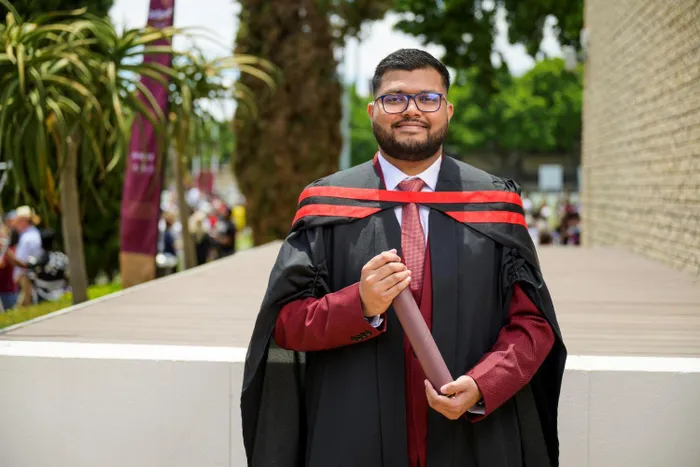
Trevolin Pillay at the December graduation ceremony at Stellenbosch University this week. He is the first Deaf student to graduate with a BSc Honours in Bioinformatics and Computational Biology from the university.
Image: Stefan Els
In a remarkable celebration of resilience and success, Trevolin Pillay, a proud member of South Africa's Deaf community, achieved a significant milestone this week when he graduated with a BSc Honours degree in Bioinformatics and Computational Biology from Stellenbosch University (SU). Born profoundly deaf, Trevolin embodies the ethos of being "Deaf with a capital D," embracing his identity and cultural richness within the Deaf community.
Hailing from Chatsworth in Durban, Trevolin’s journey has been supported by a strong family foundation and a dedicated educational background. He fondly recounts his formative years at Fulton School for the Deaf in Gillitts, where his academic excellence saw him consistently ranked as a top pupil, earning numerous accolades, including the prestigious dux award. “I was lucky to have a supportive family, and my education was crucial in shaping my future,” he said in an email.
Trevolin made history as part of the first cohort of six Deaf students to graduate with a bachelor's degree in IT from Belgium Campus iTversity, proudly achieving this magna cum laude. Thanks to a conducive learning environment complete with resources tailored for Deaf students and proficient South African Sign Language (SASL) interpreters, he was able to navigate this crucial stage of his academic career with remarkable success.
However, Trevolin encountered a significant transition when he began his studies at SU this year, becoming the sole Deaf student at the university. “I had always been surrounded by fellow Deaf learners and had to learn to adapt to a predominantly hearing environment,” he reflected. Despite these initial challenges, Trevolin grew comfortable in his independence, and his journey led to meaningful connections, such as with Rahkeenah Peterson, an administrative assistant at the Centre for Bioinformatics and Computational Biology.
Rahkeenah’s proactive approach to learning SASL before Trevolin’s arrival proved invaluable. “The day Trevolin walked into my office, I could greet him and communicate at a basic level,” she remembered. Their interactions throughout the year fostered an atmosphere of mutual learning and understanding, showcasing Trevolin’s admirable patience and resolve.
Dr Lenine Liebenberg, Trevolin’s supervisor at the Centre for Epidemic Response and Innovation (CERI), attests to the profound impact of working with him. “Trevolin has shown tremendous resilience and dedication, entering an academic domain that was previously unfamiliar to him and engaging with it fearlessly,” she noted. Her team endeavoured to cultivate an inclusive environment through the use of SASL apps, speech-to-text tools, and real-time communication options, ensuring that Trevolin received every opportunity to thrive academically.
Trudie Theunissen, a SASL interpreter, underscores the importance of ensuring that Deaf students have access to all necessary academic supports from the outset. “Every Deaf student has the right to professional interpreting services, and we must facilitate an effective partnership between students, interpreters, and educators,” she said. Her insights highlight a vital message: having an interpreter should amplify, not hinder, academic pursuits, empowering Deaf students to excel in any field.
Trevolin’s message to fellow Deaf students is clear: “Never give up,” even amidst daunting circumstances. Facing difficulties with complex biological concepts early in his studies, he considered exiting the programme. However, with unwavering support from mentors and supervisors, he persevered, transforming challenges into triumphs.
With immense gratitude for his mentor, Dr TJ Sanko, Trevolin credits him for instilling deeper knowledge and technical skills in bioinformatics. “Dr Sanko has been instrumental in my journey; he guided me through complex concepts and coding, enhancing my confidence and competencies,” Trevolin expressed.
As he prepares to take this significant academic step, Trevolin encourages the broader deaf population to pursue opportunities within the hearing world. “I am just a simple Deaf person from Chatsworth, KwaZulu-Natal, who strives to achieve my goals — this is who I am,” he said, embodying the spirit of determination and advocacy for inclusivity.
IOS