
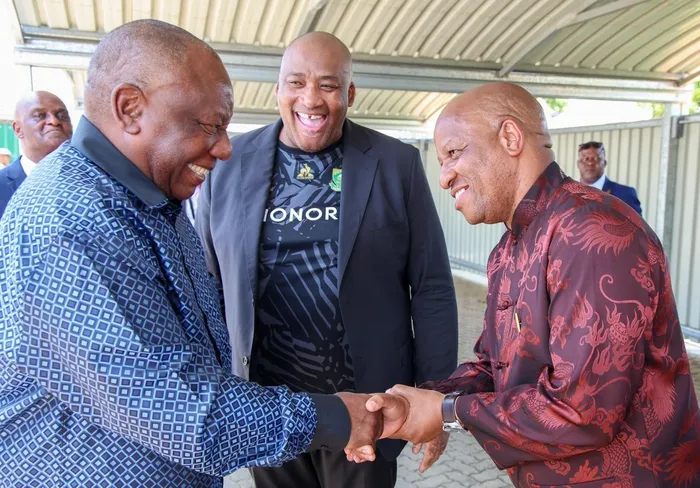
President Cyril Ramaphosa is welcomed at the Ncome Museum, Nquthu, for the 2025 National Reconciliation Day Commemoration by KwaZulu-Natal Premier Thami Ntuli, with Sport, Arts and Culture Minister Gayton McKenzie looking on.
Image: SA Government/Supplied
In a marked response to rampant misinformation regarding farm murders, President Cyril Ramaphosa delivered a powerful message during his Day of Reconciliation address at the Ncome Museum in KwaZulu-Natal on Tuesday. Joined by KZN Premier Thami Ntuli and Sport, Arts and Culture Minister Gayton McKenzie, the president's keynote remarks were made under the theme “Reaffirming Reconciliation for Future Generations,” creating a platform aimed at reinforcing South Africa’s commitment to unity, healing, and nation-building.
Ramaphosa referenced the controversial comments made by US President Donald Trump, who recently took to his social media platform to accuse the South African government of ignoring what he termed “horrific human rights abuses” against Afrikaners, Dutch, French, and German settlers. Trump claimed that “they are killing white people, and randomly allowing their farms to be taken from them,” a narrative that Ramaphosa confronted directly.
While Trump’s rhetoric included a threat to exclude South Africa from future G20 events as a direct consequence of the nation’s perceived negligence in addressing these so-called issues, President Ramaphosa focused on a narrative of inclusiveness and shared hope instead of division.
“Our democracy was built on reconciliation. South Africans bear the scars of centuries of dispossession and oppression, of resistance being met with batons and bullets,” Ramaphosa said, urging citizens to confront their complex history with honesty for the benefit of future generations.
The President emphasised the importance of fostering a more nuanced and positive discourse. “There are those, inside and outside our country, who are trying their utmost to paint a false picture of us as the South African people,” he said, pointing out that surveys reveal a widespread belief in the improvement of race relations since the end of apartheid in 1994.
In a celebration of unity, Ramaphosa spotlighted the everyday interactions among South Africans of various racial backgrounds: “They do not show the pictures of African, white, Indian and coloured children learning together, studying together and playing together... Our country’s detractors are drawing a false picture designed to sow fear and hatred.”
He underscored the success stories of land restitution and the emergence of black farmers, marking these achievements as crucial components of the nation's progress. “If we continue and together we build our nation as South Africans, there will be no one who will be able to plant the seed of discrimination and exclusiveness amongst us,” he added.
The president also called attention to the critical need for dialogue around the varying experiences and perspectives within South Africa. “For as long as the majority of black South Africans live in poverty, for as long as inequality persists, our country will not find true reconciliation,” he said.
IOS