
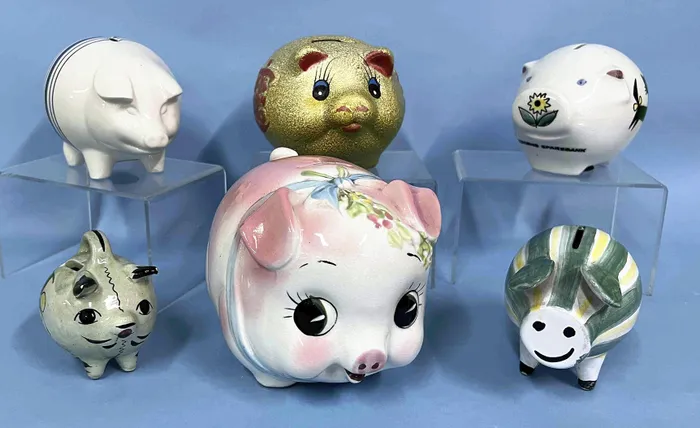
Ceramic piggy banks from Japan, Britain, Norway, Switzerland and other places entertain visitors to the Amagasaki Shinkin Bank's museum in Japan with their diverse colors and shapes.
Image: The Japan News
Kenji Iwaasa
TOKYO - Money boxes come in all shapes and sizes, but the pig is one of the most familiar shapes, as is indicated by the fact that they are commonly called piggy banks in English. Pig-shaped money boxes have been made all over the world. The joy of saving up with the jingle of coins, aiming for a “full belly,” seems universal across time and place.
The Amagasaki Shinkin Bank's museum of money boxes, in Amagasaki, Hyogo Prefecture, has examples from across the world. It has a collection of about 25,000 items from 62 countries, including money boxes from the West, Asia and the Middle East. Pig-shaped money boxes alone number about 450.
Some of the pig-shaped money boxes have wide-open eyes like anime characters, while others are entirely gold, like lucky charms. While there are simple ceramic ones, there are also transparent glass banks that allow you to see the contents at a glance.
Others are made from unusual materials such as leather and rattan. Money boxes from Japan, China, the United States, Britain, Mexico, Switzerland, Norway - each one of them has its own expression and charm.
Why are there so many pig-shaped money boxes, or piggy banks? "They've long been made in various countries as auspicious items to bring good fortune," said the museum's director, Tsutomu Mitoori, 65. Mitoori joined the bank in 1984 after graduating from college, and he has been serving as museum director since 2020.
One theory is that pigs have been regarded as symbols of prosperity due to their prolific breeding. Another suggests that pigs represent efficiency, as every part of the animal - from skin to bones - can be used.

Listening to the jingle of the coins is one of the allures of owning a piggy bank.
Image: File
In Japan, ceramic and vinyl piggy banks became popular after the war. One reason behind their popularity seems to be the fact that their rounded shape is well-suited for holding coins.
Money boxes reflect ordinary people's longing for wealth. Those used during the early Meiji era (1868-1912) were called "chokin-dama," or savings balls, and were shaped like a wish-fulfilling jewel, which was believed to grant wishes to its owner. Those made from the Meiji era to the Showa era (1926-1989) were in the shape of storehouses with thick earthen walls, conveying people's wish to become wealthy enough to own a storehouse.
Overseas, auspicious chickens or honeycombs were used as motifs for money boxes.
Each money box reflects the social conditions and trends of its time, serving to pass on the culture of everyday life. People who live in a largely cashless society today have fewer opportunities to handle physical money.
"It might be meaningful to reflect on the times when money boxes were produced and cherished," Mitoori said.
There are also unique money boxes that mimic human movements. A Tammany Bank money box from the United States dating back to the 19th century is one such example. When a coin is placed in the seated official's hand, the arm slowly moves to tuck the coin into his pocket.
A William Tell money box features a mechanism in which coins are launched like arrows into a tower-shaped money bank.
"The movement is so well calculated. I was amazed with the craftsmanship behind the product," Mitoori said.