
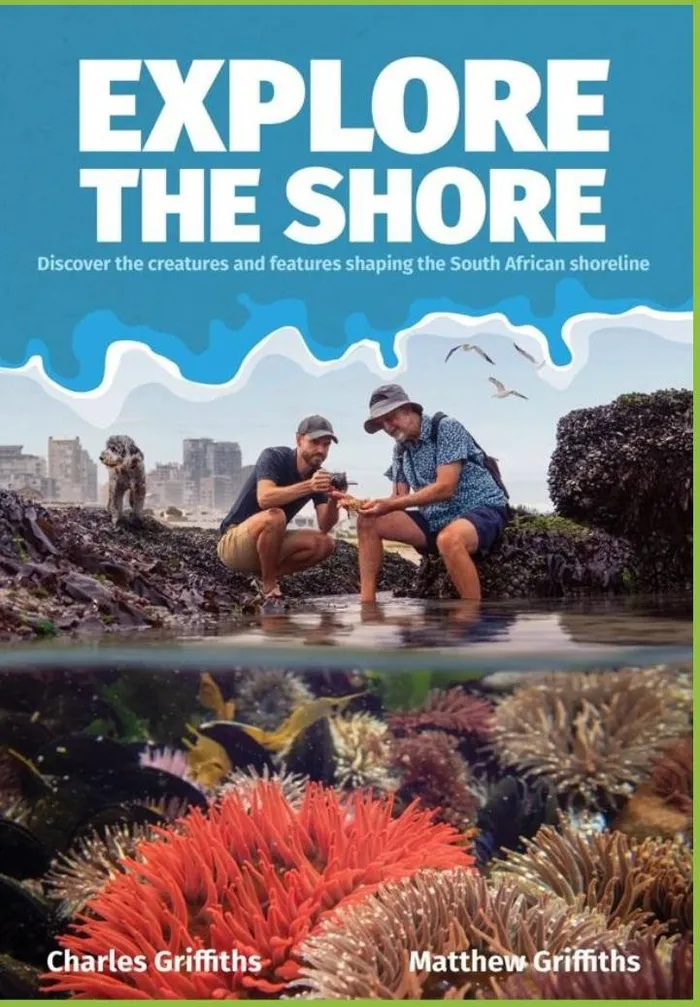
Explore the shore, a treasure trove of information about the sea from father and son team Charles and Matthew Griffiths.
Image: Supplied
SALT spray coats your face. Tiny organisms scuttle under rocks, and the waves lap gently at your feet; all while Ben the labradoodle sniffs out the next discovery.
That’s the world of Explore The Shore, a book by Charles and Matthew Griffiths that brings the seashore to life.
Father and son have spent decades exploring the shore, now captured in a book and YouTube video series that reveals the extraordinary hiding in plain sight. From rock pools teeming with tiny creatures to intertidal zones where the ocean tests even the hardiest organisms, they guide readers on a journey full of wonder, humour, and salty surprises.
And Ben provides a touch of playfulness, giving readers permission to have fun and ignite a sense of adventure.
“I often say to people, you pay thousands of rands to go on safari in the Kruger, but there's these super interesting things happening in a rock pool, which you can just walk down and go and see. You can find all these amazing things and have a little safari on the seashore,” says Matthew.
Charles, a marine biologist and an emeritus professor with over five decades of teaching experience, hundreds of papers, and dozens of books to his name, spotted a gap in the market: books that entertain, educate and inspire without overwhelming readers with Latin names and technical jargon. It had to be complex enough for scientists, yet simple enough for those just developing an interest in the seashore.

Matthew Griffiths and his father, Professor Charles Griffiths at the launch of their book, 'Explore The Shore'.
Image: Wesley Ford
Matthew says it was also a way of preserving all the anecdotes his dad had collected throughout his career.
For instance, in the book, Charles recounts a report from the 1800s stating that inmates from the Breakwater prison, at the V&A Waterfront, rioted about the food they were getting because they didn't want to eat rock lobster more than three times a week. “Lobsters have thus gone from being cheap and undesirable prison food to gracing the tables of the most expensive fine-dining restaurants.”
Matthew’s late mom, Roberta — also a marine biologist — was delighted to see her husband and son start the project, though she passed away before its completion. She was Explore The Shore’s first and biggest supporter, and her spirit lives on in every page, writes Charles.
“The formal guidebooks have a little brief explanation about an animal’s biology, but they don’t tell you about the weird things that they do,” says Matthew, recalling how rediscovering the shore as an adult revealed hidden wonders he’d never noticed growing up alongside it.
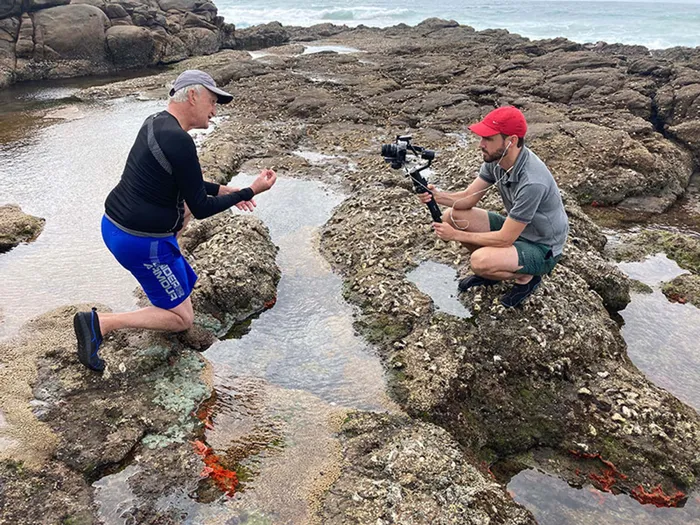
Father and son Charles and Matthew Griffiths have published a book Explore The Shore and have a YouTube channel uncovering the mysteries of the seashore.
Image: Supplied.
Charles chuckles at the memory of the long-suffering Matthew, who just wanted to play his guitar and listen to music rather than take yet another trip to the beach. The book is undoubtedly a team project, one that enhanced their relationship and drew them closer to each other. Charles brought his scientific expertise, Matthew his content creation and filmmaking skills, while Ben added a layer of charm and mischief that could temper the roughest waves. “We fit fantastically,” says Charles.
If you’re looking for breathtaking pics, dad jokes, and knowledge about strange creatures that could make you win a quiz show, then this book ticks all the boxes. They are teaching South Africans to kneel, look closer, and discover what's always been there.
Rock pools, for example, are harsh habitats, undergoing dramatic temperature swings, oxygen fluctuations, and the rapid depletion of food. You’ll learn the difference between boulder, cobble, and pebble shores, and explore South Africa’s 290 estuaries, where rivers meet the ocean. The book is packed with laugh-out-loud moments while combining creativity with scientific rigour. For instance, take the tiny creature with five pairs of caterpillar-like legs and long trunk-like mouthparts, living on the arms of a feather star. For months, it was simply dubbed the “oval thingies,” until finally classified as a myzostid worm.
Then there’s Ben, whose speech bubbles warm the heart: “Seaweeds are also very slippery, so watch your step,” he says, often sniffing out discoveries too small for the human eye.
Charles says the project started small and then took on a life of its own. “And then it grew and grew. We started with some simple videos of obvious, common and interesting organisms, and then a longer list of things we could do. It’s like Mrs Ball’s making her chutney; I’m sure she started just making it for the family on the kitchen stove,” he chuckles.
Matthew adds that they worked well together and most of their discussions were about taking Charles’ “very efficient lecture style” and years of knowledge and turning it into an entertaining on-camera presentation. “So there were a lot of take-twos and ‘Can we do that again?’” laughs Matthew. “Be a bit more animated, dad,” adds Charles.
Watching the videos is like being a student in a live seashore classroom. Charles, and sometimes Matthew, explain creatures and their behaviour right there on the shore.
You see plough shells, also known as surfing snails, hydroids, which are tiny, tentacled forests of the sea, and hear anecdotes that make science come alive. It’s immersive, hands-on, and often hilarious — with sounds of the ocean in the background.
In one video, Charles uses a tennis ball to illustrate the moon, and while he’s explaining, Ben cheekily steals the “moon” and wanders off. It’s so funny and perfectly captures the spirit of the series: learning with a laugh.
This is a family steeped in marine science. The Griffiths have the unusual distinction of each having a species named after them: Charles, Matthew, Roberta, and their daughter, Melinda. And now they’ve produced the only book I’ve ever wanted to take to the water’s edge. Imagine learning about sea hares — giant, gentle grazers with bunny-like faces — whelks, bivalves, “life squeezed between two shells,” the mystery of rock pools and rocky shore crabs, “ten-legged and armour plated.”
The book gives you insights on marine invasive species, climate change, overexploited marine resources, and bizarre behaviours you’d never expect. And we all know that sea air makes you hungry, which makes the recipes in the videos, seafood of course, even more appealing.
So, should you read the book first or watch the videos? It doesn’t matter, says Charles, but the videos open a whole new world. “A lot of these things are quite small, and watching the videos really teaches you: you need to get down on your hands and knees and look closely at these animals, and then a whole new world opens up for you.”
At a time when climate change is reshaping coastlines, and many children only know wildlife through screens, Explore The Shore opens your eyes to the wonder that exists if you’re willing to wet your feet and stick your toes in beach sand.
If you’re looking for a festive-season gift for young and old, science buffs or beach lovers, that will encourage them to leave their screens behind and explore maritime mysteries, then Explore The Shore fits the bill. The book retails for about R380 and can be found at all good bookstores.