
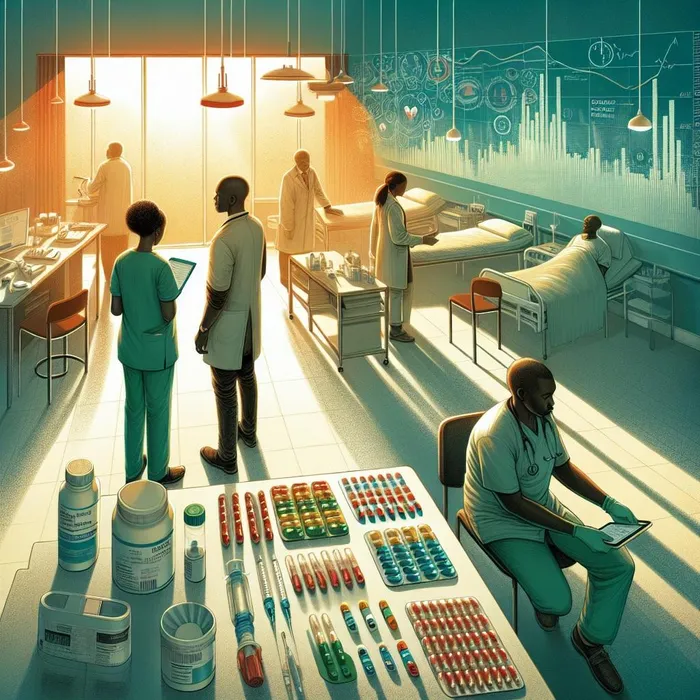
The abrupt, politically-driven pause in PEPFAR funding in 2025 sent shockwaves through the world's largest HIV treatment programme, exposing deep vulnerabilities and forcing a chaotic fight to secure life-saving antiretroviral treatment for millions.
Image: IOL / Ron AI
The year 2025 will be remembered in South Africa not just for political shifts, but for a sudden, terrifying wobble in its world-leading HIV response.
The abrupt, politically charged pause in funding from the President’s Emergency Plan for AIDS Relief (PEPFAR) sent shockwaves through the country’s health sector, forcing a rapid, often chaotic re-evaluation of its dependence on foreign aid.
Since PEPFAR’s inception in 2003, the US government has invested over $100 billion in the global HIV/Aids response, saving over 25 million lives, preventing millions of HIV infections, and supporting several countries to achieve HIV epidemic control, all while significantly strengthening global health and economic security.
While a series of waivers and a partial resumption of funding averted the worst-case scenario of mass treatment failure, the crisis exposed deep vulnerabilities within South Africa’s healthcare system, triggered a diplomatic firestorm, and put thousands of jobs at risk in the non-profit sector.
The crisis began with US President Donald Trump's executive order, which halted all foreign aid programmes for a 90-day review period, citing geopolitical concerns and South Africa's controversial Expropriation Act.
Trump’s claim that South Africa was "confiscating land" and "treating certain classes of people very badly" was the immediate flashpoint.
The impact was immediate and devastating for the non-governmental organisations (NGOs) and research institutes that rely on approximately $400 million (R8.5 billion) in annual funding from PEPFAR.
The Wits Reproductive Health and HIV Institute (RHI), a major recipient, was among the first to announce the closure of its clinics, directing patients to already-strained government facilities.
"It’s like walking into a hospital and turning off the power while patients are on ventilators and in surgery," an NGO programme leader, who requested anonymity due to the political sensitivity, lamented at the height of the crisis. "This abrupt funding pause has essentially stopped our work dead in its tracks. The damage is irreversible."
For South Africa, which has the world's largest HIV epidemic, the fear was palpable. PEPFAR funding, though constituting only 17% of the total HIV/Aids budget, was strategically deployed in 27 high-burden districts, supporting key personnel, operational costs, and research.
"Without immediate intervention, South Africa faces a dire risk of mass treatment defaulting, heightened vulnerability to HIV, and a reversal of years of progress in addressing public health crises," warned the Sex Workers Education and Advocacy Taskforce (Sweat).
The panic was intensified by the immediate threat to life-saving antiretroviral (ARV) treatments.
"We all know that if you think about HIV, it is not the case that if you don't find medication, you can wait until it’s available," said Alan Brand, founder of Positively Alive, a support network.
"There is a very high risk of drug resistance, and an incredible risk of people going from being undetectable to having a viral load, which means they are transmitting again," he said.
The South African government’s response was swift, walking a tightrope between diplomatic appeasement and national defiance.
Health Minister Dr Aaron Motsoaledi quickly sought to reassure the public that the core supply of ARVs — 80% of which is funded by the South African government — was secure.
He explained that 5.9 million people are on ARVs, with no other country coming close to this. The minister added that the total amount spent on this campaign is R44.4 billion.
Motsoaledi emphasised that PEPFAR contributes 17% of this.
However, the Minister of Mineral and Petroleum Resources, Gwede Mantashe, adopted a more aggressive stance, threatening to withhold critical minerals from the US.
"They want to withhold funding, but they still want our minerals. Let’s withhold minerals. Africa needs to assert its advantage and take charge of the growing demand," Mantashe said, framing the issue as an assertion of African economic sovereignty.
The diplomatic pressure led to a partial reprieve. US Secretary of State Marco Rubio signed an "Emergency Humanitarian Waiver", securing uninterrupted ARV treatment for millions.
But this limited waiver only covered life-saving treatment and excluded critical areas like family planning, transgender services, and administrative costs.
This limited scope meant NGOs were still forced to retrench thousands of skilled workers —doctors, nurses, lay counsellors, and data capturers — whose salaries were paid by PEPFAR funds.
The Portfolio Committee on Health expressed concern that this exodus of personnel would cause "significant service disruptions" in the 27 key districts.
The crisis prompted renewed calls for South Africa to achieve health sovereignty.
Professor Salim Abdool Karim, director of CAPRISA, argued that the country was ready to take full control of its programmes.
"We don't depend on the US taxpayer and US charity for treating diabetic patients or hypertension patients; why should we depend on that for Aids treatment? We should really take care of our own people, in my view," Prof Karim asserted.
He called for a phased, systematic handover, warning that an abrupt cut was "catastrophic".
Civil society groups, including the Treatment Action Campaign (TAC), however, warned that the government was not yet ready to absorb the operational and management functions performed by the NGOs.
TAC chairperson Sibongile Tshabalala called the initial withdrawal "nothing short of a death sentence".
As the year draws to a close, a fragile sense of stability has returned, with a number of PEPFAR-supported activities resuming under the waiver. Yet, the underlying issues remain unresolved.
The experience of 2025 served as a stark "clarion call for SA to self-correct", as Madeleine Hicklin, DA Member of the Gauteng Provincial Legislature, put it, forcing the government to seriously consider domestic funding for essential services.
Last month, in response to the withdrawal of PEPFAR funding, Finance Minister Enoch Godongwana allocated an additional R590.4 million to sustain crucial provincial HIV/TB services, while calling on provinces to develop credible long-term transition plans.
The high political cost and the near-disruption of the HIV programme have left a clear message that the reliance on foreign aid for core public health functions carries an unacceptable level of political and human risk.
The true long-term impact on job losses, research, and service quality in the most vulnerable communities, however, may only become fully clear in the years to come.
karen.singh@inl.co.za