
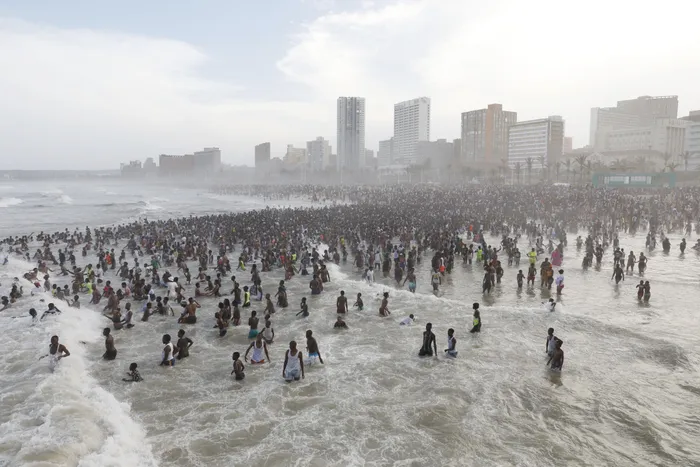
Durban trembles, comes to a standstill as thousands holiday makers descend for the holiday season.
Image: Doctor Ngcobo./Independent Newspapers
TOURISM bosses are confident Durban is heading for a record-breaking festive season, even though some visitors arriving for their seaside holiday may have to stay on dry land after four of the city’s beaches were closed due to pollution.
Blue Lagoon, Ethekwini Beach, Country Club Beach and Battery Beach, all in the city centre, were closed as a “precautionary measure” on Thursday while a team investigates the source of the pollution and implements “appropriate mitigation measures”, the municipality said.
The closures come just days after record-breaking crowds flocked to the beachfront on Reconciliation Day, with at least 75 000 swimmers entering the water and 234 500 people using the promenade — one of the busiest days in recent history, according to the council.
Municipal spokesperson Gugu Sisilana told the Independent on Saturday that water samples were taken on Friday and that if they pass all safety tests, the affected beaches would reopen today. She said the city’s remaining 19 bathing beaches continue to meet acceptable water quality standards and remain open.
“Maintenance of sewer infrastructure along various coastal catchments is ongoing. Any issues identified are addressed promptly to ensure compliance with environmental standards. Once pollution sources are contained, seawater quality is expected to return to normal,” Sisilana said.
Earlier this week, the Pietermaritzburg High Court ordered the eThekwini Municipality to take urgent steps to address failures in its water and sewer infrastructure following legal action by the Democratic Alliance. The court’s ruling includes instructions that the city publish weekly E. coli readings for all public beaches, urgently repair and maintain sewer infrastructure, and improve communication with residents and businesses about water-related health risks.
In response, the municipality said several of the interventions referenced in the judgment were already being implemented, including ongoing pollution monitoring, regular water quality testing at bathing and non-bathing beaches, and the immediate closure of beaches where contamination levels are found to be high.
DA eThekwini mayoral candidate Haniff Hoosen said the party had turned to the courts after repeated attempts to engage the municipality failed. “For far too long the political leadership of eThekwini have taken the public for granted and have been ignoring the scores of complaints regarding sewer overflows into our rivers and oceans.
Every attempt to secure reasonable and urgent mitigating measures from the municipality has been ignored, leaving us with no other option but to force the municipality to do what it is legally obligated to do,” he said.
The beach closures come at a time when hotels and other accommodation providers are reporting strong bookings as thousands of holidaymakers arrive, testing the resilience of Durban’s tourism sector at its busiest time of the year.
The Durban Chamber of Commerce and Industry believes the city is still in for a strong festive season, particularly compared with last year’s challenges linked to E. coli outbreaks. CEO Palesa Phili said that for the first time in five years, the municipality’s bulk water reservoirs are stable, with the Durban Heights, Wiggins and Midmar treatment works all operating at full capacity.
“We believe the progress made in addressing critical infrastructure issues, together with efforts to strengthen business confidence and improve safety and security, will support increased local and international tourism,” Phili said. “We also anticipate higher spending during the festive period, boosting demand across accommodation, transport, restaurants, entertainment and other tourism-related services.”
KwaZulu-Natal Tourism and Film marketing authority spokesperson Pinky Radebe said booking and occupancy indicators suggest the province is already enjoying a solid festive season. She said occupancy rates are expected to average about 60% in mid-December, rising to between 75% and 80% around Christmas before tapering off in the new year.
“Durban remains a strong anchor destination, while several coastal districts are indicating peak-period occupancy in excess of 80%,” Radebe said. However, she cautioned that service delivery remains critical to tourism confidence.
“Infrastructure challenges such as road conditions, waste removal and general public-environment management all shape visitor experience, particularly during high-volume periods,” she said. “While destination marketing entities do not manage municipal services, issues are escalated through appropriate channels to mitigate reputational risk to the destination.”
Radebe said that non-hotel accommodation, guesthouses and smaller establishments in districts were also seeing improved demand. “The wider impact is felt through tour operators, transport services, attractions, food outlets, craft traders and experience-based offerings.”
She said that township tourism also showed growth as a distinctive part of KwaZulu-Natal’s offering, particularly for visitors seeking authentic cultural, culinary, heritage and music-based experiences.
“Its strength lies in being experience-driven and community-anchored. When properly packaged, quality-assured and linked to established tourism routes, township tourism plays a meaningful role in broadening participation in the tourism economy and spreading benefits beyond traditional nodes,” said Radebe.
Brett Tungay, national chairperson of hospitality industry body Fedhasa, said coastal destinations such as Durban, uMhlanga and Ballito are performing strongly, with Durban expected to see a 10% to 15% boost over the festive season. Inland areas, however, are lagging due to access challenges.
“People shy away from areas with poor road access, and we’re seeing that in parts of the Drakensberg and northern KwaZulu-Natal,” Tungay said. “During this period, around 95% of tourism is domestic, largely from Gauteng and other inland provinces.”