
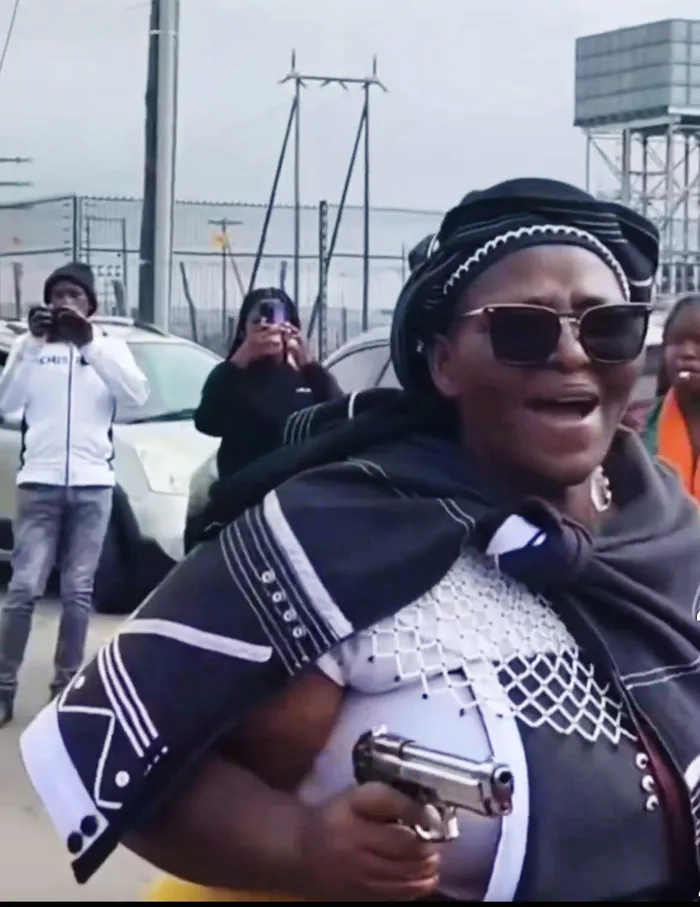
Bitou Deputy Executive Mayor Nokuzola Kolwapi is facing criminal charges and widespread condemnation after a video emerged appearing to show her discharging a firearm during a celebratory gathering in KwaNokuthula, Western Cape
Image: Screengrab/ X
In a fervent response to a viral video capturing her in a controversial celebration, Nokuzola Kolwapi, Deputy Executive Mayor of the Bitou Local Municipality and President of the Ikhwezi Political Movement (IPM), has denied allegations of discharging a firearm, asserting that she was merely holding a toy gun during her son's ulwaluko, a significant Xhosa initiation ceremony. The incident, however, has ignited heated political debates and scrutiny, with opposition parties calling for a thorough investigation.
The now-infamous video emerged on social media platforms, eliciting swift condemnations from members of the African National Congress (ANC). Moyisi Magalela, spokesperson for the ANC's Victor Molosi Region, expressed serious concern regarding Kolwapi's actions, regardless of the context, emphasising that public representatives must uphold the law and act responsibly. "The ANC calls on relevant law enforcement agencies to conduct an independent investigation into the authenticity of the video and the circumstances surrounding the incident," Magalela stated, urging accountability and adherence to legal standards.
Following the ANC's criticisms, Kolwapi released a statement clearly outlining her position on her social media channels. She denounced the attempts by political foes to leverage what she described as a personal and cultural moment to score political points. “It is unfortunate that this moment has been used to score political points by the ANC and bogus so-called local community leaders,” she remarked. Kolwapi further highlighted the cultural significance of the event, underlining that her actions were part of a celebratory tradition and not a threat to public safety.
Kolwapi's visionary remarks recognised the complexities of gender roles in both South African culture and politics. She articulated a deeper reflection on the societal implications of a woman visibly asserting her identity in a traditional ceremony, stating, “For generations, power, ritual authority, and public symbolism have been narrowly defined along patriarchal lines.” The Deputy Mayor asserted that her actions served as a declaration for the empowerment of women and the necessity for societal evolution. “This was a symbol of taking back our culture, taking back our identity and taking back our power,” she declared, reinforcing her commitment to advancing women's rights in a landscape marked by violence against women.
The DA, Kolwapi's coalition partner, also expressed its stance on the issue. Tertuis Simmers, DA leader in the Western Cape, confirmed that they do not condone the discharge of firearms in public and indicated that investigations are ongoing, with two cases filed with the South African Police Service (SAPS). Simmers stated, “We will await due process and will not comment further at this stage.”
The political fallout from the incident places both Kolwapi's leadership and the credibility of opposition parties under scrutiny, as calls for accountability and the necessity of responsible behaviour among public representatives remain paramount in the eyes of the constituents.
As South Africa grapples with pressing issues of gender inequality and public safety, this incident not only challenges the norms of political authority but also sparks pertinent conversations about the role of women in cultural spaces. Kolwapi’s unwavering stance aims to reshape the narrative, asserting that celebrations of culture can coexist with the pursuit of justice and respect for all individuals.