
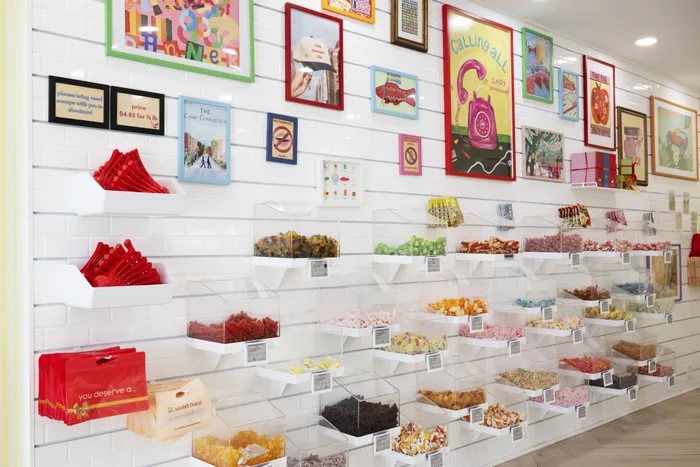
Many of these new candy stores use a pick-and-mix setup, including the Lil Sweet Treat location in D.C.’s Georgetown neighborhood.
Image: Marvin Joseph/The Washington Post
NORDIC candy was almost inescapable for Maddie Langlois.
Anytime she opened TikTok last year, she encountered sweets of all shapes and sizes from the New York shop BonBon. It had tiny strawberry squids, various types of sour fish, foam skulls, and raspberry puckers. Soon enough, other confectionery companies - including Swedish brand Bubs and the Los Angeles-based Sockerbit - began swarming social media. Nearly all of these candy enterprises sourced their sweets from Europe.
This was good news for Langlois, 26, who had long been self-conscious about preferring gummies to chocolate. “In my mind, gummy candy is immature,” said Langlois, who works as a publicist in Boston. “I felt like chocolate was more widely acceptable. So, when gummies were like popping off, I was like, ‘Oh, sweet, I need one of these stores near us, so I can go in and get all this gummy candy that I want to try.’”
She got her wish. This year, a handful of stores that stock Nordic candies opened in Boston, beginning in February with Madeleine’s Candy Shop. They’re part of a larger wave of boutique, social-media-friendly shops cropping up around the country off the back of the viral Swedish candy craze.
In 2024, Elly Ross opened a quaint West Village shop called Lil Sweet Treat, before rapidly adding six more locations in Manhattan, Boston, Philadelphia and (as of last month) D.C. Farther north, in Portland, Maine, Nikoline Ostergaard founded Sodt, alongside her mother and sister, after seeing that there was a market for treats from her native Denmark. In Utah, the two co-founders of a Swedish-inspired clothing brand brought some Nordic sweets to a pop-up event. Seeing the fervor that the candy caused, Malia Bradburn, Olive Redd and Greta Sunderlage decided to open So Swede in an extra office space.
These shops bring Nordic sweets into the neighborhoods of online candy connoisseurs. But inside the shops, the line blurs between the digital sphere and reality: With bright wallpapers, cute baggies and the pick-and-mix setups, these stores are playgrounds for those making TikTok videos and Instagram posts.
It’s that sleek, fancy feel that defines many of these shops, including Madeleine’s Candy Shop, which “feels like you’re at like a boutique clothing store or a boutique grocery store,” according to Marina Gearhart, 31, who first encountered Madeleine’s while looking for a specific elderflower fish candy from BonBon. “The wallpaper in there feels like a hotel. They really know what they’re doing.”
That emphasis on elevating candy culture comes from Scandinavia, where a weekly dose of candy for kids is as standard as recess. Leo Schaltz, one of BonBon’s co-founders, remembers biking to pick up sweets for lordagsgodis, a Swedish and Norwegian tradition where children eat candy only on Saturdays. “To a Swede, going to buy your candy on Saturday is the closest thing we have to a religious tradition,” he said.
Sweets shops are, of course, not exclusive to Europe. Across America, penny candy shops used to be well-represented at general stores and apothecaries, on boardwalks and in vacation towns. Often featuring specific, locally made treats, many of them began to close because of corporate consolidation or because the candy manufacturers moved overseas between the 1970s and ’90s, according to Sasha Zabar, who owns Glace Candy in Manhattan and whose family runs Zabar’s.
“A lot of the smaller-scale candy businesses became co-packers and manufacturers for nutraceuticals, like vitamin gummies and also THC-related stuff as well,” Zabar said. “There’s not a lot of companies that make candy anymore, especially in the U.S.”
These new European-inspired shops are just the latest in a long history of upscale sweet spots, according to Susan Benjamin, a candy historian and the founder of the True Treats store. In contrast to inexpensive, corner-store-type shops, Benjamin notes a long history of posh places selling bonbons and truffles or advertising French-style chocolates. Madeleine’s and Lil Sweet Treat are among the latest places to capitalize on Americans’ curiosity about European snacks.
“Even though they may not know it, they’re going back to the old model of candy being special, where you get a sample when you go in a candy store on a little silver plate and you try a little bit, or where it’s got special lighting,” Benjamin said. “It’s almost like a jewelry store, the way they used to do it.”
For the candy fans The Washington Post spoke to for this story, the polished look of these stores doesn’t hurt, but the thrill is around the novelty: different flavors, chewy textures and a freedom to buy whatever amount they want through the mix-and-match system. Christine Oh, a 36-year-old intensive care unit nurse who lives near Sodt in Maine, said it’s about trying something that she had previously seen only online.
“There’s definitely plenty to choose from, but it wasn’t too much,” Oh said about Sodt’s cozy space. “It was fun because everything was new. Of course, Bubs and Squashies I had seen from TikTok. But all the other options I really wasn’t familiar with.”
In these stores, sweets are presented as a conduit to the customer’s inner child. Schaltz said that he has a touch of Peter Pan syndrome, which is how BonBon came up with its tagline: “Growing up is a trap.” After all, it’s hard for customers to be upset about work or politics or parenting when they’re considering whether to purchase marshmallow squeezes or tart gummies.
Some of these shops don’t exclusively carry European candy. But a broader selection of treats brought Gearhart right back to her childhood when she first went to Madeleine’s. “Walking in there, seeing ones like sour Airhead belts - something that I remember having at summer camp when I was a kid - is really nostalgic,” she said.
The demand for higher-quality candy also helps. Several treat slingers noted that customers are intrigued by European health regulations, where ingredients such as titanium dioxide and potassium bromate, which can be found in some fruity candies, are banned. These stricter rules appeal to the MAHA-curious who stop into the stores.
“There’s something to be said about the health movement that’s happening in America on TikTok and social media,” said Bradburn, adding that the use of natural dyes and the lack of high-fructose corn syrup or red dye No. 40 in Nordic candies “has also played a part in people being intrigued by it.”
Nearly all of the shop owners The Post spoke with mentioned that, just after opening, they had to quickly place additional orders or close because they sold out of European candies. A few spots - Lil Sweet Treat, So Swede and BonBon - have plans to expand, while others are just trying to keep up with the demand of a single location.
“I don’t need to have 17 locations,” said Madeleine Brason, the founder of Madeleine’s Candy Shop. “I want to be that nostalgic neighborhood local store that hopefully has longevity.”
Integrating Madeleine’s into the surrounding community in Boston was always part of Brason’s plan. Otherwise, she fears, these candy stores might go the way of the frozen yogurt boom. Even if retail is struggling, the brick-and-mortar shops help candy become a place for people to connect, according to shop owners.
“It’s a lot harder to do that over e-commerce, because it’s a little bit more transactional,” said Ross, who worked in tech before founding Lil Sweet Treat. “There’s no way for two old best friends to meet up and make an activity of creating a candy bag.”
The remarkable staying power of those colorful Swedish candies was a shock to Madison Banks, 25, who thought “we would move on to maybe a different nationality or a different niche” by now. But hearing that So Swede was regularly selling out of sweets this summer, Banks decided to drop by the shop, where the continued success began to click.
“Everyone was in there, gathering around these jars of candy, talking about what they wanted.”