
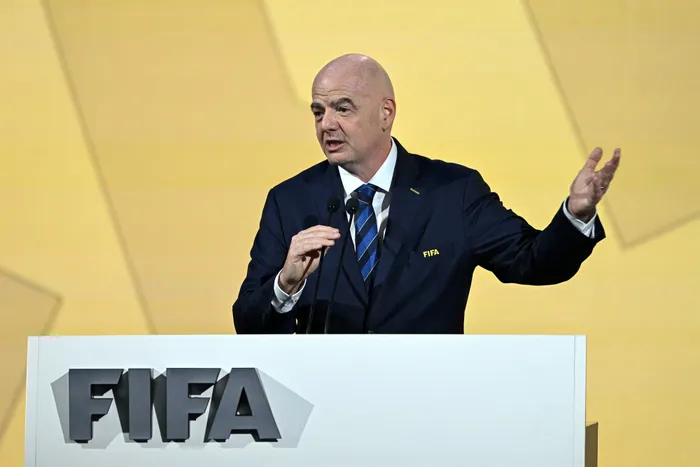
Speaking at the World Sports Summit in Dubai, FIFA President Gianni Infantino said the high demand for tickets shows the World Cup’s global popularity.
Image: Manan Vatsyayana / AFP / File
TICKET prices for the 2026 FIFA World Cup have triggered anger among supporters, but FIFA president Gianni Infantino says the revenue is critical to sustaining football across the globe.
Fan groups have slammed the cost of attending matches, prompting FIFA to introduce a lower-priced “Supporter Entry Tier” ticket at $60 (about R1,013) for every game. Despite this concession, many fans are still facing eye-watering prices — particularly for marquee fixtures.
The cheapest standard ticket for the final next year will cost $4,200 (around R70,443), a sharp jump from the previous tournament.
Steep prices for major matches
Tickets for high-profile games remain firmly out of reach for many. For the opening match against Mexico, Category Three tickets start at $1,020 (about R17,000), Category Two at $1,705 (R28,500), and Category One at $2,365 (R39,600).
Group-stage matches are more affordable. For example, tickets for a group fixture in Atlanta against South Korea are priced from $140 (around R2,345) in Category Three.
Prices rise significantly as the tournament progresses, with knockout rounds — especially the final — carrying the highest costs.
Infantino: revenue keeps football alive
Speaking at the World Sports Summit in Dubai, Infantino defended FIFA’s pricing strategy, saying the World Cup’s popularity justifies the demand.
“Without FIFA, there would be no football in 150 countries in the world,” he said. “There is football because, and thanks to, these revenues we generate with, and from, the World Cup, which we reinvest all over the world.”
Infantino pointed to unprecedented demand for tickets. FIFA has around six to seven million tickets available for the tournament, but received 150 million requests in the first 15 days alone — roughly 10 million requests per day.
He also placed the numbers in historical context. “In the almost 100 years of history of the World Cup, FIFA has sold 44 million tickets in total,” Infantino said. “So, in two weeks, we could have filled 300 years of World Cups. This is absolutely crazy.”
Funds reinvested globally
Infantino stressed that ticket revenue is used to support football development worldwide.
“What’s crucial is that the revenues that are generated from this are going back to the game all over the world,” he said.
The 2026 World Cup — the first to feature 48 teams — is already shaping up to be the most in-demand edition in the tournament’s history. According to FIFA, ticket requests have come from more than 200 countries and territories, with demand exceeding supply by a factor of 30.
Balancing access and income
In response to criticism, FIFA introduced the $60 Supporter Entry Tier for every match across the United States, Canada and Mexico. FIFA says the initiative is aimed at widening access for fans, even as overall ticket revenue remains a key pillar of the sport’s global funding model.
“This overwhelming response from passionate fans is a true representation of how our game is loved globally,” Infantino said. “We are going to make history in North America when we bring the world together like never before.”