
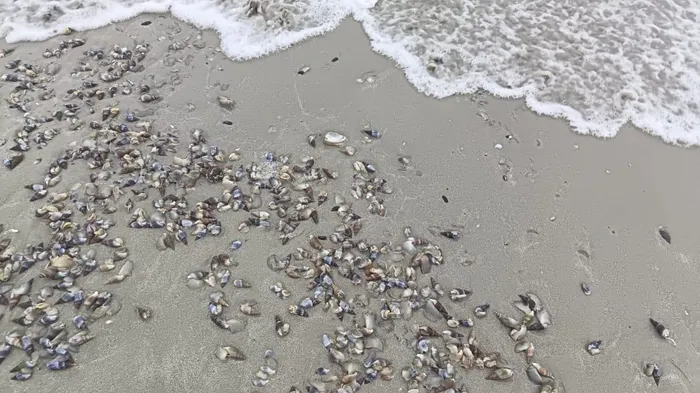
Authorities have warned the public not to collect or consume shellfish washed up along the West Coast after a red tide led to mass shellfish deaths, with toxic algae posing serious health risks.
Image: Supplied
MEMBERS of the public have been warned not to consume white mussels or any other shellfish found along parts of the West Coast after authorities confirmed the presence of a harmful algal bloom, commonly referred to as red tide.
The Department of Forestry, Fisheries and the Environment (DFFE) said large numbers of dead white mussels, whelks, and other shellfish have washed ashore at St Helena Bay and Elandsbaai over the past 48 hours.
According to the department, the condition of the shellfish indicates they were likely paralysed before dying, leaving them unable to burrow and more vulnerable to being dislodged and washed out by the sea. The mortalities are believed to be linked to a harmful algal bloom (HAB), which occurs when phytoplankton accumulate in high concentrations in coastal waters.
While red tides are a regular occurrence along the West Coast during the summer and autumn months, the DFFE said the current bloom is colourless and not visible to the naked eye. Despite this, it produces paralytic shellfish poisoning neurotoxins, which are extremely dangerous to humans.
“All shellfish, irrespective of whether they are washed up or collected from the shore or subtidal areas, should not be eaten,” the department said in a warning. The public has also been cautioned against consuming any washed-up marine animals, as they pose serious health risks and are not safe for human consumption.
The department said it would continue monitoring the situation to assess the extent of the algal bloom and the associated mass mortalities along the West Coast.
Harmful algal blooms have repeatedly affected the Western Cape coastline in recent years, with previous incidents posing risks to marine ecosystems and public health. Similar events have previously resulted in large numbers of dead marine animals washing up along the West Coast, prompting authorities to issue health warnings to residents and beachgoers.
In earlier incidents linked to red tide, swimmers were advised to stay out of the water in parts of Gordon’s Bay, while a major bloom along the West Coast was associated with a mass rock lobster walkout that left hundreds of thousands of crayfish stranded on beaches.
Authorities have again urged members of the public to heed official warnings and to avoid collecting or consuming shellfish or other marine animals from affected areas until they are declared safe.