
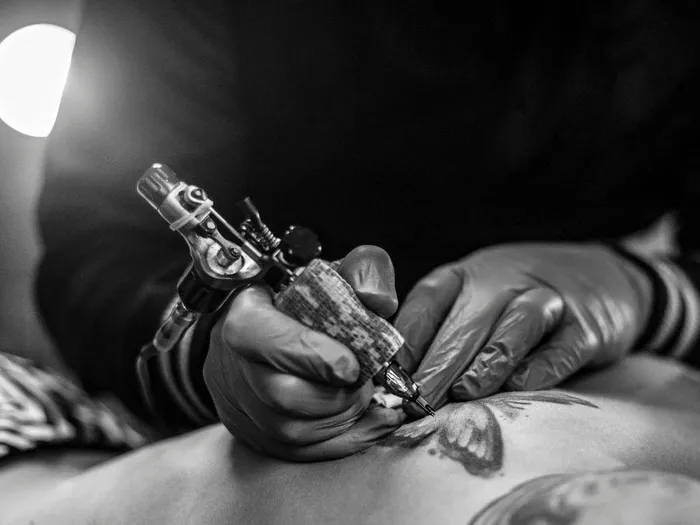
There is no code of conduct regulating tattoo artists or body piercing in South Africa.
Image: Files
THEY pierce, they inject, they carve your skin. And in South Africa, it’s perfectly legal.
Experts warn that body piercings can ruin your sex life and tattoos can spread disease. Yet, the industry is largely unregulated and anyone can open a shop.
Bradley Wilson, who started the Council for Piercing and Tattoo Professionals in 2010, says that with the unstoppable global craze for body art, regulation is urgently needed.
“You’re not drawing on the skin, you’re carving it,” he told the Independent on Saturday this week. “Think before you ink, some mistakes can’t be erased.”
Wilson says years ago he pushed for stricter controls but got nowhere. “Over many years, I wrote a policy or a white paper which just ended up in file 13, I would believe, with the government.”
He adds that without enforceable health and safety regulations, it’s up to clients and artists to take their chances. Municipalities have some rules, but these only affect registered businesses. “Because nobody’s regulating, they’re not signed up with anybody,” he says.
It also means that there’s little recourse for people with “buyer’s remorse,” those who don’t get what they paid for.
And then there’s the lack of ethics, he says, referring to a 14-year-old who got a tattoo.
“At that age you’re not really mentally strong enough to make those decisions for something for life. You can’t just buy a bottle of beer because they’re going to ask where’s your ID, are you 18? With tattoos it should be the same.”
Wilson says there are also concerns about the needles as well as the pigments used, and ethical body artists must do their research to get the best quality products.
“There’s an large number of manufacturers in the world making these things. I don’t know where they come from or how they are made. As an artist, you just get it from your supplier and you trust that it’s okay. But you have to do your homework. It’s about ethics.”
South Africa has thousands of tattoo artists but nobody knows the exact number. “I think the only way you would be able to find out something like that is to approach each health department. And they’re going to tell you who’s on their books, but you don’t know your guys that are not registered.”
The Council for Piercing and Tattoo Professionals believes that body artists should start as apprentices in an established studio, and also take courses in First Aid and blood pathogens. But again it cant be enforced, he says.
“If your client’s body goes into shock and you haven’t done a First Aid course, what are you going to do, call the fish and chip shop next door?” he asks.
He warns that with the growing interest in tattoos many people think that just because they can draw they can do tattoos but he disagrees. “Regulations are needed for tattoos, piercings, permanent makeup, and you can even go as far as saying your nail technicians as well, because when they push your cuticle, some of the cuticles are cut.”
Stringent regulations are even more needed for piercings because they are more invasive than tattoos.
“You can’t just go in blindly and do a piercing, you need to know what you are doing because it could lead to nerve damage and numbness. If you hit the nerve next to the eye, you could cause paralysis on the side of the face. If you’re piercing areas like the genitals, you’re going to hit nerves. You’re done,” says Wilson.
At one stage, he was asked to train members of the army on tattoo safety and also approached by the local government actually to educate their health inspectors about inspecting tattoo shops, brothels and other similar industries. But he was disappointed because after that, nothing happened and no national policy was introduced. “I thought that, you know, maybe we will get somewhere. But it just seems like there’s nobody in government really interested in that. You know, it’s one of those hard line things,” said Wilson.
Research by the World Health Organization shows how necessary it is to regulate the industry. According to the WHO, carcinogenic substances like metals, polycyclic aromatic hydrocarbons, and primary aromatic amines, have been frequently found in toxicological analyses of tattoo inks. “It is known that most of the tattoo pigments do not remain in the dermis after injection but are transported to adjacent lymph nodes and potentially to other organs,” it says.
It also warned that inks may contain ingredients not listed on packaging, and while allergic reactions are rare, these can occur months or even years later.
Foster Mohale from the National Department of Health this week confirmed that there are no national policies or regulations regarding tattoos and body piercings, but municipalities would have their own regulations.
Despite the dangers many people still get inked.
Judy Muller, a retired widow from Cape Town, always warned her children not to get tattoos. But after her husband died, she had his name engraved on her arm while on holiday in Durban. “For me, it was pain-free because the pain of missing him is worse. It gave me satisfaction to have his name tattooed on my arm, somehow my heart feels closer to him, and I feel happy, and I know he’s happy too. He didn’t like tattoos but having his name on my arm, I know he doesn’t mind, and he is smiling,” she said.
Mihlali Solani from Johannesburg has two faith-based tattoos, which he got four years apart while suffering depression. “They are a visual representation of what I have overcome. As young as I was, when I had my first tattoo, I did extensive research about the health risks associated with tattoos. The aftercare process was a lot easier because of how much information I had and the tattoo artist I chose. I have never experienced any complications with either one of my tattoos,” he said.
Murray Hewlett, the CEO of Affinity Health, has warned that there are several risks associated with tattoos.
“In the short term, there is a risk of infection, allergic reactions to ink, bleeding, bruising, and slow healing if proper hygiene and aftercare are not followed. Over the long term, some people may experience ongoing skin reactions, scarring or keloid formation, fading or distortion of the tattoo, and difficulty spotting skin changes such as new or changing moles.”
He said that some of the inks contained heavy metals like lead, nickel, or chromium. While links to serious illnesses like blood cancer aren’t confirmed, people with weak immune systems or chronic conditions are more likely to suffer complications.