
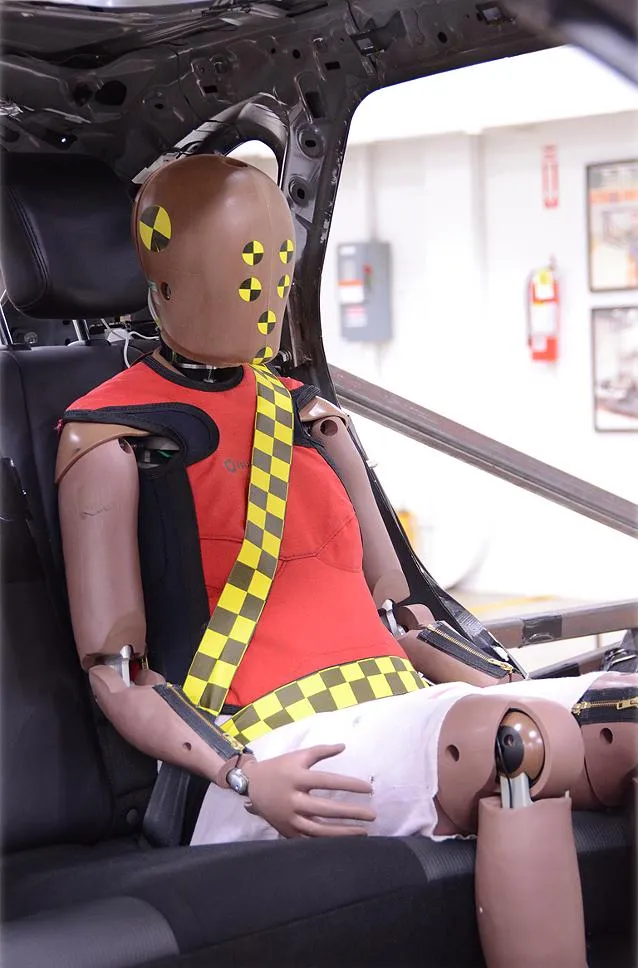
US officials have unveiled THOR-05F, the first female-specific crash test dummy. The pioneering dummy is aimed at revolutionising vehicle safety standards and addressing gender disparities on the road.
Image: National Highway Traffic Safety Administration
Bald, faceless and empirically lifelike, this dummy may not be much to look at.
But experts say it is a quantum leap forward in a decades-long effort to make cars safer for women.
In November, regulators unveiled THOR-05F - short for “Test device for Human Occupant Restraint, 5th-percentile Female” - the first crash test dummy specifically based on a woman’s body.
While car manufacturers and regulators have been testing for female crash impacts for 25 years, they’ve been using a test dummy that’s essentially a scaled-down version of the male. The THOR-05F’s movements are more humanlike and anatomically precise, with triple the number of body sensors. Developers say it will deliver more detailed data manufacturers need to address the specific risks women face, including greater chance of lower leg injuries or dying in a crash.
A new report released by the US National Highway Traffic Safety Administration last week underscored the risks women may face, suggesting that females see greater odds for injury in vehicle crashes than their male counterparts.
Federal officials are taking steps to address those risks: in a statement accompanying the report, NHTSA Administrator Jonathan Morrison said that President Donald Trump and Transportation Secretary Sean P. Duffy expedited approval of the female crash test dummy. “The administration did this because acknowledging the biological differences between men and women can save lives,” Morrison said.
Crash test dummies have helped make cars safer in recent decades, informing such features as air bags and seat belts. But building and testing them is expensive and time-consuming, and some industry players contend that virtual modeling and computer simulations would be more effective tools.
Safety advocates have been pressing for gender-specific crash test dummies for years. Previous studies found that women are 17% more likely than men to be killed in comparable crashes, according to the 2022 National Roadway Safety Strategy. They’re also 73% more likely to be seriously injured in frontal car crashes than men, researchers at the University of Virginia reported in 2019.
In a 2023 report, the Government Accountability Office said the lack of a representative slate of crash test dummies - including for women, older and heavier people - made it hard to test whether vehicle safety features are universally effective. It recommended NHTSA come up with a plan to address the information gaps.
NHTSA did so the next year, the report said. In addition to addressing demographic disparities in crash outcomes, the plan aims to leverage computer model simulations to supplement physical testing and develop a formal process for developing crash test dummies.
Women Drive Too co-chair Beth Brooke, whose group advocates for universal vehicle safety standards, said the new devices will provide researchers with data the older dummies lacked the ability to measure.
“Women deserve to know and trust that the tests and safety standards for the cars that they drive have used the latest technology that actually applies to their unique physiology,” she said. “Other parts of the world have shown that female traffic fatalities go down once the advanced technology is used.”
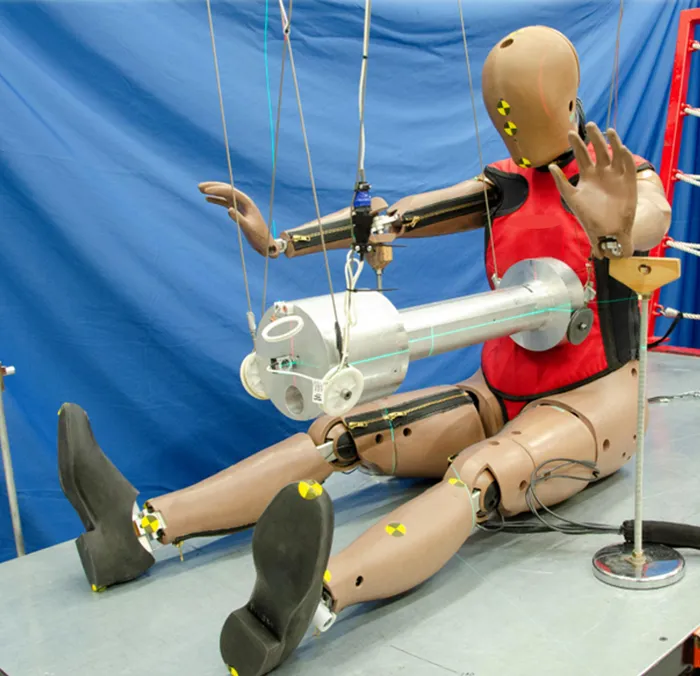
Safety officials say the THOR-05F will help regulators and carmakers better understand how crashes affect female passengers, ultimately saving lives.
Image: National Highway Traffic Safety Administration
NHTSA, which unveiled the test dummy in November, has begun incorporating it in its crash research and sharing its findings with manufacturers.
“After years of delays, our team has worked hard over the last eight months to finalise the details for this new, state-of-the-art female crash test dummy,” Duffy said at the time.
Still, under the current rulemaking process, it may take several years before THOR-05F is formally adopted for use in vehicle safety testing. The process for requiring carmakers to use a male version of the THOR in testing, which began in 2023, is still ongoing. The federal rulemaking process can take years because it can require extensive data analysis, review and public comment.
The THOR-05F’s spine is more humanlike and flexible than its predecessors. The 4-foot-11, 108-pound model is equipped with 150 sensors capable of measuring the impact of a crash on parts of the body such as the arms, thighs, shins, knees and ankles that earlier versions could not.
“This is the first time in our lifetime that we now have body sensors on dummies for where women get hurt the most,” said former congresswoman Susan Molinari (R-New York), co-chair of Women Drive Too.
While the number of US fatalities has fallen since the 2021 peak of 43,200, the current level is 20% higher than a decade ago. More than 39,345 people died in motor vehicle crashes in 2024, government data shows, a 3.8% decline from the previous year.
The current versions of crash test dummies have been in use for more than 40 years. General Motors developed a test dummy known as the Hybrid I in 1971 for use in safety testing. In the 1980s and 1990s, NHTSA used a pair of dummies named Vince and Larry, as part of public service campaign to promote seat belt use. (The pair are now housed at the Smithsonian’s National Museum of American History.)
Each THOR-05F - which Chris O’Connor, CEO of manufacturer Humanetics, said can be used for more than 20 years - comes with an estimated price tag of $1 million (R16.4 million).
But some groups - including the Insurance Institute for Highway Safety, an independent, nonprofit educational organisation supported by the insurance industry - contend that crash test dummies are not the most effective research approach.
“While we still see a gap in injury risk between men and women for the lower extremities, we don’t think a crash test dummy is the best tool to help push improvements further in this area,” the group said in an email. “Instead, making use of virtual testing allows us to understand how vehicles are protecting a diverse range of occupants, regardless of size, age, and sex.”
In a June letter to NHTSA, the head of a manufacturers' trade group said it’s not clear whether the new female test dummies would offer benefits over the current ones.
Though the agency’s efforts to evaluate test dummies are important, these devices are still in development and have yet to provide clear improvements in crash safety, said John Bozzella, CEO of the Alliance for Automotive Innovation. “This is primarily due to limitations in their ability to predict real-world injury risks.”
Even so, the issue has drawn attention on Capitol Hill, where Sen. Deb Fischer (R-Nebraska) introduced the “She Drives Act,” which would accelerate efforts to incorporate the new dummy in testing.
The bill would update crashworthiness testing protocols under NHTSA’s Federal Motor Vehicle Safety Standards, introducing specific tests for female occupants in both the front and rear seats.