
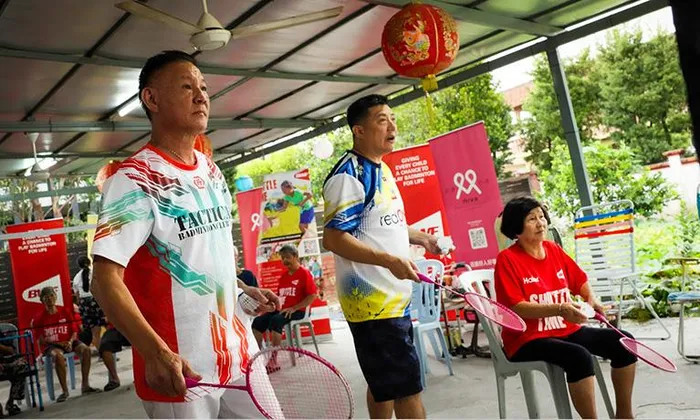
Adults take part in Coventry University's groundbreaking badminton initiative, which is transforming the lives of seniors globally, promoting health, social connection, and community engagement.
Image: Supplied
In an innovative stride towards enhancing the lives of older adults worldwide, Coventry University has partnered with the Badminton World Federation (BWF) to pioneer the Shuttle Time for Seniors programme. This initiative aims to bolster health, mobility, and social connectivity among the elderly, proving that it is never too late to stay active and engaged.
The Shuttle Time for Seniors programme is a carefully adapted version of the existing Shuttle Time initiative that has successfully engaged children and young people globally. Through rigorous testing and refinement, researchers at Coventry University have tailored the programme specifically for an elder demographic, a move that is already showing promising results in countries like Malaysia, Singapore, and South Africa.
Professor Mike Duncan, the centre director for Coventry University’s Research Centre for Physical Activity, Sport and Exercise Sciences (PASES), emphasised the holistic benefits of the programme. “At its core, this initiative is about maintaining movement skills to keep individuals independent and active for life. But it’s also about fostering community,” he said. “People come for badminton, but they return for the sense of belonging.”
Research indicates that participating in racket sports such as badminton is particularly beneficial for older adults. These activities combine multi-directional movement and cognitive engagement while ensuring a low risk of injury. Moreover, they stimulate bone, joint, and muscle health, making badminton a good choice for maintaining physical well-being.
Launched internationally, the Shuttle Time for Seniors programme not only incorporates age-appropriate badminton-based activities but also focuses on balance, co-ordination, cognitive engagement, and crucial social interaction. These components are vital for developing a supportive network for participants, encouraging them to engage with each other in both physical activities and meaningful conversations.
In highlighting the programme's unique approach, Professor Duncan explained, “This isn’t about pushing people through an exercise routine. It’s about moving at your own pace, together as a group. The socialising — whether it’s over a cup of tea or coffee — carries just as much weight as the physical activity itself. Physical activity is one of the strongest predictors of longevity and good health. But if people lose confidence in their ability to move, they withdraw. Our initiative aims to restore that confidence on physical, social, and psychological levels.”
Dr Jason Tallis, the principal investigator from PASES, conveyed the importance of the programme in breaking down barriers to participation in physical activity. “Sport, notably badminton, has the potential to significantly promote the physical and mental well-being of older adults,” he stated. “However, there are several obstacles to participation that we need to address. Through our partnership with the BWF, we aim to tackle these challenges, demonstrating that Shuttle Time for Seniors can be a vital tool for enhancing health and wellbeing.”
Sahir Edoo, Head of Development Projects at the BWF, echoed this sentiment, noting that the Shuttle Time initiative aligns perfectly with the BWF's philosophy of using badminton as a positive force in society. “This collaboration with Coventry University is essential for extending our vision to older adults. By applying our global Shuttle Time framework to seniors, we reinforce our promise that badminton is accessible for everyone, fostering community enrichment across all ages.”
With ongoing pilot studies and plans for global expansion, the Shuttle Time for Seniors programme represents a significant leap forward in using sport as a vehicle for health promotion and community engagement among older adults. It is clear that badminton is more than just a game; it is a crucial part of the solution for healthier, happier aging worldwide.
IOS