
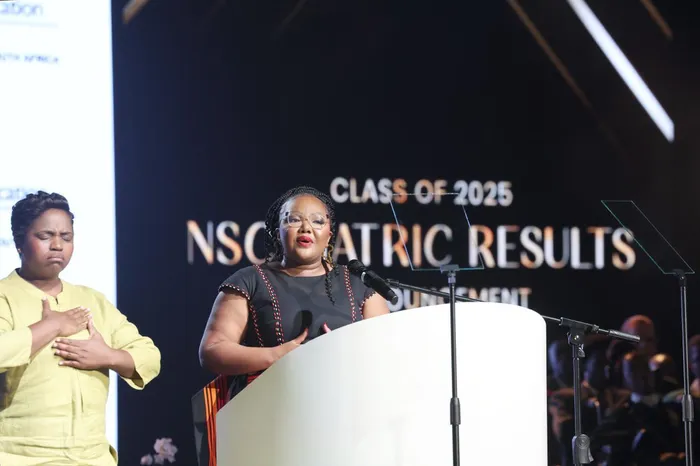
Basic Education Minister Siviwe Gwarube releases the 2025 matric results.
Image: GCIS
THE euphoria following one of the country’s best-ever matric pass rates has been tempered by the harsh reality that high marks do not guarantee a place at university. As the 2026 academic year looms, tens of thousands risk unemployment unless they explore alternative career and study pathways.
Across the country, universities face overwhelming demand as tens of thousands of first-time applicants hope to get in. The University of KwaZulu-Natal (UKZN) received 326 546 applications for 9 000 first-year places. UCT received 102 182 applications for 4 000 places, while UWC received more than 177 000 applications for just 4 715 places. The University of Johannesburg (UJ) processed 450,000 applications for its first-year intake of 11,200 students, while Wits University received 160,000 applications for about 5,800 places.
Similar pressures are evident at the Cape Peninsula University of Technology (CPUT) and North-West University (NWU).
“It's going to be absolutely catastrophic,” said Professor Wayne Hugo of UKZN. “Universities aren't getting enough funding to keep pace with the growth in bachelor passes and the demand for students to access university.”
Hugo said NSFAS also cannot fund everyone and blamed the crisis on government underfunding. He encouraged matriculants to focus on technical and vocational qualifications as well as non-traditional forms of education. “Huge organisations like Vodacom, Google, Facebook, and Gemini all offer free courses that give you globally recognised qualifications,” said Hugo. “The other option is TVET colleges, where students can simultaneously work and acquire skills.”
“What it means is that your chances of finding a job, if you get that kind of qualification, are starting to rise - especially because many university subjects can now be done by AI. If you're a lawyer, you can just load the case into AI and it’ll give you an answer. But if you're a plumber, you need a person to go fix the toilet,” he added.
Last year, more than 900 000 learners wrote matric, achieving a national pass rate of 88%, one of the best in the country’s history. Despite the success, many still do not know what the future holds as they wait for feedback from universities.
One matriculant told the Independent on Saturday that she didn’t understand the current placement crisis. “We worked so hard to do well. But getting a good pass rate was actually bad for those who want to study further. We just can't win.”
Drawing from his experience as a student leader, Mathabatha Malete said uncertainty is one of the most pressing challenges facing matriculants. “Many are still waiting for university offers and funding decisions without clear communication, which creates anxiety, self-doubt, and fear about the future, given South Africa’s socio-economic inequality.”
Malete, who works with the Destiny Achieve Foundation (DAF), said it is especially stressful for learners from under-resourced backgrounds. “…A single acceptance or funding outcome can determine whether they study or stay home, which takes a real emotional and mental toll on them.”
Momentum Group Youth Employment Specialist Nkosinathi Mahlangu warned that celebrating matric results without addressing what follows can be risky. He said access to tertiary education remains constrained by funding limitations, space shortages, and learning gaps, which also takes an emotional toll on families who often see university as the only route to success after school.
“What is less discussed is that university is not the only viable post-matric pathway. Many learners remain unaware of alternatives such as TVET colleges, accredited private institutions, and online learning platforms that offer job-ready, in-demand skills. These options are often overlooked or misunderstood, despite being aligned with key economic sectors and, in many cases, provided by registered non-profit training organisations with accredited programmes.”
Without decisive action, Mahlangu warned, the Class of 2025 risks being remembered not for its achievement but as another missed opportunity, questioning whether society will invest in young people now or “only count them once opportunity has already passed.”
Dorcas Dube-Londt, National Marketing and Communications Manager at Citizen Leader Lab, said the digital economy offers opportunities that previous generations did not have. Coding boot camps, graphic design, video editing, data and IT support systems, and content creation are some of the avenues learners can explore.
“Although we are in the fourth industrial revolution, most parents just want their children to go to university to study engineering, medicine, or accounting. No one says, ‘I want my child to be a content creator,’ but most content creators earn more than people working eight-to-five jobs,” she said.
Dr Memuna Williams, founder of Empowering Sustainable Change, said according to Statistics SA, 40% of youth aged 15–24 are not in employment, education, or training. “You’re among the best-educated on the continent. You’re the most digitally connected. You’re graduating at a time when global conversations at the UN and Davos centre on skills you can build: critical thinking, adaptability, collaboration across differences,” said Williams.
She encouraged young people to explore multiple pathways such as building online businesses, apprenticeships, and updating their social media profiles with new skills so potential employers and scholarship committees can see them. “Thirty years ago, transformation created opportunities for those who moved quickly. Cyril Ramaphosa and Patrice Motsepe built empires. Today, Siya Kolisi represents what’s possible when systemic barriers in a single sector finally shift. The question for South Africa's private sector, funders, and policymakers: What are you transforming right now that will create the same momentum for this generation of matriculants?”
Leon Smalberger, CEO of the Academic Institute of Excellence (AIE), said South Africa urgently needs a more diversified, skills-focused post-school system that places equal value on vocational, technical, and hybrid learning pathways alongside traditional degrees. “South Africa’s learners are more than capable, with immense potential that consistently goes unrealised due to a persistent systemic mismatch at the post-school level,” he said.
“Our system is failing students by limiting capacity and not supporting them effectively through to completion. We need to question whether institutions are structurally equipped to take students from enrolment to qualification sustainably, and whether students are being equipped with the right skills for successful futures.”
Smalberger added that post-school challenges cannot be solved through university expansion alone, pointing to global trends favouring specialised, skills-based qualifications such as diplomas, higher certificates, and occupational programmes in engineering, technology, data, design, and applied trades.
He urged matriculants and parents to resist panic-driven decisions and to explore all accredited post-school options carefully. “Check whether your institution is registered with the Department of Higher Education and Training, and whether its programmes are accredited by the Council on Higher Education and aligned to the National Qualifications Framework. This ensures your qualification remains relevant for the future.”
The Department of Basic Education and the National Youth Development Agency did not respond to questions.