
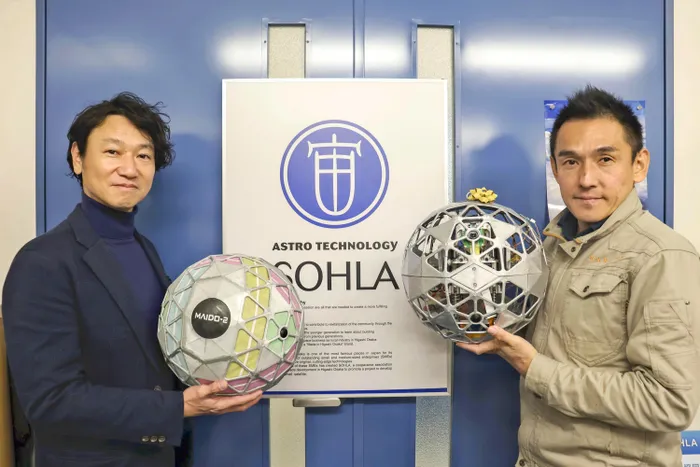
Yasuhisa Tomita, left, and Munenaga Yoda hold prototypes of the Maido 2 lunar exploration robot in Japan's Higashiosaka, Osaka Prefecture.
Image: The Japan News
A group of small and midsize companies based in Higashiosaka, Osaka Prefecture, is crowdfunding the development of a lunar exploration robot, with the aim of launching the device by around 2030.
The group, named Sohla, is an organization comprising businesses based in the renowned manufacturing city. In 2009, Sohla successfully launched a small satellite called the "Maido 1." It hopes that sending the "Maido 2" to the moon will prove once again that even small enterprises "can aim to reach space."
Sohla was established in 2002 and has expanded to include companies based outside Osaka Prefecture. The Maido 2, a spherical robot, will collect data while hopping along the moon's surface. The robot's leg structure uses springs made from a shape-memory alloy that returns to its original form when heated.
A prototype exhibited at the 2025 Osaka-Kansai Expo drew considerable attention.
"We got a positive reaction, with many Expo visitors telling us our robot was amazing," said Munenaga Yoda, a representative of Higashiosaka-based mechanical design firm Karakuri, Inc., which is involved in developing the jump mechanism and a Sohla member. "That really spurred us on."
Companies reportedly reached out after the exhibition, keen to lend a hand in developing the robot.
Sohla is running a crowdfunding campaign until the end of this month to help cover the costs of conducting trials in an environment similar to what the Maido 2 will encounter in space. As of 9 a.m. Tuesday, the group had raised about 1.68 million yen, almost half of its 4 million yen target. Sohla has prepared thank-you gifts for donors, such as full-scale models of the Maido 2.
The Maido 1, which launched from the Tanegashima Space Center in Kagoshima Prefecture, completed tasks such as monitoring lightning and taking photos of Earth. The project inspired people across Japan, showing that even small and midsize enterprises can set their sights on space-related projects.
The satellite has completed its mission and is now orbiting Earth while gradually losing altitude. It is expected to plunge into Earth's atmosphere in 20 to 40 years and burn up.
Yasuhisa Tomita, an official at Sohla, said, “We want to make the Maido 2 project a success and prove to many people that Japanese technologies are incredible.”