
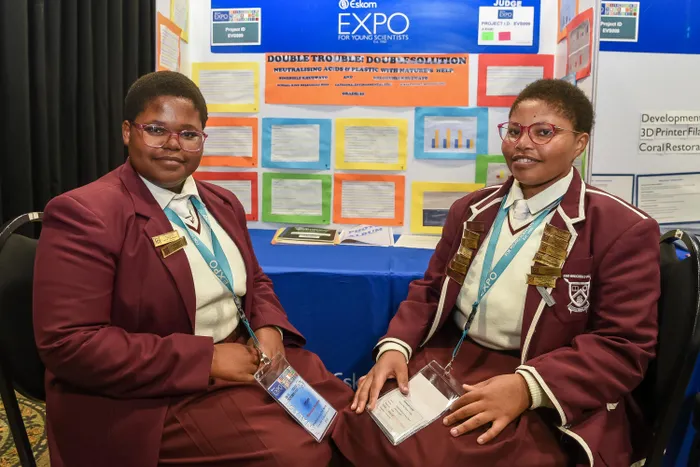
Melokuhle Khuzwayo and Simesihle Khuzwayo from King Bhekuzulu High School in Nongoma have been selected to represent South Africa at the Initiative for Research and Innovation in STEM (IRIS) Global Symposium in India. They will present their study, which found that banana peel and yeast extracts can reduce water acidity and remove microplastics as effectively or better than traditional chemical treatments.
Image: Supplied
Four of South Africa’s most promising young scientists are gearing up to represent the country at the Initiative for Research and Innovation in STEM (IRIS) Global Symposium, scheduled to take place in India from January 27 to 31. These budding researchers, who all excelled at last October's Eskom Expo for Young Scientists International Science Fair, will present groundbreaking projects that address pressing environmental issues and enhance accessibility for the visually impaired.
The esteemed delegation, under the leadership of Dr Krishnie Naidoo, the Eskom Expo Academic Director, is poised to showcase innovations that not only highlight South Africa’s scientific talent but potentially hold solutions for global challenges.
The selected pupils, each presenting unique projects, are making strides in various fields of science:
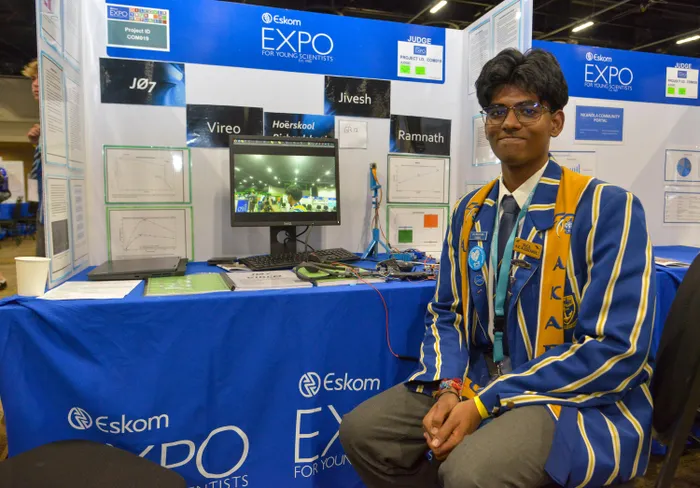
Jivesh Ramnath from Hoërskool Richardsbaai in Richards Bay will present a low-cost AI-powered navigation device for the blind and visually impaired.
Image: Supplied
Mologadi Motshele, Acting Chief Executive Officer of the Eskom Development Foundation, expressed pride in supporting the next generation of innovators. She stated, “Investing in young scientists strengthens South Africa’s future, developing leaders who will drive technological advancement, sustainability, and social impact on both a national and global scale. We wish our pupils all the best as they take South Africa’s scientific talent to the world stage.”
The Eskom Expo continues to be a vital platform for pupils in Grades 4–12 and Technical and Vocational Education and Training (TVET) colleges. Those interested in participating can register their projects at www.exposcience.co.za.
IOS