
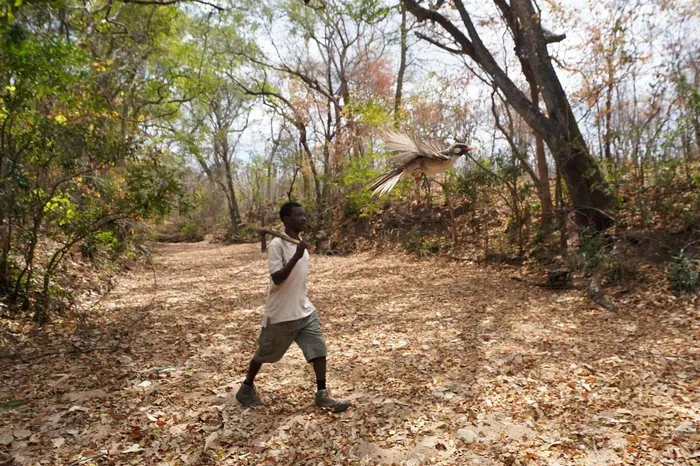
Carvalho Nanguar, Yao honey-hunter from northern Mozambique, with a male greater honeyguide released from the hand after being caught for research purposes.
Image: David Lloyd-Jones and Dominic Cram
In a groundbreaking study, researchers from the University of Cape Town (UCT), in collaboration with international partners, have uncovered a fascinating aspect of human-animal communication. The study, published in the journal People and Nature, reveals that honey-hunters in northern Mozambique employ regionally distinct “dialects” when communicating with honeyguide birds — an insight that mirrors the diversification found in human languages.
The research has illuminated the intricate relationship between local communities and the wild birds, known scientifically as Indicator indicator, which play a crucial role in the hunt for honey. This unique partnership allows honey-hunters to extract honey from wild bee nests, while honeyguides benefit by feasting on leftover wax and larvae.
In various regions across sub-Saharan Africa, honey-hunters and honeyguides engage in a co-operative endeavour that exemplifies one of the few documented cases of interspecies co-operation. Using distinct vocalisations, honey-hunters can lure honeyguides to assist them in locating bees’ nests without any domestication or training of the birds. Instead, honeyguides interpret the unique signals of their human counterparts, showcasing an extraordinary form of mutualistic reliance.
“While honey-hunters in different parts of Africa are known to have culturally distinct calls to honeyguides, we wanted to see whether calls also vary between neighbouring communities and follow predictable patterns,” explained lead author Jessica van der Wal, a researcher associated with UCT’s FitzPatrick Institute of African Ornithology.
To investigate this phenomenon, the team recorded calls from 131 honey-hunters across 13 villages in the Niassa Special Reserve. Focused primarily on the Yao community, the researchers explored both recruitment calls used to attract honeyguides from a distance and quieter co-ordination calls employed while trailing a guiding honeyguide at close range. The analysis revealed that honey-hunters used a variety of calls, trills, grunts, whoops, and whistles, showcasing a stark regional variation that increased with distance. Notably, environmental factors such as habitat acoustics could not account for these differences, indicating that cultural processes were at play.
“These regional honey-hunting calls pattern across space in a way that looks remarkably similar to human dialects,” van der Wal noted. “It suggests that cultural processes within human communities, rather than environmental pressures, are the primary drivers of this diversity.”
Further findings suggest that honeyguides also appear to adapt and learn local dialects. Despite the apparent differences in calls, the collaboration remains effective, underscoring the resilience of this ancient partnership in the search for honey.
“This suggests that both species are adjusting to each other across the Niassa landscape,” commented senior author Professor Claire Spottiswoode. She leads the Honeyguide Research Project at UCT. “Humans learn and maintain the local signals needed to co-operate with honeyguides, and honeyguides are in turn probably learning and reinforcing these local human dialects, much like they learn larger-scale variation in human signals across Africa.”
This research not only provides compelling insights into interspecies communication but also highlights how human cultural diversity shapes wildlife interactions. “It’s been a privilege to study this rare example of co-operation between our own species and free-living wild animals, in collaboration with Niassa’s honey-hunting communities,” Spottiswoode concluded. “In so doing, we gain a profound understanding of the evolution of communication between species.”
IOS