

An artist's impression of the WOH G64 system composed of a red supergiant (at left, in orange) and a smaller hot star (at right, in blue). New observations with the the Southern African Large Telescope (SALT) suggest that the hot star may be causing the atmosphere of the red supergiant to spread out.
Image: Jacco van Loon
Astronomers at the Southern African Large Telescope (SALT) have made a groundbreaking discovery, reassuring the scientific community that one of the universe's most extreme stars, WOH G64, is very much alive and remains a red supergiant. This revelation comes in the wake of significant fading observed over the past decade, which led many to speculate that WOH G64 was undergoing a radical transformation or nearing the end of its life cycle.
Located in the Large Magellanic Cloud (LMC) — a satellite galaxy of the Milky Way — WOH G64 has long stood out as the most luminous, coolest, and one of the dustiest red supergiant stars known to humanity. Historically, massive stars like WOH G64 are destined to end their lives in spectacular core-collapse supernova explosions. Yet, in this case, the star's behaviour took a notable shift; its brightness diminished considerably, pulsations were suppressed, and its spectral emissions were dominated by ionised gas, raising alarms among astronomers about its evolutionary destiny.
The intrigue deepened in 2024 when a new dust cloud obscured the star, leading to theories that WOH G64 might have evolved into a yellow hypergiant — a brief, transitional phase preceding a supernova — revealing a previously hidden hot companion star. In a bid to uncover the truth, a dedicated team led by Dr Jacco van Loon from Keele University, UK, and Dr Keiichi Ohnaka from Universidad Andrés Bello in Chile turned to SALT, situated in Sutherland, Northern Cape, at the South African Astronomical Observatory.

The red portion of the SALT spectrum of WOH G64, plotted here, shows emission lines (in blue) from atoms caused by the hot star, but also absorption dips (in red) from TiO molecules in the extended atmosphere of the red supergiant. The system is enveloped in a shroud of dust that formed in the red supergiant wind and that makes it more difficult to see the stars themselves. The absorption dip (in green) from oxygen molecules is caused by the Earth's atmosphere through which we look out into space.
Image: Supplied
Using the Robert Stobie Spectrograph (RSS) between November 2024 and December 2025, the researchers acquired comprehensive optical spectra of the fading star system. “WOH G64 has been claimed to have turned into a yellow hypergiant, which could signal a pre-supernova post-red supergiant evolution,” noted Dr. van Loon. “However, our new spectra obtained with SALT show not only the presence of a hot companion star but also clear molecular absorption bands from Titanium Oxide (TiO). This implies that WOH G64 is currently a red supergiant and may never have ceased to be.”
The detection of these TiO molecules serves as a "smoking gun" confirming the star's classification as a red supergiant, refuting any previous notions of its demise. Instead, the researchers propose a new scenario that involves binary star interaction. The analysis suggests that the fainter, hot companion star (Component B) is affecting the red supergiant (Component A), causing strains in its previously extended atmosphere. This interaction is believed to have influenced the significant mass loss observed and the formation of the dust cloud that partially obscured the star's light. Concurrently, the gravitational pull of the companion star allows it to ionise the surrounding gas.
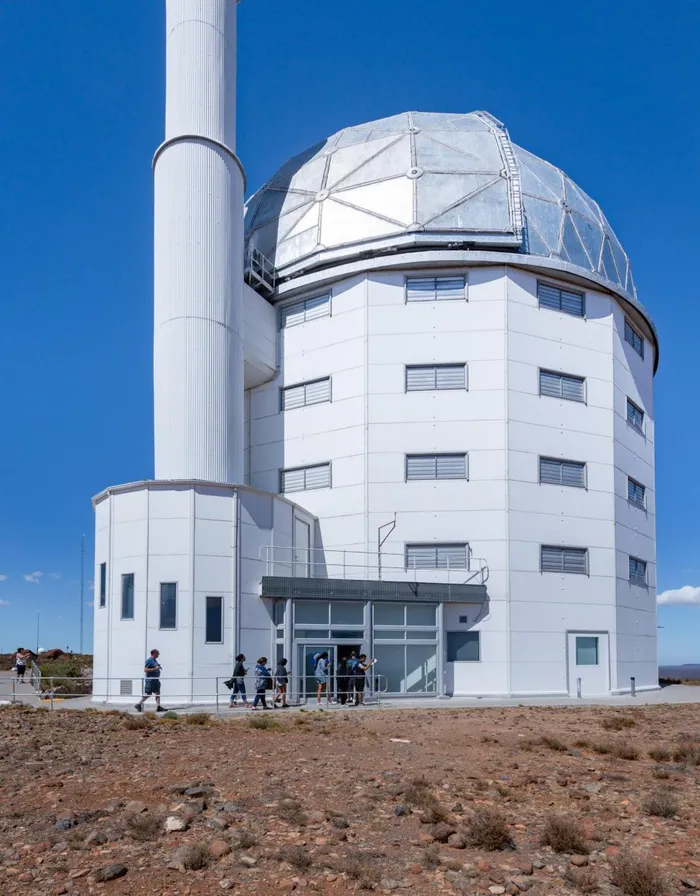
The Southern African Large Telescope (SALT), Africa's largest optical telescope.
Image: Supplied
“We are essentially witnessing a ‘phoenix’ rising from the ashes,” Dr. van Loon remarked, highlighting the enduring nature of WOH G64 amidst this cosmic turmoil. The atmosphere of the red supergiant is flexibly responding to the proximity of its companion, demonstrating that it has not been completely stripped of its stellar identity.
This remarkable discovery not only clarifies the fate of WOH G64 but also underscores the importance of long-term observation with large-aperture instruments like SALT in demystifying the final evolutionary stages of massive stars. The findings, articulated in the paper titled A phoenix rises from the ashes: WOH G64 is still a red supergiant, for now, will be published in the Monthly Notices of the Royal Astronomical Society (MNRAS), contributing significantly to our understanding of stellar life cycles.
IOS