
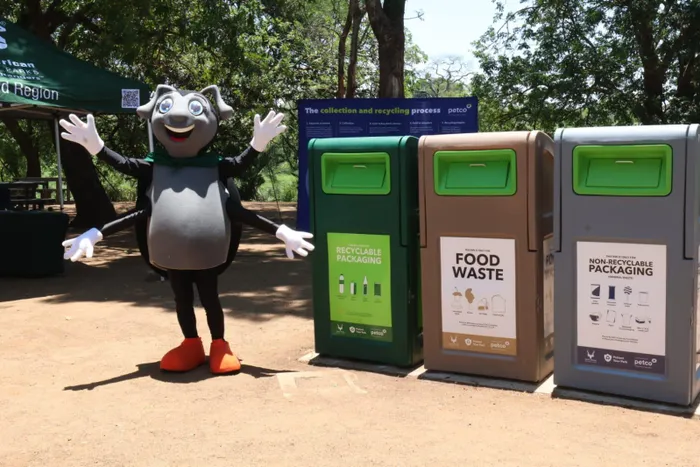
Mascot Dungwani is excited to show visitors to the Tshokwane picnic site in the southern Kruger National Park how to separate their food and packaging waste in a way that’s kind to the environment, thanks to a new three-bin system introduced by SANParks and producer responsibility organisation Petco.
Image: Supplied
In a significant environmental initiative, authorities at the Kruger National Park — one of South Africa's premier tourist destinations — are optimistic that a new recycling pilot project will divert tons of waste from landfills, turning it into a valuable part of the country’s circular economy. This collaborative effort, involving SANParks and Petco, aims to create a sustainable waste management system that not only benefits the park, but also enhances the overall experience for its millions of visitors.
The pilot project, recently launched at the bustling Tshokwane picnic site near Skukuza in the southern Marula region, features an innovative three-bin recycling system that is both user-friendly and animal-proof. Over the busy festive season, Tshokwane sold over 43,000 food and beverage items, resulting in the recovery of more than half a ton of recyclable packaging, thanks to this new initiative.
“Day visitors make up over 70% of the gate traffic at Kruger National Park, often using picnic sites during their travels,” explained Dr Danny Govender, SANParks’ general manager for sustainable development and management. “This makes these sites crucial for enhancing waste management across the park.”
The new colour-coded bins — green for recyclables, grey for non-recyclables, and brown for compostables like food waste — are designed to facilitate proper waste separation for visitors. Prior to this initiative, waste was manually sorted at 10 different sites, leading to contamination and inefficient recovery of materials.
“Establishing robust separation-at-source partnerships with organisations like Petco is essential for ensuring that valuable resources can be recycled back into the economy,” Govender said.
Telly Chauke, CEO of Petco, echoed the sentiments of sustainability, noting that the Kruger National Park is a vital natural asset for South Africa. “Supporting the park in its mission to enhance waste management is critical. Involving the public in separating waste at the source will ensure that recyclables remain uncontaminated, thus holding a higher value for collectors and recyclers alike.” Chauke expressed pride in contributing to a practical, scalable long-term solution aligned with SANParks’ commitment to a circular economy.
Under South Africa's legislative framework, producers are responsible for their packaging materials even after they have been consumed. “Our role is to guarantee that the packaging materials put onto the market by our members — who include major retailers and brand owners — are collected for recycling,” Chauke elaborated.
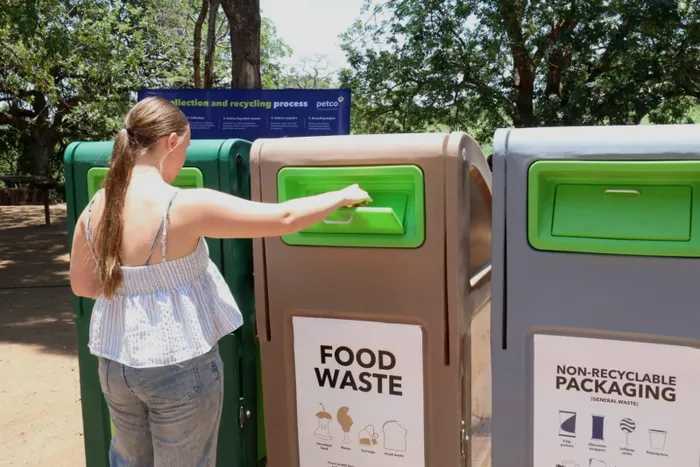
A woman tries out the new three-bin recycling system introduced by SANParks and Petco at the Tshokwane picnic site in the southern region of the Kruger National Park. The bins are colour-coded for ease of use – recyclable packaging into the green bins, non-recyclable waste into the grey bins, and compostable materials into the brown bins.
Image: Supplied
To implement the project, Petco partnered with Pioneer Plastics to refine a baboon-proof bin system capable of enduring the demanding environment of the park. Gary Wiid, Marketing Director at Pioneer Plastics, reported that the large 240-litre bins are securely mounted on concrete slabs, designed to withstand potential tampering by scavengers such as hyenas and honey badgers.
“These bins are made from durable LLDPE plastic, offering UV and impact resistance, and long-term stability under harsh sun conditions,” added Wiid.
Furthering this initiative, Tourvest, a long-standing concession partner with SANParks, emphasised the importance of the recycling and waste management effort. Henry Daschner, regional operations manager at Tourvest, said, “These projects are crucial for minimising environmental impact, preserving ecosystems, and ensuring sustainability for the future.” He expressed enthusiasm about using data gathered from the initiative to inform future commercial practices within the park.
Looking ahead, the recycling project is set to be expanded to additional sites, including Nkuhlu, which overlooks the scenic Sabie River, and Afsaal, which is operated by Tindlovu further south towards Malelane gate.
IOS