
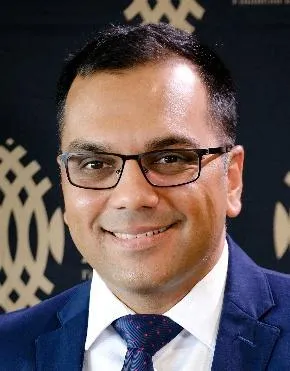
Finance guru Yusuf Bodiat has penned a book on what South Africa needs to do to improve its finances.
Image: Supplied
FINANCE Minister Enoch Godongwana will have to pull a rabbit out of his hat when he delivers the 2026 budget later this month. Plagued by theft, corruption and decades of mismanagement, many South Africans feel it will be impossible to reverse the country’s precarious financial position.
However, finance guru Yusuf Bodiat disagrees. The Chartered Accountant, certified director and CFO argues that things can improve, and details his plan in his new book, The Bottom Line: A CFO’s Blueprint for South Africa’s Turnaround.
“The entire budget needs to be flipped upside down. It’s about where we want to be in 5, 10, 20 years, not just next year,” Bodiat told the Independent on Saturday.
The book frames South Africa as a company in crisis. The president is the CEO, ministers form the executive team, parliament is the board, and the Finance Minister should not only balance the books but also drive strategic investment and long-term sustainability.
Bodiat stresses that South Africa needs long-term strategies, not political-cycle budgets. “If we fix a five-year-old today, we will only see the results in 20 years.” He believes that while the country has the talent to succeed, the wrong people are often in critical positions — mainly due to cadre deployment rather than expertise. And private-public partnerships will be key to the country’s success.
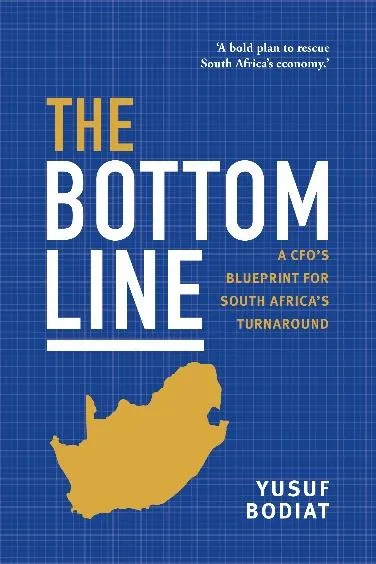
The book cover.
Image: Supplied
“A lot of decision-makers are politicians… sometimes you need a partnership between people who understand politics and people who understand business and industry to make decisions collectively.”
And while South Africa has the requisite skill set to improve its economy, the wrong people are often placed in positions to which they are not suited, often due to cadre deployment.
“You wouldn’t put someone who’s never flown a plane in charge of an airline; why do we do that in government?” he says.
To rebuild the economy, Bodiat proposes five “levers” — the same principles used by successful organisations:
In the book, he stresses that each lever must work in harmony, as ignoring one will weaken the rest.
“When companies present budgets, the numbers are always second. The first part is reviewing last year and defining a vision forward. Government should do the same,” he says.
Trust, though fragile, is rebuildable and key to transformation — but it must be earned. Once the government roots out corruption and makes examples of those who steal, he argues, trust can slowly be rebuilt.
Bodiat also calls on citizens to demand transparency and access to information, as they would in the private sector.
“Where’s South Africa’s balance sheet? You can go on any company website and see it — but what about our nation?”
Bodiat refers to several countries in the book, one of them, Greece, as a case study in fiscal collapse and recovery.
“The bigger lesson lies not in the pain Greece endured, but in the steps it eventually took to regain trust. It tightened reporting cycles, modernised tax systems, faced its deficit head-on, even at political cost. And critically, it accepted oversight and accountability in return for financial rescue,” he writes.
Bodiat says South Africa is not a failed state, but egos must be set aside if the country is to succeed. “We are currently paying for the sins of the past and we perpetuate those sins.” While he sets out the problems, he also gives solutions in two of the chapters, A Vision Renewed and Execution and Evolution.
“The purpose of the book is to give hope, because I do honestly believe that we can fix things. I don't believe there's a point of no return coming up soon, but I do think we need to act.”
Bodiat’s approach isn’t just technical but deeply personal, motivated by his daughters and the legacy created for future generations. He has also linked the book to a pledge supporting SmartStart, a national early learning initiative. A portion of every book sale will help expand access to quality early learning.
“Early childhood development and reading for meaning are the foundations of a capable, resilient society. SmartStart’s work is systemic, scalable, and rooted in impact,” he says.
Bodiat is a Chartered Accountant and Certified Director with experience across finance, audit and governance in both corporate and development environments. He speaks widely on finance and leadership. The Bottom Line is his first book.
The book is written to be accessible for non-financial readers but detailed enough for policymakers and finance professionals. This, he says, is intentional, because he hates financial jargon and enjoys simplifying complex issues so that anyone can understand them.
Bodiat insists there is still hope for South Africa.
“Performance is no longer optional. It’s time to lead with discipline, act with purpose, and turn intent into impact. Our nation deserves better.”