
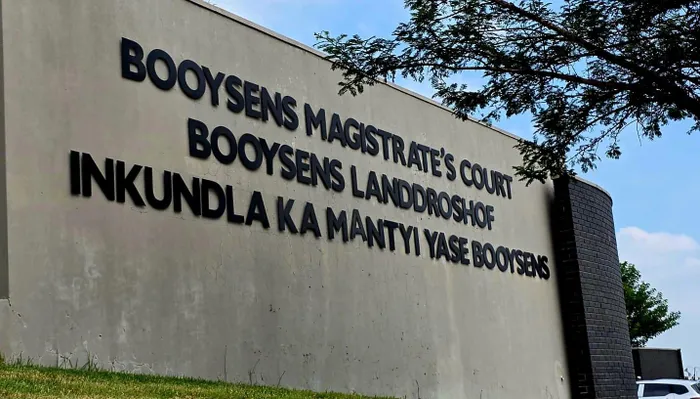
At least five people were shot, and two were killed outside of Booysens Magistrate's Court on Tuesday (20 January 2026).
Image: Independent Newspapers
THE Department of Justice is relying on technology and the support of SAPS to bolster security at courts and protect the integrity of South Africa’s judicial system, following an increase in violence in and around courts dealing with gang-related activities.
Malfunctioning X-ray machines have already been replaced, while SAPS has increased visible policing outside courts identified as gang-related hotspots. These measures are part of a broader strategy to ensure that magistrate's courts remain safe spaces for all who enter; from staff and magistrates to witnesses, accused persons, and members of the public.
Last week, a shooting outside Booysens Magistrate’s Court in Gauteng left two people dead, highlighting the ongoing risks associated with gang activity in and around court precincts.
Samuel Modipane, the department’s director of media liaison, said court staff, magistrates, prosecutors, court officials, and interpreters must be confident that courts are safe spaces where their constitutional rights can be exercised freely.
“Courts in Gauteng and the Western Cape are most affected,” Modipane said.
“Increasingly, our courts are becoming battlegrounds for rival gangs and organised criminal activity. Assailants know where and when their opponents will be at court, and target them outside — on the street or, as in Booysens, in the parking lot,” he said.
Most reported incidents have occurred outside court buildings, sometimes even beyond the immediate precinct. However, some have taken place inside, such as the Wynberg Magistrate’s Court shooting in April last year, Modipane noted.
He said the department is responsible for ensuring all magistrates' courts are secure. “This includes providing security personnel at all lower courts and maintaining adequate measures such as functioning CCTV systems and scanners or metal detectors at entry points,” he said. However, he added, ensuring safety requires collaboration with other roleplayers, including the police, and other members of the JCPS cluster.
Modipane said that criminals have exploited gaps in court security, such as at Booysens, to stalk their victims. However, significant resources have already been deployed to cover these gaps, and they are confident that collaboration with law enforcement can address the problem.
Significant resources have already been deployed to hotspots and areas assessed as prone to this kind of violent incidents, Modipane said. “We are also exploring further technological measures, such as enhanced CCTV, which was already in place and helped police identify the assailants. We are looking at making greater use of crime wardens in public spaces and expanding X-ray screening at all court precinct entrances. These efforts are ongoing and will be continuously reviewed and supplemented.”
He emphasised that violence in and around courts poses a serious threat to the delivery of justice. “These incidents are a direct assault on our constitutional democracy. The judiciary and our legal system are central pillars of our democracy. Any activity that undermines their functionality is a direct attack on constitutional principles, and we take that very seriously.”
Modipane added that the department is working around the clock to ensure courts are safe for everyone and will continue its close collaboration with the NPA, SAPS, the Magistracy, and members of the legal fraternity to address all safety issues. He said these measures are part of a long-term commitment to strengthen the rule of law and ensure that the public can attend court proceedings without fear of intimidation or harm.
Responding to the Booysens shooting last week, Nkosana Mvundlela, president of the Law Society of South Africa, said courts must remain safe spaces where legal practitioners, litigants, court officials, and members of the public can access justice without fear or intimidation.
“The safety of legal practitioners and court users is not negotiable. The justice system cannot function effectively in an environment where violence threatens those tasked with upholding the law. We urge the government to prioritise the protection of judicial institutions and all who serve within them,” he said.
Last week, the Independent on Saturday reported that violence has not been limited to courts, but has also affected other public institutions where South Africans should feel safe, such as schools and hospitals. At the time, Cosatu said frontline workers were paying the price, reporting high levels of trauma, PTSD, burnout, fatigue, and a drop in morale.
A political commentator said the buck stops with the government and that violence at state institutions reflects a failing state with high levels of political instability. These incidents, they argued, underscore the urgent need for coordinated action to protect both public institutions and those who work within them.