
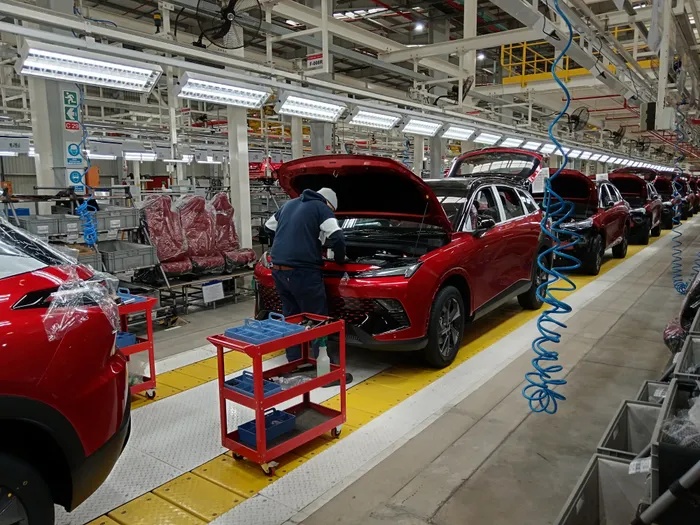
The Beijing X55 is being assembled at the company's Coega facility in limited numbers. South Africa's automotive sector is thriving, but challenges loom as Morocco ramps up vehicle production.
Image: Supplied
The global automotive market is in a state of dynamic reconfiguration, influenced by evolving consumer behaviour, rising price sensitivity, and varied technological transitions across regions. Among emerging markets, South Africa stands out as a beacon of recovery, posting impressive gains in the automotive sector after a tumultuous period characterised by volatility and supply-chain disruptions. This is according to Quotes Advisor (www.quotesadvisor.com), which said 2025 marked a significant upswing, allowing the market to not only regress its losses but also exceed pre-pandemic levels.
As the automotive sector in South Africa closed the year on a high note, December saw momentum reach its peak, resulting in 48,983 new vehicle sales — an impressive 19.2% increase compared to the same month in 2024. Despite this upswing, sales indicated a typical seasonal decline from the November total of 54,896 units, suggesting a natural cooling after a vigorous sales period.
The dominance of Toyota remains unchallenged, as the manufacturer sold 12,933 vehicles in December, again solidifying its position at the helm of the South African automotive market. Volkswagen reclaimed second place by selling 5,014 units, edging ahead of Suzuki, which closed with 4,961 sales. This shift not only signifies market preferences transitioning back to established brands, but also serves as a pivotal reminder that consumer choices are evolving, reflecting a broader trend towards affordability amidst tighter household budgets.
Interestingly, while the battle for second place unfolded, Suzuki continued to linger close behind. This raises questions about the data from Volkswagen, which includes Audi sales and complicates direct comparisons. Nevertheless, the overarching narrative highlights a burgeoning inclination in the South African market towards value-oriented brands — a shift underlined by the growing supply of competitively priced vehicles manufactured in countries like India and China.
Overall, December's results reaffirmed notable trends witnessed throughout the year. Passenger vehicle sales climbed by 20.3% year-on-year, while light commercial vehicles surged by 23.7%. This uptick underscores a recovering consumer spending climate and rejuvenated business activity. However, heavy transport segments are lagging, indicating softening demand in logistics and infrastructure towards the year-end.
On an annual scale, South Africa's automotive market concluded 2025 with total vehicle sales reaching 596,818 units — a robust 15.7% increase compared to 2024, marking the industry's most successful year since 2008. Naamsa attributed this recovery to favourable macroeconomic factors, such as cumulative interest-rate cuts, low vehicle inflation, decreasing fuel prices, and improved access to credit, alongside renewed household spending facilitated by the introduction of the two-pot retirement system.
Consumer preferences are evident in the rankings, with the locally manufactured Toyota Hilux leading as the country’s best-selling vehicle, followed closely by the Corolla Cross in the passenger car segment. Imported models from India and China, such as the Toyota Starlet and the Chery Tiggo 4 Pro, signify the increasing prioritisation of price and efficiency in consumers' purchasing decisions.
However, amid this domestic resurgence, exports present a mixed picture. December witnessed a 10.4% year-on-year decline in vehicle exports, yet the overall figures for 2025 rose by 4.4% to a record 408,224 units. Notably, while passenger car exports have waned, the light commercial vehicle export sector has expanded, reflecting a diversification in South Africa’s automotive production outputs.
Looking ahead to 2026, industry forecasts remain cautiously optimistic, projecting a continued upward trajectory in sales, potentially rising between 9% and 11%. A stable inflation rate at around 3.3%, coupled with expected GDP growth between 1.4% and 1.6%, fuels this optimism. Access to finance, with personal loans and vehicle financing at lower rates, will again become pivotal in sustaining this demand within an economy that continues to challenge consumers.
As South Africa celebrated its automotive revival, another narrative was unfolding in the background. The country, traditionally the continent's leader in vehicle manufacturing, received a stark wake-up call when Morocco overtook it to become Africa's largest vehicle producer, hitting the one-million-unit mark in early December 2025. This dramatic shift underscores deeper challenges facing South Africa's automotive sector.
From January to November 2025, South African output was relatively stagnant, with 554,613 vehicles manufactured — only marginally above the previous year’s production of 548,819 units. This stagnant production starkly contrasts with Morocco’s accelerated growth, attributed to a forward-thinking industrial strategy which has attracted substantial foreign investment and production facilities, including those from Renault and Stellantis.
The stark differences in energy strategy also play a role. With Morocco benefitting from investments in renewable energy that support its growing manufacturing industry, South Africa remains heavily reliant on fossil fuels, facing chronic power supply disruptions that hinder productivity and increase operational costs.
As the African automotive landscape evolves, it becomes increasingly clear that historical dominance is no longer sufficient, said Quotes Advisor. Only with a renewed focus on industrial policy, innovation, and resilience can South Africa reclaim its leading position in an environment where it must adapt swiftly to both internal and external challenges.
IOS