
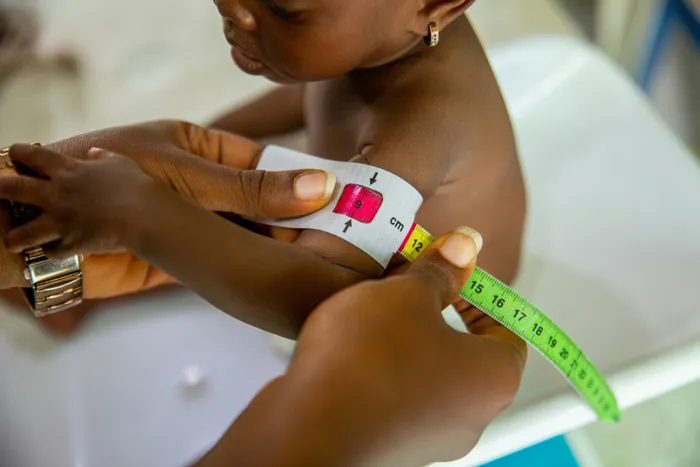
Following the SONA 2026, the commitment to end stunting by 2030 is now on record.
Image: Lagos Food Bank Initiative / pexels
At the State of the Nation Address (SONA) 2026, President Cyril Ramaphosa announced a renewed push to tackle child malnutrition, including the rollout of the National Strategy for Accelerated Action for Children (NSAAC).
For Dr Edzani Mphaphuli of Grow Great, the announcement marked a breakthrough.
"This could be a defining moment for child nutrition and health," she said. "It’s a very proud moment for Grow Great. We have fulfilled a central objective of our advocacy campaign, placing ending stunting firmly on the national agenda."
Yet, she cautioned that political recognition must now translate into decisive action.
South Africa’s latest National Food and Nutrition Security Survey shows stunting increased from 27% of children under five in 2016 to nearly 29% in 2023, with roughly 35% of children under two affected.
South Africa has made progress. The Child Support Grant and the National School Nutrition Programme have reduced food insecurity among children.
But experts argue these interventions miss the most critical window, the first 1,000 days of life, from conception to age two.
"The first 1,000 days are still not protected," Mphaphuli said. "The Child Support Grant is received too late, and its value has not kept pace with inflation, now falling below the food poverty line."
According to Mphaphuli, a Maternal Support Grant has been proposed since 2012 but remains unimplemented. Meanwhile, previous policy efforts, including the 2018–2023 National Food and Nutrition Security Plan, underperformed due to weak coordination and accountability.
Mphaphuli said the next few months will be critical. Grow Great is calling for the Cabinet to approve the Maternal Support Grant, increase the Child Support Grant to at least the food poverty line, starting with children aged 0 to 35 months, and scale up community health worker programmes to ensure early growth monitoring and malnutrition detection.
"Make stunting a political priority," she urged. "Implement NSAAC with presidential oversight. Ensure every child is measured, referred, and treated, especially under twos."
Angelika Grimbreek, from the Healthy Living Alliance (HEALA), welcomed the president’s recognition of the crisis, describing it as a significant step forward.
"The fact that the president is speaking about it and sees its importance is a huge step forward," she said. "The plan being developed is a good sign."
But she echoed concerns about implementation. "Well-researched and evidence-based policies and guidelines are already there. The issue is that they are not implemented as they need to be. We need to see this taken seriously," she said.
Grimbreek also warned that stunting cannot be addressed in isolation from childhood obesity, a growing but often overlooked threat.
"We often see the connection between stunting and obesity," she explained. "Stunted children later have a higher risk of becoming overweight or obese, and are more vulnerable to non-communicable diseases. These conditions must be taken seriously together."
She pointed to South Africa’s food environment as a major driver of poor nutrition, particularly the aggressive marketing of ultra-processed foods high in sugar, salt, and saturated fats to children.
"There is so much evidence showing that the food and beverage industry targets children with unhealthy products," she said.
HEALA is advocating for stronger regulatory measures, including increasing the Health Promotion Levy on sugary drinks and implementing front-of-package warning labels to help consumers better understand what is in their food.
Proposed marketing restrictions on unhealthy foods aimed at children, she added, must also be enforced.
"We know there are solutions the government can put in place. What we’re hoping to see is that this plan is taken seriously. Social protection measures must include nutrition outcomes as part of their evaluation. Grants must be increased above the poverty line so they can meet nutritional outcomes," Grimbreek added.
lilita.gcwabe@inl.co.za