
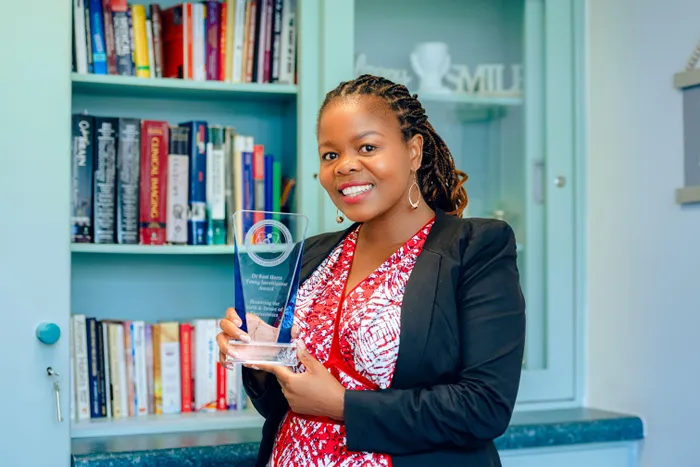
Dr Bawinile Hadebe, a senior UKZN lecturer and Head of the Nuclear Medicine Clinical Unit at Inkosi Albert Luthuli Central Hospital (IALCH) in Durban, with her Saul Hertz Young Investigator Award for her research on improved approaches to cancer treatment.
Image: Supplied
In a poignant demonstration of how personal loss can fuel innovation in science, Dr Bawinile Hadebe, a senior lecturer at the University of KwaZulu-Natal (UKZN) and head of the Nuclear Medicine Clinical Unit at Inkosi Albert Luthuli Central Hospital in Durban, has been awarded the Saul Hertz Young Investigator Award. This distinguished accolade was presented at the 8th Theranostic World Conference held in Cape Town earlier this month, recognising her groundbreaking research in theranostics — an innovative approach to cancer treatment.
Hadebe’s journey into the realm of cancer therapy began three years ago after losing her father due to chemotherapy-related complications. The ordeal impacted her as she witnessed first-hand the severe side-effects of conventional treatments. “My father is the quiet strength behind my work. I see his face in every patient I treat, fuelling my drive to redefine what is possible in cancer care,” Hadebe said. This personal tragedy sparked her determination to pursue more effective, less debilitating treatment strategies.
Under the mentorship of Professor Mariza Vorster, Hadebe's PhD work focused on CXCR4-targeted imaging and the development of targeted radionuclide therapies for prostate and neuroendocrine tumours. Theranostics melds diagnostic imaging with targeted treatment, aiming to personalise patient care and reduce the harsh effects commonly associated with chemotherapy.
“Cancer is a growing challenge worldwide, and we urgently need new ways to fight it. Theranostics is an exciting approach that lets us ‘see what we treat and treat what we see’. We use a special ‘search-and-destroy’ technique, injecting a patient with a targeted radiotracer that highlights cancer cells during scans. Following that, a more potent radiotracer is used, delivering a concentrated dose of radiation that effectively annihilates the cancer cells, all while sparing healthy tissue,” she explained.
Despite the promise of targeted radionuclide therapy, Hadebe acknowledges that access remains a significant barrier for many patients. “Currently, this treatment remains a distant dream for numerous individuals battling cancer. More efforts are needed to make it accessible to all,” she remarked.
Receiving the Saul Hertz Young Investigator Award not only highlights Hadebe’s contributions to cancer treatment, but also reinforces her belief that her journey is on the right track. Her research is a beacon of hope, signalling a shift towards more sophisticated and humane cancer care strategies in South Africa and beyond.
IOS