
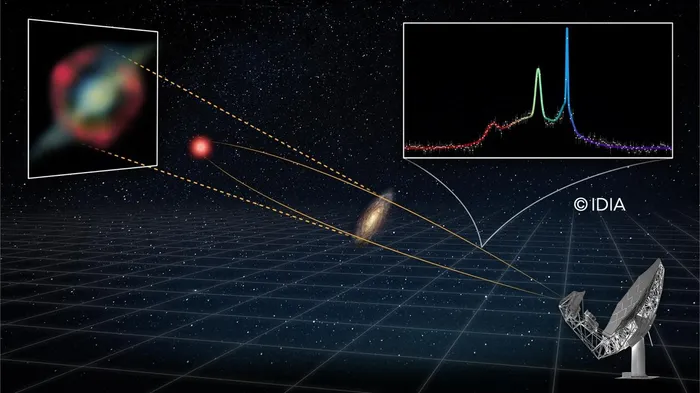
An illustration of a distant galaxy 8 billion light-years away (red), magnified by an unrelated foreground disk galaxy, resulting in a red ring. Splitting up the radio light into different colours, as a prism does, reveals a hydroxyl gigamaser (top-right rainbow-coloured line).
Image: Inter-University Institute for Data-Intensive Astronomy (IDIA)
Astronomers working with the MeerKAT radio telescope in South Africa have made a groundbreaking discovery with significant implications for our understanding of the universe. They have identified the most remote hydroxyl megamaser ever detected, located in a violently merging galaxy over 8 billion light-years away. This extraordinary find opens a new frontier in radio astronomy and sheds light on cosmic phenomena that have long piqued the curiosity of scientists.
Hydroxyl megamasers, often referred to as natural “space lasers,” produce extremely bright radio-wavelength emissions when hydroxyl molecules in gas-rich, merging galaxies collide. Such cosmic collisions compress gas and stimulate sizeable reservoirs of hydroxyl molecules, leading to an amplification of radio emissions. While these processes bear a resemblance to the operation of lasers on Earth, they occur at a wavelength of about 18 centimetres, far longer than the optical light visible to the human eye. When the radio light emitted is exceptionally luminous, it is termed a megamaser — a “cosmic beacon” that can be detected across vast stretches of the universe.
The newly identified system bears the designation HATLAS J142935.3–002836. Impressively, its significant distance implies that we are observing it as it existed when the universe was less than half its current age. Notably, this system is both the most distant and luminous known to date. So remarkably bright that it has been classified as a gigamaser rather than a mere megamaser, it provides a stunning view into early cosmic processes.
The strength of the signal produced by this distant galaxy can be attributed to both the capabilities of the MeerKAT telescope and a phenomenon known as gravitational lensing, first theorised by Albert Einstein. According to Dr Thato Manamela, the lead author of the study and a postdoctoral researcher funded by the South African Radio Astronomy Observatory (SARAO), “This system is truly extraordinary. We are seeing the radio equivalent of a laser halfway across the universe. Plus, during its journey to Earth, the radio waves are amplified further by a perfectly aligned, unrelated foreground galaxy.” The galaxy acts like a cosmic lens, curving space-time and enhancing the signal before it is captured by MeerKAT.
The design of MeerKAT is incredibly well-suited for detecting faint radio emissions at centimetre wavelengths. However, gathering this data is only part of the challenge; astronomers must analyse terabytes of information using sophisticated algorithms and advanced computational platforms. Prof Roger Deane, co-author of the study and Director of the Inter-University Institute for Data Intensive Astronomy (IDIA), highlights the importance of this combination. “This result is a powerful demonstration of what MeerKAT can do when paired with advanced computational infrastructure,” he said, emphasising how this synergistic approach empowers emerging South African scientists like Dr Manamela to lead in cutting-edge research.
Hydroxyl megamasers are relatively rare, and previous studies have indicated that they trace significant galaxy collisions, environments that fuel intense starbursts and feed central black holes. Ongoing systematic searches, such as those carried out by MeerKAT, have the potential to transform these rare finds into valuable probes for understanding cosmic evolution. “This is just the beginning,” Dr Manamela stated. “We don’t want to find just one system – we wish to uncover hundreds to thousands. At the University of Pretoria, we are conducting systematic surveys and building the computational frameworks necessary to explore this frontier further, particularly with the future Square Kilometre Array.”
The discovery lays bare South Africa’s expanding role in the forefront of data-intensive radio astronomy, bolstered by a strong partnership between IDIA and SARAO as they unveil the vast potential of MeerKAT science while preparing for the upcoming SKA era.
The findings of this study have been accepted for publication in the Monthly Notices of the Royal Astronomical Society Letters, with the preprint available for those eager to delve deeper into this astonishing discovery.