
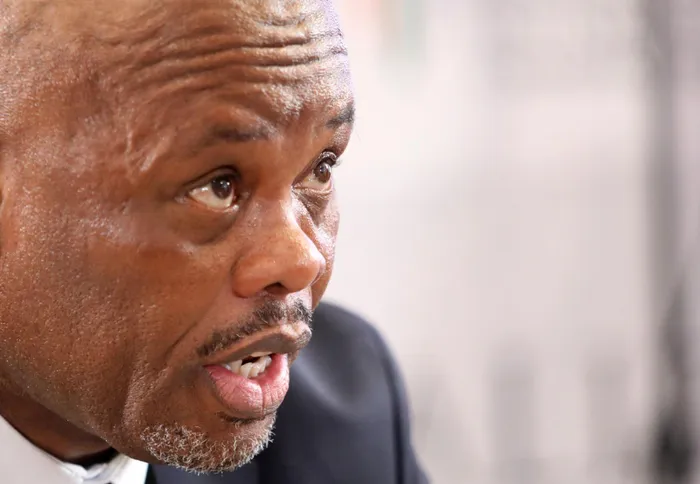
Suspended SAPS Deputy National Commissioner of Crime Detection, Lieutenant-General Shadrack Sibiya testifies at the Madlanga Commission of Inquiry on the disbandment of the Political Killings Task Team.
Image: Oupa Mokoena/Independent Newspapers
Suspended Deputy National Commissioner Shadrack Sibiya told the Madlanga Commission of Inquiry on Wednesday that he was unaware Police Minister Senzo Mchunu would disband the Political Killings Task Team (PKTT) on December 31, 2024, but was not surprised by the decision.
Sibiya was testifying regarding circumstances surrounding the PKTT's dissolution as directed in a letter dated December 31, 2024 penned by Mchunu, who is currently on special leave.
He revealed that SAPS National Commissioner Fannie Masemola did not oppose the PKTT disbandment because the subject of disbandment formed part of a meeting of November 1, 2025, which was one of the consultative meetings.
Sibiya has been accused of advocating for the disbandment of the PKTT and his alleged links with the criminal cartel previously came under scrutiny.
KwaZulu-Natal Police Commissioner Lieutenant-General Nhlanhla Mkhwanazi testified that 121 case dockets involving politically motivated killings were removed from the PKTT in March 2025 and kept in Sibiya's Pretoria office.
Sibiya told the commission that existing task team structures, including the 2018 PKTT, were set to be replaced by provincial robbery and murder units, according to a study group's recommendations.
"I am aware of the study group that was established to replace PKTT with murder and robbery unit," he said.
This corroborated Mchunu’s testimony two months ago, that if Masemola had approved the new organisational structure based on the 2019 work study, the PKTT would have been dissolved back in March 2024.
Mchunu’s letter stated that the task team was not adding value to the policing work.
But Mkhwanazi testified that Mchunu’s conclusion that the team does not add any value to policing in South Africa “was misplaced”.
Masemola told the commission last year that he deemed as “unlawful” a directive by Mchunu to disband the PKTT, saying he reached out to President Cyril Ramaphosa for intervention.
According to Mchunu, the 2019 work study was translated into organisational structure, “effectively de-established the PKTT and established a single murder and robbery unit”.
Mchunu said Masemola, on June 5, 2024, signed off on the work study with an instruction that implementation must be expedited.
Sibiya told the commission that his role in the disbandment of the PKTT was “undertaken solely in the course of and instructions issued to me by the national commissioner”.
“As I report directly to him, I was entitled to presume that such instructions were lawfully issued and duly authorised particularly as I know that the national commissioner himself had received the directive from Minister Mchunu. The alternative would have been to defy a direct order from my superior, which would itself have constituted unlawful conduct and a disciplinary offence,” he said.
He said on January 3, 2025 he received a communication directing him to communicate the deactivation of PKTT to the relevant teams and implement its disestablishment.
He testified that on October 31, 2024 Professor Mary de Haas of KwaZulu-Natal lodged a complaint with Mchunu, through Parliament, regarding PKTT.
Sibiya said: “In her complaint De Haas alleged that PKTT was abusive and amounted to a gross wastage of personnel and financial resources. She noted that these issues arose while General Mkhwanazi was in charge.”
According to him, De Haas also called for the immediate disbandment of PKTT and an urgent establishment of a judicial oversight body to investigate its operation, cases and related matters.
Sibiya also testified the then Public Protector (PP) Mkhwabane’s 2020 probe exonerated him and the City of Joburg (CoJ) of any wrongdoing in relation to his appointment as head of Group Forensics and Investigation Services (GFIS).
However, he noted that Al-Jama-ah’s Thapelo Amad continued to publish statements impugning the legitimacy of the appointment that he was incapable, unfit to hold positions of head of GFIS despite the PP report.
“In the PP report Mkhwabane found that the allegations regarding the establishment of the GFIS and my subsequent appointment as its executive head by CoJ were not substantiated. She further held that both my appointment and and the grading of my remuneration were in compliance with the applicable legal framework of CoJ and that on the evidence available to her she concluded that there was no justifiable basis, either in law or on the facts to impugn the process followed by COJ in appointing me and subsequently adjusting my salary,” Sibiya said.
He responded to the allegations made by former Gauteng head of the Hawks Major-General Prince Mokotedi during December 2016 that together with several other individuals was implicated in offences of high treason and espionage.
He said the allegations were based on the so-called “Top Secret Intelligence Report” which he claimed to have received around April 2016.
“The report allegedly implicated me, Mr Paul O’ Sullivan, Mr Robert McBride, Ms Candice Coetzee and other unidentified persons said to be associated with AfriForum and the Democratic Alliance. The intelligence report concerned was highly questionable,” he said.
Sibiya's testimony continues.
rapula.moatshe@inl.co.za