
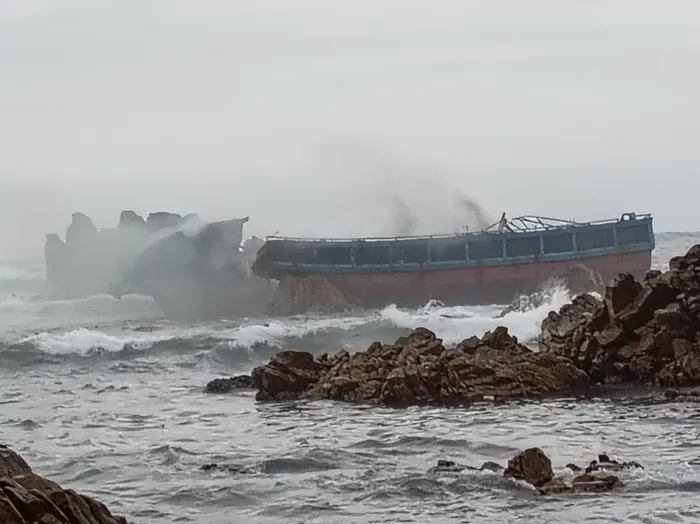
Organisations argue that expanding offshore oil and gas exploration undermines South Africa’s climate obligations.
Image: Supplied
Civil society organisations have escalated their legal battle over proposed offshore oil and gas drilling off South Africa’s south-west coast, filing an answering affidavit in the Supreme Court of Appeal (SCA) as the long-running Block 5/6/7 dispute intensifies.
The Green Connection and Natural Justice confirmed in a joint media release that they are opposing efforts by the State and Shell to widen the grounds of appeal after the Western Cape High Court set aside the environmental authorisation (EA) for the project in August 2025.
The authorisation would have allowed the drilling of up to five exploratory wells about 60 kilometres off Cape Point.
"This case has always been about more than administrative legality," said Neville van Rooy, outreach ambassador for The Green Connection. "It is about good governance, climate responsibility, and the constitutional rights of coastal communities whose futures depend on a healthy ocean."
The dispute began in 2022 when the organisations objected to the environmental impact assessment submitted by TotalEnergies EP South Africa (TEEPSA), arguing it failed to properly assess risks to small-scale fishers, marine ecosystems, and the climate.
In 2023, the Department of Mineral Resources and Energy granted environmental authorisation despite what the organisations describe as widespread public and scientific opposition. More than 20 formal appeals were lodged by communities, civil society groups, and experts, but these were dismissed by the then Minister of Forestry, Fisheries and Environment.
Community resistance grew along the West Coast and KwaZulu-Natal coastline, with small-scale fishers raising concerns about threats to food security and livelihoods.
"Over and over again, civil society and small-scale fishers highlighted all the different problems with this application to drill up to five oil wells 60 kilometres off Cape Point, but the authorisation was still granted," Van Rooy said. "That is when we turned to the courts so that we can test the lawfulness of these decisions, because it should have, in the first place, been guided by the law."
In 2024, the organisations launched a High Court review of the decision. Although TotalEnergies later indicated it intended to withdraw from Blocks 11B/12B and 5/6/7, the case continued, and Shell subsequently took over as lead applicant in Block 5/6/7.
In August 2025, the Western Cape High Court set aside the environmental authorisation, finding that the department had failed to properly consider relevant environmental and socio-economic factors under the National Environmental Management Act.
The court held that the final Environmental Impact Report did not adequately assess the socio-economic consequences of a potential well blowout and did not comply with requirements under the Integrated Coastal Management Act. It also found that key oil spill and blowout contingency plans were not made available for public scrutiny before approval.
The State and Shell applied for leave to appeal the judgment. In November 2025, Judge Mangcu-Lockwood granted limited leave to appeal on two of the five review grounds, those relating to the consideration of lifecycle climate impacts and transboundary harm, but refused leave on the remaining three grounds, including socio-economic impacts, public participation, and coastal protection requirements.
In December 2025, the State and Shell petitioned the SCA to expand the appeal to include the grounds that had been denied. The answering affidavit filed last week formally opposes that request.
"Last year, the court already granted limited leave to appeal on two of the five grounds," Van Rooy said.
"Because the court has already scrutinised the process and found it severely lacking, in addition to earlier warnings from civil society and small-scale fishers, we do not believe they should be allowed to appeal on any further grounds."
He added that the case carries broader implications for environmental governance in South Africa.
"Good governance requires transparency, full information, and genuine public participation. Anything less places people, ecosystems, and the public trust at risk."
The organisations argue that expanding offshore oil and gas exploration undermines South Africa’s climate obligations at a time when the country is already the continent’s largest carbon emitter and faces mounting climate impacts, including warming oceans and shifting fish stocks.
"For coastal communities and small-scale fishers who rely on the ocean for food security, livelihoods, and spiritual grounding, these are not abstract concerns," Van Rooy said. "If the ocean is harmed, these communities will suffer the earliest and deepest impacts. You cannot compensate a community for a lost ocean or a destroyed way of life."
The Supreme Court of Appeal must now decide whether the State and Shell will be permitted to broaden their appeal. For now, the environmental authorisation remains set aside, meaning no drilling can proceed unless a new and lawful authorisation process is undertaken.
lilita.gcwabe@inl.co.za