
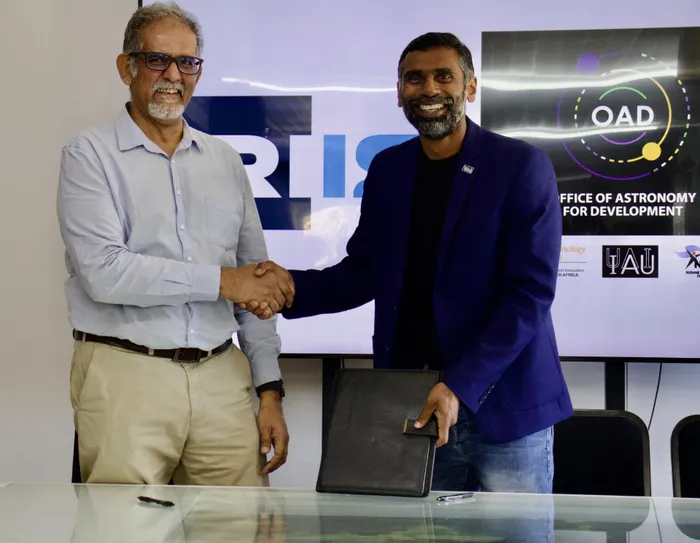
Imraan Saloojee, executive of the Research Institute for Innovation and Sustainability, and Kevin Govender, director of the IAU Office of Astronomy for Development, celebrate signing an agreement to establish a strategic partnership.
Image: Supplied
The Office of Astronomy for Development (OAD) has cemented a groundbreaking partnership with the Research Institute for Innovation and Sustainability (RIIS) through a newly signed Memorandum of Understanding (MoU). This strategic collaboration seeks to harness the power of scientific knowledge and innovation to generate meaningful, sustainable development outcomes across Africa.
By merging OAD’s global mandate of leveraging astronomy as a vehicle for development with RIIS’s formidable expertise in designing impactful innovation programmes, the two institutions are poised to create connections that bridge science, data, and innovation with entrepreneurship and policy engagement.
Imraan Saloojee, Executive of RIIS, expressed his enthusiasm for the partnership, noting, “The OAD has been instrumental in using astronomy to inspire and empower young Africans, encouraging them to dream bigger and pursue new frontiers of knowledge.” He highlighted the simultaneous growth of astronomical research and infrastructure on the continent, suggesting that these advancements pave the way for expanded opportunities in entrepreneurship and economic development.
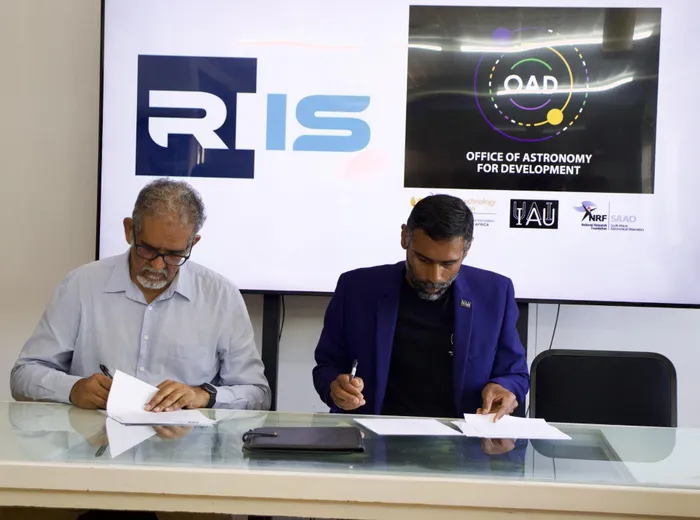
Imraan Saloojee and Kevin Govender ink the Memorandum of Understanding (MoU) which establishes a strategic collaboration focused on the translation of scientific knowledge and innovation into tangible, sustainable development outcomes.
Image: Supplied
The collaboration’s primary focus will be on establishing structured pathways that allow promising ideas — particularly those generated through hackathons and innovation challenges — to extend beyond the ideation stage. By aligning the OAD’s Skills for Development Programme and Flagship Ecosystem with RIIS’s incubation and acceleration platforms, the institutions aim to offer teams vital mentorship, skills development, and access to innovative ecosystems.
Kevin Govender, Director of the IAU Office of Astronomy for Development, underscored the strategic alignment between RIIS and OAD, stating that the partnership “strongly aligns with the OAD’s mission to use astronomy, data science, and scientific skills as drivers of inclusive development.” He added that the combined resources and expertise of RIIS and OAD can transform scientific concepts from hackathons into practical solutions that deliver lasting socio-economic benefits.
Central to this collaboration is a commitment to youth engagement and capacity building. Through initiatives like the Africa Earth Observation Challenge (AEOC) and its junior counterpart, alongside targeted innovation challenges, this partnership seeks to immerse pupils, university students, and early-career innovators in science, entrepreneurship, and practical problem-solving. These initiatives are designed not only to develop skills but also to cultivate a culture of innovation and applied science across the continent.
Beyond educational outreach, the partnership aims to establish stronger innovation ecosystems by fostering connections among scientists, developers, policymakers, and entrepreneurs. Showcasing joint activities through innovation, policy, and public communication platforms will bolster the visibility of astronomy and space science as critical enablers of sustainable development in Africa.
This innovative collaboration is projected to yield a replicable pipeline connecting hackathons to incubation and enterprise development. Additionally, it will focus on scalable projects that address pressing development priorities including climate resilience, health, and community empowerment. With the ambitious goal of bridging science, policy, and entrepreneurship, both RIIS and OAD share a commitment to move beyond mere conceptual generation toward real-world implementation, impact, and sustainability in Africa and beyond.
IOS