
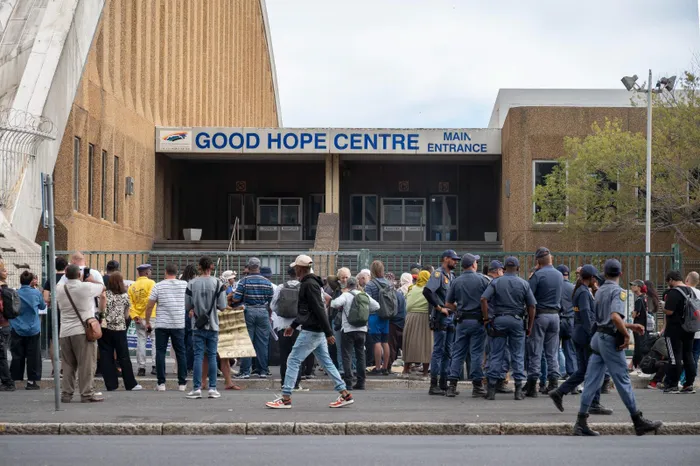
On Tuesday, activists, community organisations and residents gathered outside the Good Hope Centre to protest against the City’s upcoming land auctions.
Image: Armand Hough / Independent Newspapers
The City of Cape Town is pressing ahead with plans to auction off more public land, despite there being more than 400,000 people on Cape Town’s housing waiting list, with civil society groups saying this will deepen the crisis and push the poor and working class further out of the city.
On Tuesday, activists, community organisations and residents gathered outside the Good Hope Centre to protest against the City’s upcoming land auctions. The site itself is among the properties the City intends to sell, arguing that the process will "unlock idle municipal land so that the private sector can invest, build, and create thousands of jobs".
But protesters reject the notion that any land in Cape Town is "idle" while thousands live in informal settlements, backyard shacks or on the streets after evictions and rising rental costs.
"We don’t want the auction of this land that the City is going to do. We want the land to be utilised. And the problem is that the City doesn’t consult with community, the City just does whatever they want to do," said Kashiefa Aschmat, Chairperson of Housing Assembly.
According to Housing Assembly, the scale of the housing backlog reflects the desperation of families seeking safe, affordable homes large enough to accommodate them.
"There are properties being auctioned by the City, but in our communities there are people being evicted at the same time because we are told that they don’t have any houses or land available for houses. So we feel that the City is lying and that there is an agenda of power and control," Aschmat said.
"We have seen Bromwell, we have seen Cecil Street in Woodstock. Evicted communities are still waiting for permanent housing, but the City claims that there are no alternatives. It feels like the City does not want poor people living in the city."
Aschmat added: "We know that the buyers are investors who are not from the country. The City will still be in control through these sales."
Community activist Jeffrey Van Wyk, who has previously spoken out about the backlog affecting elderly backyard dwellers and residents in the Cape Flats and Ravensmead, said many groups oppose the auctions because of their lived experiences of homelessness and hardship. He claimed there had been no meaningful consultation before the DA-led City decided to auction the land.
"There was no consultation on the different ways that the available land can be used before auctioning. We also get the sense that there is no respect for the sacred land," he said.
Van Wyk accused the DA of running the City as though it belongs to the party, rather than the people who live in it.
Addressing the crowd, GOOD Party secretary-general Axolile Notywala urged those gathered "to fight the billionaires who are taking over our cities, provinces, our country, and are trying to take over the world".
He said the GOOD Party had joined the protest to demand that the City of Cape Town and the DA stop selling land to billionaires and tourists.
"While the people who are making this city what it is are the majority of the working class, who are mostly low-income and mostly Black and Coloured, this land must be prioritised for those people," Notywala said.
He argued that the Good Hope Centre land alone could potentially house thousands of people if properly developed, and that government should invest in the properties for public benefit rather than profit.
Referring to the BM Section informal settlement, home to more than 4,000 households, Notywala said it is one of the largest informal settlements in South Africa, adding that many such communities have existed for more than two decades.
"We disagree with the sale of land because it won’t solve the current housing crisis in Cape Town," he said.
The City has listed 50 properties, which are all zoned for residential, commercial, industrial, community and mixed-use development, on the website of its appointed auctioneer, Claremart Group.
In statements from the Mayor’s office, the City said the auction presents an opportunity for private-sector investment across the metro.
"From the Good Hope Centre precinct to commercial and industrial parcels in Mitchells Plain, Atlantis Industrial, Parow, and Goodwood, each site has been carefully packaged to attract capable investors ready to deliver tangible benefits for communities and the broader economy," said Alderman James Vos, Mayoral Committee Member for Economic Growth.
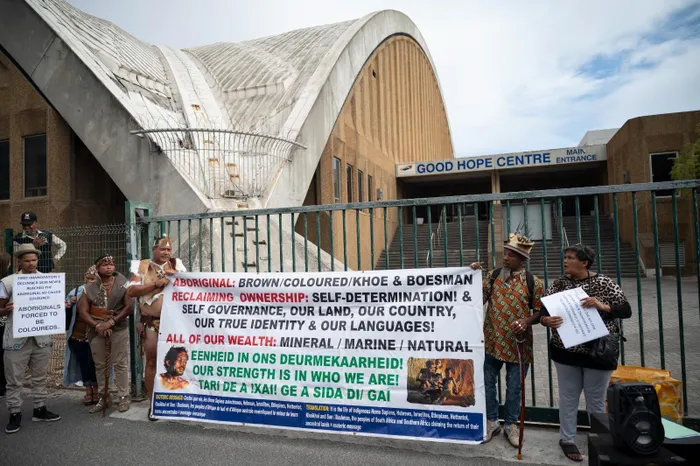
Civil society groups on Tuesday urged the City to halt land auction amidst a housing crisis.
Image: Armand Hough / Independent Newspapers
According to the City, "All properties identified for auction have been thoroughly assessed and are not required for municipal purposes. Revenue generated from the sales will be used to fund service delivery."
Civil society groups argue that genuine consultation could have produced alternatives that prioritise community needs, even if the land is not required for municipal operations.
"The alternative to the auction is to use those properties to build houses by the City for the City. If there is land that is not for residential purposes, then our people should be able to use the land to grow their own food and for agriculture. It should be utilised in a way that benefits communities," Aschmat said.
lilita.gcwabe@inl.co.za