
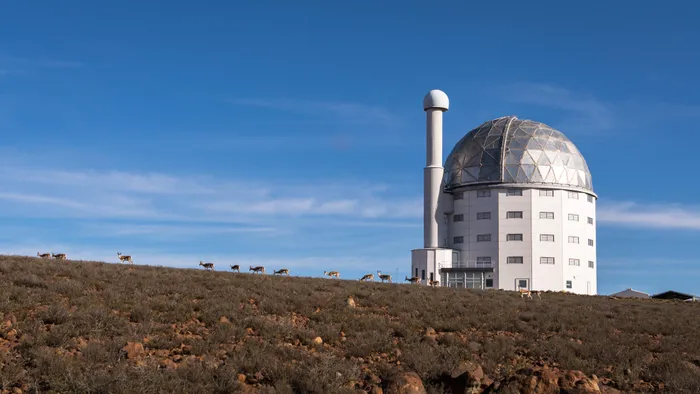
The Southern African Large Telescope (SALT) is joining forces with a major global observatory to observe and analyse celestial events in real-time.
Image: Supplied
The Southern African Large Telescope (SALT) is set to embark on a groundbreaking collaboration with the Vera C. Rubin Observatory as it begins observing selected astronomical alerts issued by the observatory. This initiative marks a pivotal moment in South Africa's contribution to an evolving field of time-domain astronomy, where the mysteries of the universe are unravelled in real-time.
Located in Chile, the Rubin Observatory is engaged in one of the most ambitious sky surveys ever pursued, using its formidable 8.4-metre Simonyi Survey Telescope. This state-of-the-art facility conducts repeated scans of the southern sky to detect transient and variable events including spectacular phenomena such as supernovae, flaring black holes, and near-Earth asteroids that might pose threats to our planet. Significant findings are disseminated globally in the form of “alerts,” empowering partner institutions to conduct detailed follow-up observations.
SALT, stationed at the National Research Foundation’s South African Astronomical Observatory (NRF-SAAO) in Sutherland, Northern Cape, has a unique advantage in responding to these alerts. As the largest single optical telescope in the southern hemisphere, SALT’s 11-metre segmented primary mirror provides unmatched light-gathering capability supported by advanced spectroscopic instruments. This combination allows for precise measurements of physical characteristics, distances, and chemical compositions of newly discovered celestial objects, a crucial aspect of understanding their nature and behaviour.
While the Rubin Observatory excels at quickly identifying new astronomical phenomena across expansive areas of the sky, SALT's expertise lies in its comprehensive spectroscopic follow-up. By analysing the light emitted from these transient sources, SALT helps to clarify their identity and evolutionary trajectories. This symbiotic relationship between discovery and in-depth analysis positions the two facilities at the forefront of time-domain astronomy.
Enhancing this capacity is SALT’s collaboration with the South African Astronomical Observatory’s Intelligent Observatory (IO) programme. This initiative has yielded an automated 1-metre telescope named Lesedi, which operates robotically and actively participates in time-domain science by routinely monitoring variable and transient astronomical objects. With its responsive design, Lesedi provides essential early photometric characterisation for newly discovered events, working in tandem with SALT’s detailed spectroscopic analyses to create a well-co-ordinated response system to Rubin Observatory's alerts.
The geographic positioning of South Africa offers a strategic advantage as SALT has immediate access to the same southern sky explored by the Rubin Observatory, thus ensuring rapid reaction times for observing transient events as they are detected. This immediacy is critical for studying phenomena that may fade or change rapidly, often within a matter of hours or days.
“This is an exciting moment for South African astronomy,” said Prof Rosalind Skelton, Managing Director of NRF-SAAO. “Rubin Observatory is transforming how we discover dynamic events in the universe, and SALT is ideally equipped to investigate them in detail, building on an existing highly successful transient programme. Our ability to respond quickly to these alerts ensures that South Africa will play a leading role in the scientific return from this global endeavour.”
This collaboration significantly strengthens prospects for South African researchers and students, allowing them to engage with and contribute to the forefront of international astronomy. As discoveries unfold, there lies the potential to reshape our understanding of the dynamic nature of the universe.
IOS