
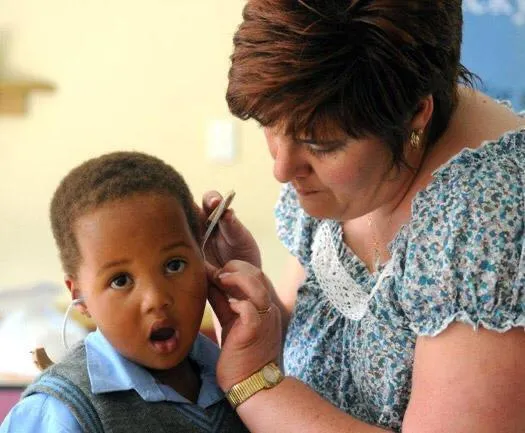
Yolandi Marais du Plessis conducts a hearing assessment with a young patient, ensuring the next generation’s hearing health is on the right track. Experts are calling for newborns to be assessed for hearing abnormalities.
Image: Supplied
In a poignant reminder during the recent State of the Nation Address, President Cyril Ramaphosa reaffirmed South Africa's dedication to nurturing its youngest citizens, especially during the critical first 1,000 days of a child's life. Yet, a vital early intervention continues to be overlooked: universal newborn hearing screening.
A recent policy brief, "Every child heard: Why South Africa must implement universal newborn hearing screening now," released by Hold My Hand and Change Ideas in collaboration with the Early Hearing Detection and Intervention (EHDI) Community of Practice, declares that too many infants are slipping through the cracks. With statistics indicating that approximately 17 infants are born with permanent hearing loss every day, translating to around 6,000 newborns each year in South Africa, the call for immediate action cannot be ignored.
Shockingly, fewer than 10% of newborns currently receive hearing screening, forcing many families to wait until their children are 20 to 30 months old for a diagnosis — long after the critical window for effective early intervention. This delay stands in stark contrast to the World Health Organization's guidelines advocating for screening within the first month of life.
Professor De Wet Swanepoel, a renowned audiology expert at the University of Pretoria and WHO Collaborating Centre for the Prevention of Deafness and Hearing Loss, highlights the urgency of immediate screening: "No child should wait years for a condition that can be identified within hours after birth!" Moreover, he emphasises parental right to know their child's hearing status before leaving a medical facility.
The recently adopted National Strategy to Accelerate Action for Children (NSAAC) acknowledges the pressing need for newborn hearing screening. Identified as a catalytic intervention, this screening can easily be integrated into routine maternal and child health services, benefitting countless families.
The financial implications of inaction are staggering. The policy brief estimates the lifetime economic burden of unidentified infant hearing loss from a single annual birth cohort at R68.6 billion, or approximately R1 billion annually per child affected. As Dr Noxolo Gqada, Strategy Lead for the Hold My Hand Accelerator for Children and Teens, succinctly puts it, "Every child deserves the chance to understand their name, sing a song, or laugh with their friends." The disparities in access to support, often predicated on families' ability to navigate the healthcare system, must be addressed to ensure equitable outcomes for all children.
The EHDI Community of Practice has made it clear that South Africa must transition from sporadic access to a streamlined national pathway that guarantees comprehensive benefits for every child. Their recommendations include:
On World Hearing Day, March 3, its theme, "From communities to classrooms: hearing care for all children," challenges society to reconsider the community's role in identifying early hearing impairment. While classrooms may serve as effective screening entry points, active participation from parents, caregivers, and communities is essential for success.
Professor Claudine Storbeck, Director of HI Hopes and Associate Professor at Wits University’s Centre for Deaf Studies, encourages caregivers to trust their instincts: "If in doubt, follow up." Research within South Africa indicates that maternal concerns are often overlooked, stalling early diagnoses by nearly a year.
In this light, Prof Swanepoel emphasises that World Hearing Day should not only be a platform for raising awareness: "It should raise the standard. We have local evidence, workable community models, and clear lessons on what improves uptake. We need to act on what we already know."
Hold My Hand is dedicated to facilitating this required change, rooted in the NSAAC, and is committed to guiding parents, caregivers, and adults to champion the rights and welfare of children and teens across South Africa.
IOS