
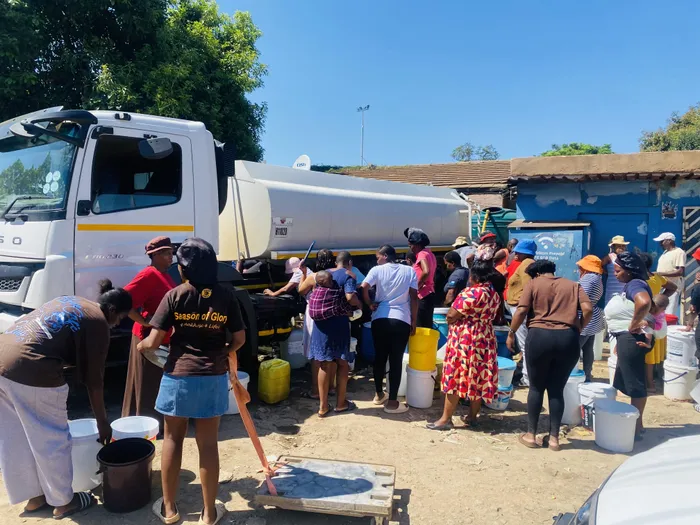
For many around the country, the water crisis is a daily struggle. From dry taps and low pressure to disrupted schools, clinics and businesses, the issue will be key in the run-up to the crucial 2026 local government elections.
Image: Simon Majadibodu/IOL
As South Africa approaches the pivotal 2026 local government elections, a newly released factsheet by the Centre for Analytics and Behavioural Change (CABC) reveals that the worsening urban water crisis is taking centre stage in political discourse, particularly on social media. This transformation of service delivery failures into significant campaign issues underscores the shifting landscape of public sentiment and political strategy.
The discussion gained momentum following a controversial remark made by Gauteng Premier Panyaza Lesufi in February. In a seemingly tone-deaf statement, Lesufi admitted that during water outages he had sometimes resorted to bathing at hotels before attending official events. His comments angered residents who have endured ongoing water shortages, sparking a wave of online criticism that quickly morphed into a broader political debate.
South Africa, already grappling with water scarcity, faces a severe crisis attributed to chronic infrastructure failures and governance issues. In Johannesburg alone, nearly half (46.2%) of the water supply is classified as non-revenue water, comprising leaks and inefficiencies that far exceed international standards. Since 2022, residents have experienced frequent water interruptions, often lasting days or even weeks, culminating in protests calling for immediate intervention, financial transparency, and expedited repairs.
Between February 1 and March 5, 9,280 mentions related to water issues were recorded across various social media platforms, including X, Facebook, and Instagram. The peak occurred on February 12 when Lesufi's comments went viral, leading to a torrent of negative feedback. Many social media users contrasted the Premier's privileged experiences with the harsh reality faced by those reliant on water tankers or without water altogether.
In the aftermath of the controversy, political messages around water access began to emerge prominently. The DA seized the opportunity to critique the Premier's statement during parliamentary debates, launching a billboard campaign with the effective slogan: “ANC showers in hotels. You have no water. Vote DA to put water in your taps.” Accompanying this campaign was the hashtag #fixdrytaps, which garnered over four million impressions, amplifying the conversation and extending its reach well beyond the initial incident.
The analysis from CABC indicates that while the first spike in discussion was rooted in public outrage, subsequent peaks were primarily driven by concerted political campaigning. This evolving dynamic demonstrates how leadership misjudgments, public dissatisfaction, and political strategising coalesce on social media, particularly concerning emotive service delivery concerns like water access.
As South Africa inches closer to the 2026 municipal elections, the significance of water access — a constitutional right and a fundamental duty of local government — is brought into sharp focus. Service delivery failures, including not only water shortages but also electricity disruptions, are poised to dominate political canvassing and online conversations. The factsheet emphasises how social media is shaping voter perceptions, transforming instances of public frustration into enduring political narratives that can mobilise party support.
Ultimately, addressing the water crisis will necessitate prolonged investment in infrastructure and an enhancement of governance practices, the CABC says. However, it is clear the issue will remain a key battleground in the fight for control over South Africa's municipalities in the months leading up to the elections.
IOS