
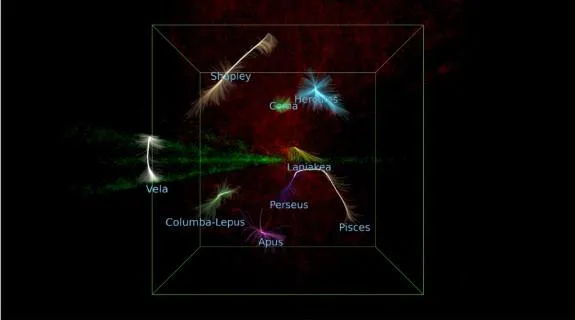
A map of the Local Universe highlighting the main superclusters. Vela, a massive hidden structure, is on the left. The image shows how galaxies flow through space and the large-scale “basins” that channel them.
Image: Dr Jérôme Léca, RSA Cosmos
In an extraordinary revelation that reshapes our understanding of the Universe, astronomers have uncovered a colossal cosmic structure that had long remained veiled behind the dust and stars of our own Milky Way. This groundbreaking discovery highlights the Vela Supercluster as one of the largest concentrations of matter in the nearby cosmos, bridging a significant gap in our cosmic map.
The region, known as the "Zone of Avoidance," has posed a significant challenge for astronomers; it covers approximately 20% of the sky and is obscured by the dense disk of the Milky Way. For decades, this blind spot has thwarted efforts to gain a comprehensive understanding of the large-scale structure of the Universe, particularly the origin of vast cosmic flows — the large-scale movements of galaxies driven by gravitational forces.
To decode the mystery behind the Zone of Avoidance, an international team of researchers has crafted an innovative hybrid reconstruction technique. This groundbreaking method merges two types of galaxy measurements: galaxy redshifts, which reveal how rapidly galaxies are receding from us as the Universe expands, and galaxy distances along with their peculiar velocities, illustrating the gravitational interactions over vast cosmic expanses. This combination enables the reconstruction of the hidden mass distribution, including the elusive dark matter.
Employing over 65,000 galaxy distance measurements from the CosmicFlows catalogue and adding more than 8,000 new galaxy redshifts captured close to the Milky Way's plane, the researchers made a pivotal breakthrough. The Southern African Large Optical Telescope (SALT) and the MeerKAT radio telescope — one of the world’s most powerful radio arrays — played critical roles. MeerKAT's ability to detect hydrogen gas at radio wavelengths allowed it to penetrate the thick clouds of dust within the Zone of Avoidance, unveiling previously obscured galaxies.
This pioneering research has unveiled the startling reality that the Vela Supercluster is not only far more expansive than previously estimated, but also extraordinarily dense. Situated approximately 800 million light-years from Earth, this astronomical marvel stretches across 300 million light-years and is believed to contain an astonishing amount of matter, equivalent to around 30 million billion Suns (approximately 3 × 10¹⁶ solar masses).
The Vela Supercluster, now known affectionately as "Vela-Banzi" — a term derived from isiXhosa meaning "revealing widely" — challenges the dominance of the famed Shapley Supercluster as the most massive structure nearby. Vela's intricate internal composition reveals two main dense cores that are gradually converging, highlighting the complexity of this remarkable cosmic entity. Its gravitational influence consequently surpasses that of other well-known cosmic regions, including Laniakea, which houses our own galaxy, and the Great Attractor.
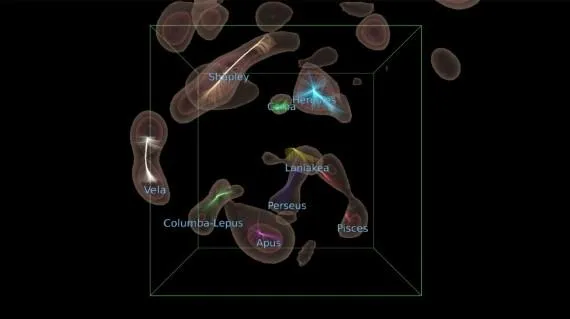
The Local Universe mapped in 3D, revealing its major superclusters. On the left, the hidden Vela supercluster emerges. Flow lines trace the paths of galaxies, while the surrounding cosmic basins show the regions where matter collects.
Image: Dr Jérôme Léca, RSA Cosmos
Understanding massive structures like Vela is crucial; they exert formidable gravitational pulls on surrounding galaxies, shaping the large-scale movements of matter throughout the Universe. The insights gleaned from the Vela Supercluster equip astronomers with the tools to better comprehend cosmic flows that dictate galaxy motion across hundreds of millions of light-years.
This recent discovery not only enhances our astronomical knowledge but also showcases the potential of synergising diverse observational techniques to reconstruct the Universe's structure, even in the most challenging regions to observe. As upcoming generations of astronomical surveys and advanced observatories come to fruition, these hybrid techniques promise to unlock unprecedented insight into the hidden architecture of the cosmos.
“This discovery helps complete our map of the nearby Universe,” the research team shared in their findings. “For the first time, we can clearly see one of the major gravitational players hidden behind our own galaxy.” The research highlights not only humanity’s quest for understanding the cosmos, but also pays respect to the communities and custodians of the land in South Africa and Australia, where these groundbreaking observations were made.
The full paper entitled Hidden Vela Supercluster Revealed by First Hybrid Redshift & PeculiarVelocity Reconstruction can be found here.