
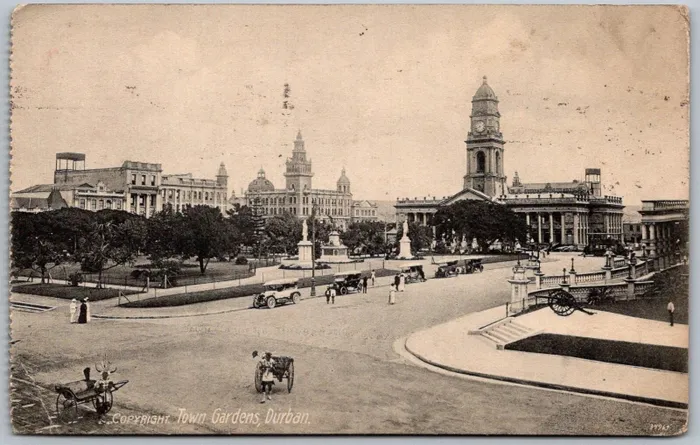
The original Durban Town Hall then the post office and the Durban Town Gardens with the entrance to the new City Hall in the foreground - probably taken shortly after it's construction in 1910.
Image: Facebook
The old picture today if from the Facebook Page Durban History and Stories and shows an early postcard of the Town Gardens, also known as Francis Farewell Square, with the front of the newly constructed City Hall in the foreground.
The photo was probably taken shortly after the City Hall was built in 1910 but before the construction of the Durban cenotaph which was unveiled in 1926 as a memorial to fallen soldiers of World War I. The cenotaph, a monument of granite decorated with glazed ceramic tiles depicting two angels raising the soul of a dead soldier, was constructed at the far side of the gardens.
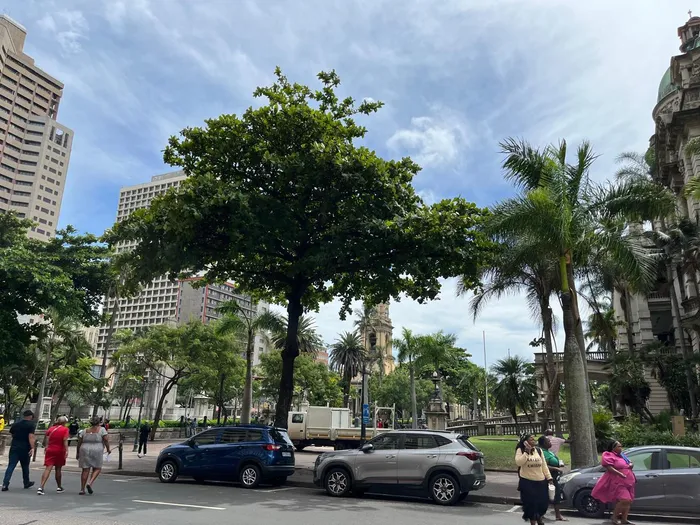
The scene today.
Image: Frank Chemaly
The building on the far side of the square is the early town's original town hall which later became it's main post office. Built in 1885 and designed in a Neo-classical/Victorian style by architect Phillip Dudgeon, it served as the civic center until 1910. The building cost £50 000 and features prominent clock and bell tower, with the British coat of arms on the attic balustrade. It hosted the first meeting of the South African National Convention in 1908, which paved the way for the Union of South Africa. Winston Churchill also famously gave a speech from its steps in 1899.
The Building on the other corner of what is today Dr Pixly ksSeme Street and Dorothy Nyember Streey was the original Natal Bank. Built in 1902 it was designed by architect William Emery Robarts. Established in the 1850s support the province's booming sugar industry it was originally on Aliwal Street (Samora Machel today) before moving to the current spot. The bank eventually became incorporated in Barclays and the First National.
At the time the road in front of the new City Hall was open to traffic, today it is a pedestrian walkway. It is interesting what traffic there was in Durban included a number of Rickshaw pullers as well as a few "modern" cars.
The central statue in the gardens is a bronze of Queen Victoria erected in 1897 to commemorate her Diamond Jubilee. It is attributed to Joseph Edgar Boehm and its cost was raised by public subscription. The other square include Harry Escombe, prime minister of Natal from 1897 until his death in 1899, and John Robinson, editor of the Mercury and first prime minister of Natal from 1893 to 1897.
The scene today is very different. While the old Town Hall and the new City Hall are still in place - the rest of buildings around them show a city changed beyond recognition.