

HIV activist Rathabeng Mamabolo's powerful narrative challenges men to stop using their partners as 'test kits' and embrace their own health responsibilities.
Image: Supplied
At 72, Rathabeng Mamabolo is a testament to resilience, a man who has not only survived the HIV/Aids epidemic in South Africa but has dedicated his life to fighting the stigma that almost destroyed him.
Diagnosed in 1995, a time when HIV was considered an automatic death sentence, Mamabolo now lives a full life, taking just one pill a day and mentoring men across the country.
His journey, however, was paved with immense difficulty, beginning with a tragedy that ultimately saved his life.
In the mid-90s, Mamabolo was a school principal at a farm school in Limpopo. He was in and out of the clinic, feeling unwell, but it was the death of the woman he was living with that forced him to get tested. “The lady passed on,” he recalls. “That’s what forced me, provoked me to go for tests in 1995.”
When he returned to the clinic a week later, he was handed an envelope. The results were positive.
“At first, I thought it wouldn’t happen to me,” he says, reflecting on the common misconceptions of the time. “I thought this thing happens to people who are living promiscuous lives… I couldn't believe it would happen to me.”
His immediate reaction was one of despair. He drank himself into oblivion and, in a moment of desperate honesty, told his fellow teachers.
Mamabolo recalls that the reaction was swift and painful.
The stigma that was rampant in South Africa during the Manto Tshabalala-Msimang era immediately affected him.
During that time, the then Health Minister opposed the provision of an antiretroviral drug called Zidovudine, which reduced mother-to-child transmission, to HIV-positive pregnant women.
The following day, he recalls, his fellow teachers started standing far away from him, with discrimination and stigmatisation starting right then.
The lack of understanding meant people believed you could contract the virus through casual contact. Mamabolo faced similar isolation, even within his teacher's union.
“You would find yourself sitting alone in a meeting of more than 100 people," he says. The constant judgment eventually drove him to leave teaching. “I left teaching because of the stigma.”
His turning point came after joining the Treatment Action Campaign (TAC), a movement that fought for the rollout of antiretrovirals (ARVs). He credits the work of TAC leaders, including Justice Edwin Cameron and TAC co-founder Zackie Achmat, as the reason people like him are still alive today.
“Many of us of that era who were HIV positive, who are still alive, is because of these two guys who came out,” he states.
The medication itself was a trial. In the early days, he took six pills daily at the same time. The side effects were debilitating, causing extreme exhaustion. Patients also suffered visible side effects like lipodystrophy, developing a hunchback, or changes in body shape.
Today, the medication is vastly different. Mamabolo now takes a single tablet, an innovation he praises wholeheartedly.
“Those medications are really working. There are no side effects, very minimal,” he says. “Right now, if you look at me… you won’t believe I’m over 70 and I’m still going strong.”
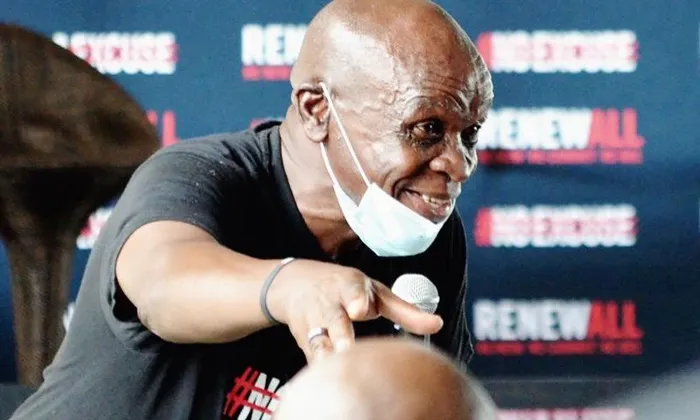
Rathabeng Mamabolo shares his journey of living with HIV for decades and advocating for men to take charge of their health.
Image: Father a Nation
His status as an HIV survivor and activist has become his life’s work. After leaving teaching, he wrote as a freelance journalist, co-chaired the Limpopo AIDS Council, and now mentors mostly men for Father a Nation, an organisation focused on gender-based violence and HIV.
Mamabolo is passionate about getting men to take responsibility for their health, saying in his opinion as an activist: “Men don’t get tested. They use their wives, their women, their girlfriends as test kits.”
He says if their test results are negative, they believe they are automatically negative, “which is not true”.
Mamabolo uses his platform to combat dangerous misinformation, like the recent fake news on social media that people with HIV would receive a R1,200 grant.
He notes that some unemployed men are now considering stopping their medication so their viral load increases, hoping to qualify for a nonexistent grant. “I’m just going to quit this medication because I don’t work, I don’t have money,” one man told him.
He is fighting the war on the ground, sharing his story in schools, TVET colleges, and even taverns, where he finds intoxicated men are often more willing to open up. He is also working to educate traditional healers about the importance of HIV testing before initiation.

Rathabeng Mamabolo empowers traditional healers by educating them on the importance of HIV testing, bridging the gap between traditional practices and modern healthcare.
Image: Supplied
Ultimately, his message to men who are nervous about testing is simple: “To know your status is far better than not to know, because if you know, you know what you are dealing with, and the devil that you know is far better than the one that you don’t know.”
He offers an encouraging perspective to the newly diagnosed: “HIV is no longer anything to fear. I would rather have HIV than hypertension or diabetes, which can cause sudden death. With HIV, if you control it, you can live.”
Mamabolo is living proof of that control. He has five children and many grandchildren who know his story.
To ensure he takes his daily pill, his Grade 8 granddaughter uses the code word “Generations”, which is a popular SA soap opera.
He explains: “When I’m sitting out there with my friends... she just says to me, 'Papa, it’s Generations.' The other guys might even think that it’s Generations, but I know... she means it’s time to come and take your medication.”
Mamabolo is an activist who believes his work is far from over. He urges the public not to become complacent simply because death rates have fallen.
“It’s just that people should not relax and think that HIV is no longer there,” he warns. “People should always be on the on the alert that HIV is there and they must take care of themselves and use protection.”

Rathabeng Mamabolo, a resilient HIV activist, receives a gentle reminder from his granddaughter to take his daily medication, highlighting the importance of health responsibility across generations.
Image: Supplied
Speaking about the progress made in the treatment of and stigma associated with HIV, infectious diseases epidemiologist, Professor Salim Abdool Karim, who is the director of the Centre for the AIDS Programme of Research in South Africa (CAPRISA), says an analysis he did of patients admitted to King Edward Hospital in the 1990s, showed that patients with Aids were more likely to leave to the hospital in a hearse than an ambulance.
“We were trying to manage opportunistic infections that were commonly fatal due to the underlying immune deficiency,” he says, adding that the situation worsened as case numbers rose in the early 2000s at a time of Aids denialism under president Thabo Mbeki, when life-saving treatment was delayed.
However, Abdool Karim said civil society, particularly the Treatment Action Campaign, successfully challenged the government, leading to a landmark 2002 Constitutional Court ruling on Nevirapine for the prevention of mother-to-child transmission.
He says Aids activism, together with court rulings, pressured the government to eventually launch a national Aids treatment programme in 2004.
“Since 2009, South Africa has rapidly expanded and modernised its HIV response. Treatment eligibility widened, fixed-dose combination pills simplified adherence, and services were decentralised to primary healthcare facilities, improving access when the country adopted the Universal Test and Treat approach in 2016.”
According to Abdool Karim, the perception of HIV/Aids in South Africa has shifted dramatically from an inevitable death sentence to a manageable chronic condition, largely due to the widespread availability of AntiRetroviral Treatment (ART).
“In the 1980s and 1990s, an HIV diagnosis was like a death sentence. This led to widespread fear and discrimination as those living with HIV were shunned and stigmatised. The rollout of free ART since 2004 has transformed this narrative by significantly reducing deaths and restoring health.”
Professor Abdool Karim says millions of lives were saved as ART led to HIV/Aids being viewed as a chronic treatable condition like diabetes. “While HIV cannot be cured yet, ART has given those living with HIV a close to normal lifespan.”
He states that the stigma has, since the 1990s, decreased markedly, but it has not disappeared entirely.
“People can now live openly with Aids. Although education and ART have transformed Aids in South Africa from a highly visible, fatal illness into a manageable chronic condition, stigma is much less common but still present. It has also shifted from fear and social exclusion to more subtle forms of moral judgement, blame, and internalised shame.”
Have thoughts on this topic or other subjects you’d like us to explore? Want to share your experiences? Reach out to me at karen.singh@inl.co.za