
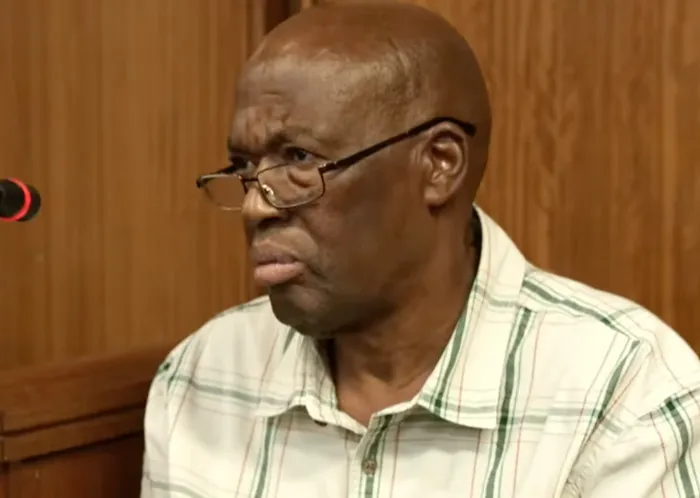
Ex-investigating officer Captain Phakisa Masigela
Image: SCREENSHOT/LIVESTREAM
The inquest into the Cradock Four murders heard on Tuesday that former investigating officer Captain Phakisa Masigela compiled a complete case docket and handed it to prosecutors, only for it to later go missing.
Testifying in the Gqeberha High Court, Masigela said he pieced together the investigation file from incomplete police records and believed it was ready for a prosecutorial decision when he submitted it to the National Prosecuting Authority (NPA).
The inquest is looking into the deaths of anti-apartheid activists Matthew Goniwe, Fort Calata, Sicelo Mhlauli and Sparrow Mkonto.
The four men, of Cradock, now known as Nxuba, were abducted and murdered by apartheid security police in June 1985 in Port Elizabeth, now Gqeberha.
Masigela told the court that he took over the investigation shortly after the 2010 FIFA World Cup, when several Truth and Reconciliation Commission cases were reassigned to him.
“I was the investigator of the case of Cradock Four matter," he said.
"I obtained all the relevant statements on this matter.”
He confirmed he joined the police on November 13 1978 and retired in 2017 with the rank of captain, serving in the Directorate for Priority Crime Investigation, also known as the Hawks.
Masigela described rebuilding the docket as a difficult process because records were incomplete and scattered.
“To put the Cradock Four docket together was not easy," he said.
"It was not a complete docket put together.
"It was documents and statements lying around in containers and then I had to compile them and build the docket from scratch.”
He said earlier investigators had marked many records, which helped him piece the file together.
Masigela estimated the docket contained “more or less 100 statements”, along with police photographs and post-mortem reports.
Documentation from the TRC was compiled into separate files.
Masigela said many of the records he found were duplicated and labelled using internal police filing codes.
He explained that several copies of the same statement were often stored under the same reference number.
“If the statement is 8-3 and then there are four 8-3s, I would take only one to reconstruct,” he said.
He was referring to the police system of numbering documents in a docket, where files are grouped into sections and items for record-keeping.
Masigela said he kept a single copy of each document to avoid duplication while rebuilding the investigation file.
Masigela confirmed he personally obtained some witness statements but could not recall all of them.
He specifically remembered interviewing former security branch officer Eric Winter.
Winter was a former head of the Security Branch in Nxuba and played a leadership role in the Special Operations K Unit, also known as Koevoet.
He was implicated in the murder of the Cradock Four by one of the operatives responsible for the killings, the late Johan Martin Van Zyl, also known by his nickname Sakkie, who said that Winter was “in charge of the mechanical means of spying on Mr Goniwe’s home".
In 1994, shortly after SA’s first democratic elections, an official inquest was held into the deaths of the Cradock Four.
Judge Neville Zietsman ruled there was enough evidence to raise a case of suspicion against Winter for the murders.
Winter did not apply for amnesty for his role and died in 2021.
Masigela said: “He did not want to commit himself in this thing totally, but I did ask him whether he knows about this Cradock Four case.
"He said yes, he was familiar and so I asked him whether he took any part or was in the planning of this shooting or assassinating the Cradock Four.
"He said no, he didn’t.”
Masigela said the completed docket linked the killings to apartheid-era security police and, in his view, was sufficient for a prosecutorial decision.
He told the court he handed the docket to the NPA around 2015 and received an acknowledgement of receipt.
“I gave the date and the signature to the current investigator," he said.
"On this date, I handed over the docket to NPA and this lady signed for it.”
Masigela said he regularly visited the office of former deputy director of public prosecutions Adv Chris Macadam to follow up on progress and deliver outstanding evidence.
“When the docket was still with Adv Macadam, I used to go to his office and discuss the progress of the docket," he said.
"Some visits were because of bringing any evidence that was not in the docket or complying with the outstanding instruction he gave to me.
"So I visited him while the docket was with him and I never took it back from him.”
He described the file as “a lever arch file, as big as those in front of the judge”.
Masigela said he retired believing the docket remained with prosecutors.
“When I retired, I thought maybe the docket is there and is going to be handed over to a new investigating officer, but only to find out that the docket is no more.”
He said he could not report the disappearance because he had already left the police service.
Masigela also testified that he made a duplicate copy of the docket and stored it securely at his office in Pretoria.
“I made a copy of the original docket, the missing docket," he said.
"I made a copy of it.
"And I put the other correspondences and the copies of the statements who are in both the original and the copy in the box and put them inside the storeroom, which is controlled.”
He said he clearly labelled the container to help future investigators.
“I marked that box with my name and on that box I wrote ‘Cradock Four’.
"Out of that box, it’s going to be easy for him to reconstruct the docket.”
Masigela later learnt that though the box was found, the duplicate docket itself could not be located.
On Monday, former apartheid mass murderer Eugene de Kock gave testimony, but Nomonde said his evidence left her with more questions than answers.
De Kock had been sentenced and spent about 20 years behind bars before being released on parole in 2015 for his role in apartheid-era crimes.
The 77-year-old said though he had no role in the actual killings of the Cradock Four, he had been part of the apartheid security system that hunted and killed "terrorists".
De Kock, former commander of the notorious Vlakplaas, said he understood a terrorist to be “any person who attacks structures that are central to the government of the state, such as electricity, water, senior personnel, or acts against the police, the government, or similar structures".
When asked if the Cradock Four had been seen as terrorists, De Kock said: “Not one single one. They were civilians. That is it."
De Kock also said: 'I'm also not aware of any testimony, statement or document that suggests I had any involvement whatsoever with the murder or planning of the murders of the Cradock Four."
He said he also told Van Zyl that a weapon used in an operation involving the Cradock Four could not be trusted to be altered.
He said it should be thrown into the sea because it had been used in a serious crime.
De Kock was then heckled and interrupted by the defence, who repeatedly questioned his relevance.
He said he wanted to tell the full story and that everything must come out, while flatly denying any involvement in the killing of the Cradock Four.
He added that the directives to kill during apartheid came straight from the top, naming former President PW Botha.
IOL