
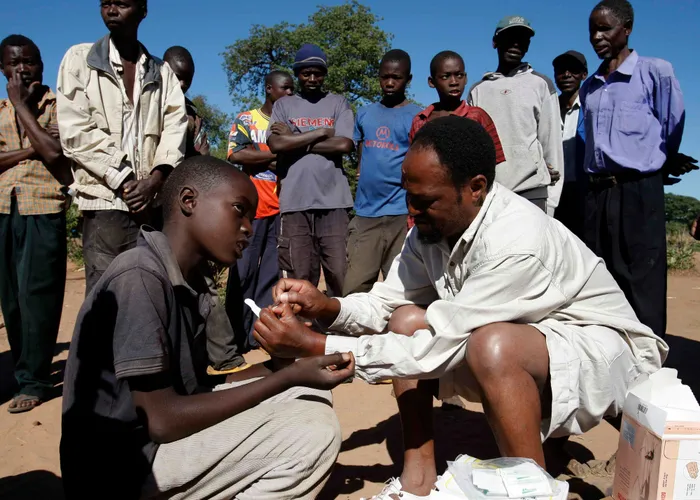
Zambian healthcare worker Laite Hanzonde performs a malaria test during the Roll Back Malaria Zambezi Expedition in Matongo village.
Image: Reuters
In a bold unified call during the recent 39th African Union Summit in Ethiopia, African Heads of State and Government underscored a pressing need for new financing methods to combat malaria, a disease that continues to claim hundreds of thousands of lives every year. With member states accounting for an astonishing 270 million malaria cases in 2024 — making up 96% of the global total — African leaders are sounding the alarm that without urgent intervention, decades of hard-won progress stand to be lost.
The stark realities captured in the 2025 Africa Malaria Progress Report paint a grim picture of the potential fallout from reduced funding. A projected 30% cut in financing could lead to a staggering reduction of 640 million insecticide-treated nets, alongside an additional 146 million malaria cases and around 400,000 deaths, three-quarters of which would be children under the age of five. Economically, this scenario translates into an estimated $37 billion (R635 bn) loss in gross domestic product (GDP) by 2030.
In light of these challenges, African researchers are turning to innovative and complementary strategies to reinforce malaria control. Highlighting these efforts, Tanzanian president Samia Suluhu Hassan announced the nation's investments in research and innovation to tackle malaria head-on.
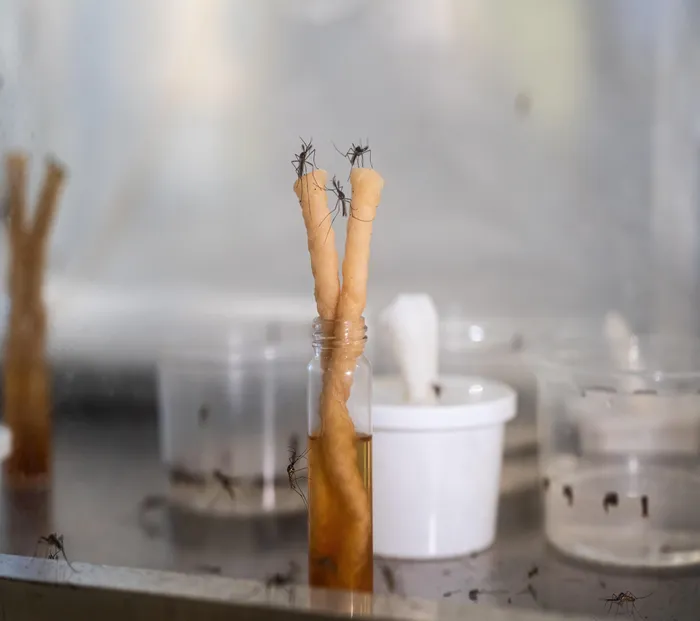
Mosquitoes feed in a contained area at the Disease Vector Education Center in St. Augustine, Florida. In Africa, top researchers are leading the charge, charting a new path in the battle against malaria that could save many lives.
Image: Michael Rakim/For The Washington Post
“Our approach has spanned the full spectrum of what it takes to beat this disease. Tanzania has invested in world-class research where our scientists are working at the frontier of new technologies,” she said. Among these efforts is gene drive technology, which aims to ensure mosquitoes can no longer carry the malaria parasite. “This is African science, conducted by African researchers, addressing an African challenge,” Hassan added.
Gene drive technology has generated significant interest owing to its innovative methods. As Dr Jonathan Kayondo from Target Malaria explains, gene drive is a naturally occurring biological process that increases the likelihood of inheritance of specific genes or traits. This research strives to be a complementary tool alongside existing malaria prevention methods, such as bed nets, insecticides, and vaccines. By creating modifications that bias inheritance, gene drive has the potential to significantly impact malaria mosquito populations.
Research teams are investigating two approaches within gene drive strategies: either reducing the number of malaria-carrying mosquitoes or stopping them from becoming infected by the malaria parasite. Target Malaria is centred on the former strategy, specifically targeting four species of Anopheles mosquitoes, which are the primary vectors of malaria transmission in Africa.
Despite the enthusiasm around gene drive technology, significant queries remain. For instance, the distinction between gene drive technology and genetically modified crops is fundamental. The focus of gene drive research is decidedly on mosquito populations, not crops, humans, or livestock, ensuring that ethical concerns are distinctly addressed.
Currently, controlled laboratory experiments are being conducted in Europe and the United States, with no gene drive mosquitoes present in Africa at this stage. All research adheres to international and national safety regulations, strict ethical review processes, and will require extensive community engagement and approvals before any field trials can commence, expected around 2030 in a malaria-endemic African country.
The imperative for gene drive research lies in the persistent challenges posed by malaria, which remains a major public health issue, particularly in Africa. The disease continues to be a leading cause of mortality among children under five and poses an enormous economic burden, estimated to cost approximately $16 billion annually in affected nations. While current tools remain valuable, rising insecticide resistance and drug-resistant parasites threaten to undermine their effectiveness.
In light of a projected additional 500,000 malaria-related deaths and 123 million clinical cases over the next 25 years due to climate change — despite meeting current climate pledges — researchers are exploring gene drive as a potential complementary tool. This approach aims for a self-sustaining impact that is not reliant on insecticides and built through transparent regulatory frameworks and community engagement.
IOS